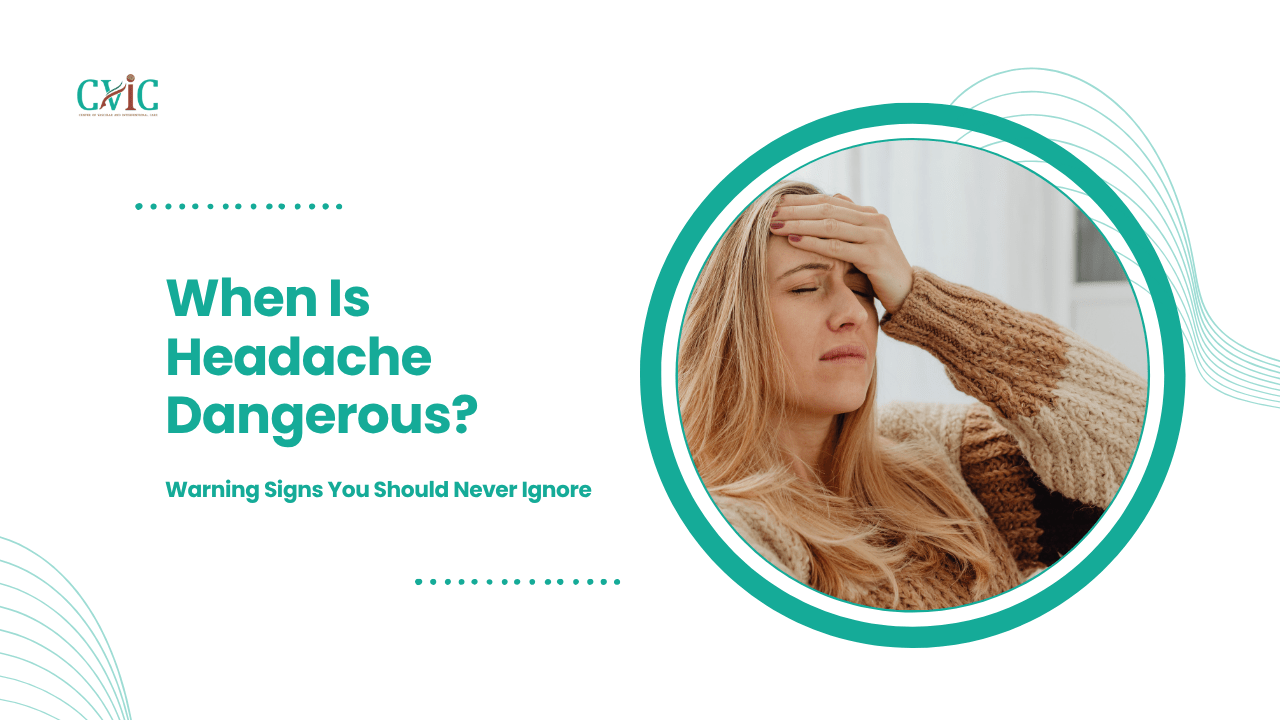
Almost everyone gets headaches. A long day at work, skipping meals, too much screen time, a sleepless night, or even simple dehydration — all of these can trigger a headache. Most of the time, a glass of water, some rest, or a basic painkiller is all it takes to feel better.
But what about the headache that feels different? The one that came out of nowhere. The one that woke you up at 3 AM. The one that has been getting worse every day for the past two weeks. The one that arrived along with blurred vision or a stiff neck.
When is a headache just a headache — and when is it something far more dangerous?
This is one of the most common and most important questions the team at CVIC Indore receives from patients every day. And it’s a question worth answering clearly and honestly — because the difference between a harmless headache and a dangerous one can be the difference between life and death.
In this detailed blog, Dr. Alok K Udiya, Dr. Shailesh Gupta, and Dr. Nishant Bhargava at CVIC Indore break down exactly when a headache becomes a red flag, what dangerous headaches feel like, and what you must do when you experience one.
The Truth About Headaches
Let’s start with some reassuring facts. The vast majority of headaches — more than 90% — are what doctors call primary headaches. These include:
- Tension headaches — the most common type, caused by stress, poor posture, or muscle tension
- Migraines — intense, throbbing headaches often with nausea and light sensitivity
- Cluster headaches — severe, burning pain around one eye occurring in cycles
- Sinus headaches — pressure and pain around the forehead, cheeks, and nose
These headaches are unpleasant and sometimes debilitating, but they are not dangerous. They do not indicate damage to the brain.
The remaining less than 10% of headaches are secondary headaches — meaning they are caused by an underlying condition. Some of these underlying conditions are serious, even life-threatening. These are the headaches we need to identify quickly.
The challenge is that headaches are so common that it can be very hard to know when to worry. That’s exactly what this blog will help you figure out.
Also Read: Chronic Headache Causes in Brain: A Complete Guide by CVIC Indore
The “Red Flags” — When a Headache Is Dangerous
Medical professionals use a set of warning signs — often called “red flag” signs — to identify headaches that need urgent investigation. At CVIC Indore, Dr. Alok K Udiya uses these red flags to triage patients and determine who needs immediate imaging and who can be managed conservatively.
Here are the most important red flags in detail:
1. The Thunderclap Headache — “Worst Headache of My Life”
This is the single most important red flag of all.
A thunderclap headache is a headache that:
- Reaches its maximum intensity within 60 seconds — often within seconds
- Is described as “the worst headache of my life”
- Hits suddenly, like a clap of thunder, without any warning buildup
This type of headache is the hallmark symptom of a ruptured brain aneurysm — a burst blood vessel in the brain that causes bleeding (subarachnoid hemorrhage). It is a life-threatening emergency.
But a thunderclap headache doesn’t always mean a ruptured aneurysm. It can also indicate:
- Cerebral venous sinus thrombosis (blood clot in brain veins)
- Reversible cerebral vasoconstriction syndrome (RCVS)
- Hypertensive crisis (dangerously high blood pressure)
- Meningitis
No matter what the cause — a thunderclap headache requires immediate emergency care. Call 112 or get to the nearest hospital right away. Do not take a painkiller and go to sleep. Do not wait to see if it gets better.
Dr. Nishant Bhargava at CVIC Indore has treated many patients with thunderclap headaches — and consistently emphasizes that the ones who arrived quickly had dramatically better outcomes than those who delayed.
Also Read: Symptoms Before Brain Aneurysm Rupture: What You Must Never Ignore
2. Headache With Fever, Stiff Neck, and Rash
This combination is a medical emergency — it is the classic presentation of bacterial meningitis, an infection of the membranes surrounding the brain and spinal cord.
Bacterial meningitis can kill within 24 hours if not treated, and survivors can be left with permanent disability including deafness, brain damage, and limb loss.
Warning signs include:
- Severe headache that comes on quickly
- High fever
- Stiff neck — the person cannot touch their chin to their chest
- Sensitivity to light (photophobia)
- Nausea and vomiting
- In some cases, a non-blanching rash — a rash that does not fade when pressed (this is a sign of meningococcal septicemia — an extreme emergency)
- Confusion or drowsiness
If you see this combination of symptoms — even two or three of them together — call emergency services immediately. Do not wait for all symptoms to appear.
3. Headache After a Head Injury
Any headache that develops after a blow to the head, a fall, or a road accident must be taken seriously. It could indicate:
- Concussion — a mild brain injury requiring rest and monitoring
- Subdural hematoma — slow bleeding between the brain and skull that builds up over hours or days
- Epidural hematoma — faster bleeding between the skull and brain covering, often following a temporal bone fracture
- Brain contusion — bruising of the brain tissue
What makes post-traumatic headaches particularly dangerous is the “lucid interval” — a period after the injury where the person feels fine, talks normally, and seems okay. Then, as the bleeding increases, they deteriorate rapidly. This is why a headache after any head injury — even a minor-seeming one — must be medically evaluated.
Never dismiss a headache after a head injury, even if the person initially seems fine.
At CVIC Indore, Dr. Shailesh Gupta frequently sees patients who suffered head injuries and delayed coming in — often with serious consequences. A CT scan done promptly can detect bleeding and guide treatment before permanent damage occurs.
4. Headache With Neurological Symptoms
A headache becomes dangerous when it is accompanied by any neurological symptom — meaning any sign that the brain or nervous system is not functioning normally. These include:
- Weakness or numbness on one side of the body (face, arm, or leg)
- Difficulty speaking — slurred speech, trouble finding words, or inability to speak
- Confusion or disorientation — not knowing where you are or what time it is
- Vision changes — double vision, blurred vision, loss of part of the visual field
- Loss of balance or coordination — stumbling, falling, or inability to walk straight
- Drooping of one side of the face
These symptoms alongside a headache strongly suggest a stroke, brain tumor, or other serious neurological event. This combination requires emergency evaluation — every minute of delay increases the risk of permanent damage.
Also Read: Memory Loss – Normal or Serious? A Complete Guide by CVIC Indore
5. Progressively Worsening Headache Over Days or Weeks
A headache that keeps getting worse — day after day, week after week — and does not respond to normal painkillers the way it used to is a significant warning sign.
This pattern of progressive worsening can indicate:
- A brain tumor growing and increasing pressure inside the skull
- A brain abscess — a collection of pus in the brain
- Chronic subdural hematoma — slow bleed that keeps expanding
- Idiopathic intracranial hypertension — raised pressure inside the skull without a tumor
The key here is the trend — a single bad headache is less alarming than a series of headaches that are clearly getting worse over time. Keep a headache diary if needed — note the frequency, intensity, location, and associated symptoms. This information is invaluable for your neurologist.
6. Headache That Wakes You Up From Sleep
Most common headaches — tension headaches, migraines — do not regularly wake people from deep sleep. A headache that consistently wakes you up in the early morning hours or is present the moment you open your eyes is a red flag for raised intracranial pressure.
When you lie flat during sleep, pressure inside the skull increases slightly. If there is an underlying mass (tumor), blocked fluid drainage, or another space-occupying condition, this increase in pressure manifests as a headache that wakes you up.
Morning headaches that are present upon waking and gradually improve after an hour of being upright — especially when accompanied by nausea or vomiting — should be investigated with a brain MRI.
7. New Headache in Someone Over 50
If a person who has never been a headache sufferer suddenly starts experiencing frequent headaches after the age of 50, it deserves attention. While it could still be something benign like tension headaches triggered by lifestyle changes, new-onset headaches in older adults can indicate:
- Brain tumor (primary or metastatic)
- Giant cell arteritis (temporal arteritis) — inflammation of the arteries in the head, causing severe one-sided headache near the temple. This condition can cause sudden blindness if not treated promptly with steroids.
- Subdural hematoma
- Cerebrovascular disease
A new headache pattern in an older person should always be evaluated by a neurologist — ideally with imaging.
8. Headache in a Person With Cancer History
If someone has a known history of cancer — anywhere in the body — and develops new headaches, the possibility of brain metastasis (cancer spreading to the brain) must be ruled out urgently. Common cancers that spread to the brain include lung, breast, colon, kidney, and melanoma.
Brain metastasis headaches are typically progressive, often worse in the morning, and may be accompanied by neurological symptoms. An MRI brain with contrast is the investigation of choice.
9. Headache With Very High Blood Pressure
A severe headache accompanied by a blood pressure reading above 180/120 mmHg is called a hypertensive crisis and is a medical emergency. Extremely high blood pressure can damage blood vessel walls in the brain, cause swelling of the brain (hypertensive encephalopathy), or even trigger a stroke or brain bleed.
If you check your blood pressure during a severe headache and find it dangerously high — seek emergency care immediately. Do not simply take extra blood pressure medication and wait. This requires hospital evaluation and rapid, controlled blood pressure reduction under medical supervision.
10. Headache in a Person With HIV or Weakened Immunity
People with HIV/AIDS, those on immunosuppressive medications (like after organ transplants), or those undergoing chemotherapy are at higher risk of brain infections like cryptococcal meningitis or toxoplasma encephalitis — both of which can present with headaches.
Any new or worsening headache in an immunocompromised person should be evaluated promptly and thoroughly.
11. Headache With Eye Pain and Redness
A sudden severe headache accompanied by eye pain, redness, and blurred vision — particularly in older adults — can indicate acute angle-closure glaucoma, a sudden increase in pressure inside the eye that can cause permanent blindness if not treated within hours.
While this is an eye emergency rather than a brain emergency, it is still a dangerous headache that demands immediate care.
A Simple Rule to Remember: The “SNOOP” Framework
Neurologists use a memory aid called SNOOP to remember dangerous headache red flags:
- S — Systemic symptoms (fever, weight loss, HIV/cancer history)
- N — Neurological symptoms (weakness, confusion, vision changes, seizures)
- O — Onset sudden (thunderclap headache)
- O — Older age (new headache after age 50)
- P — Progressive pattern (headache getting worse over time) / P — Postural (worse lying down or with straining)
If your headache fits any letter of SNOOP — see a doctor urgently.
When Is a Headache NOT Dangerous?
It’s equally important to know when NOT to panic. A headache is likely benign when:
- You have had similar headaches many times before and they follow the same pattern
- It responds well to rest, hydration, or standard painkillers
- It has a clear trigger — stress, poor sleep, skipped meals, alcohol, bright lights
- It goes away completely with no lasting symptoms
- There are no associated neurological symptoms, fever, or stiff neck
- It is not progressively worsening over weeks
Migraines, while extremely painful and disabling, are not dangerous in themselves. Tension headaches are not dangerous. Sinus headaches related to a cold or allergy are not dangerous.
However — even with known migraine or tension headaches — if a particular headache feels significantly different from your usual attacks, treat it as a new headache and get it checked.
Dangerous Headaches in Indore — Why Awareness Matters
In Indore, a growing urban population with rising rates of hypertension, stress, diabetes, and sedentary lifestyles is increasingly vulnerable to dangerous headaches caused by stroke, brain aneurysm, and brain tumors. Yet many patients still delay seeking care — either due to lack of awareness, fear, or financial concerns.
CVIC (Comprehensive Vascular and Interventional Centre), Indore is one of the most advanced neurological diagnostic and treatment centers in Madhya Pradesh. With state-of-the-art MRI, CT angiography, and a team of highly experienced specialists — Dr. Alok K Udiya, Dr. Shailesh Gupta, and Dr. Nishant Bhargava — CVIC Indore is equipped to evaluate any type of headache quickly and accurately.
Dr. Alok K Udiya brings deep expertise in neuroimaging and vascular diagnosis. Dr. Shailesh Gupta and Dr. Nishant Bhargava provide comprehensive neurovascular care — from initial evaluation to complex interventional procedures.
Patients across Indore and central India trust CVIC for clear answers, advanced diagnostics, and compassionate care.
What Happens When You Visit CVIC Indore for a Dangerous Headache?
When you come to CVIC Indore with a concerning headache, the team follows a structured, rapid evaluation process:
Step 1 — Detailed History The neurologist asks about the onset, character, location, severity, associated symptoms, and any triggers of your headache. This history alone can often point toward or away from a dangerous cause.
Step 2 — Neurological Examination A thorough check of your reflexes, strength, coordination, vision, and speech to detect any subtle neurological deficits.
Step 3 — Imaging Depending on the findings, one or more of the following may be ordered:
- CT Scan — to detect bleeding quickly in emergency situations
- MRI Brain — detailed imaging for tumors, abscesses, MS, vascular conditions
- CT Angiography or MR Angiography — to evaluate blood vessels for aneurysms or blockages
- Lumbar Puncture (Spinal Tap) — if meningitis or subarachnoid hemorrhage is suspected and CT is normal
Step 4 — Blood Tests To check for infection, clotting disorders, and other systemic causes.
Step 5 — Diagnosis and Treatment Plan Once the cause is identified, the team creates a clear, personalized treatment plan — which may include medication, intervention, surgery, or referral to the appropriate specialist.
Conclusion: Don’t Guess — Get Checked
A headache is your brain’s way of communicating with you. Most of the time, it’s saying — “I’m tired, I’m stressed, I need water.” But sometimes it’s saying something far more urgent.
Knowing when a headache is dangerous could save your life or the life of someone you love. The red flags are real, they are recognizable, and they demand action — not observation, not self-medication, not waiting until tomorrow.
At CVIC Indore, Dr. Alok K Udiya, Dr. Shailesh Gupta, and Dr. Nishant Bhargava are committed to helping every patient in Indore and across Madhya Pradesh get the right answer at the right time. Whether your headache turns out to be completely harmless or something that needs urgent attention — you deserve to know. And knowing begins with a consultation.
If your headache worries you — trust that instinct. Contact CVIC Indore today.
CVIC Indore — Comprehensive Vascular & Interventional Centre Expert Headache Evaluation | Advanced Neuroimaging | Life-Saving Neurological Care
For appointments and emergencies, contact CVIC Indore today.
Disclaimer: This blog is for educational purposes only and does not replace professional medical advice, diagnosis, or treatment. Always consult a qualified neurologist or medical professional for any health concerns.