Imagine waking up one morning and noticing that your right arm feels unusually heavy. Or while walking, your left leg drags slightly. Or perhaps you’re trying to smile and one side of your face doesn’t move the way it should. These are not experiences to ignore and sleep off. One-side body weakness — medically known as hemiplegia (complete) or hemiparesis (partial) — is one of the most important warning signs the human body can produce.
It tells you, in the clearest possible way, that something is happening inside your brain or nervous system that needs urgent attention.
Yet, in cities like Indore, it is still common to see patients arrive at the hospital hours — sometimes days — after they first noticed weakness on one side of their body. Some thought it was fatigue. Some thought they had “slept in a bad position.” Some were simply afraid of what it might mean.
This blog, brought to you by the expert neurovascular team at CVIC Indore — including Dr. Alok K Udiya, Dr. Shailesh Gupta, and Dr. Nishant Bhargava — is your complete guide to understanding the causes of one-side body weakness, why it happens, what conditions it points to, and most importantly — what you must do when it occurs.
What Is One-Side Body Weakness?
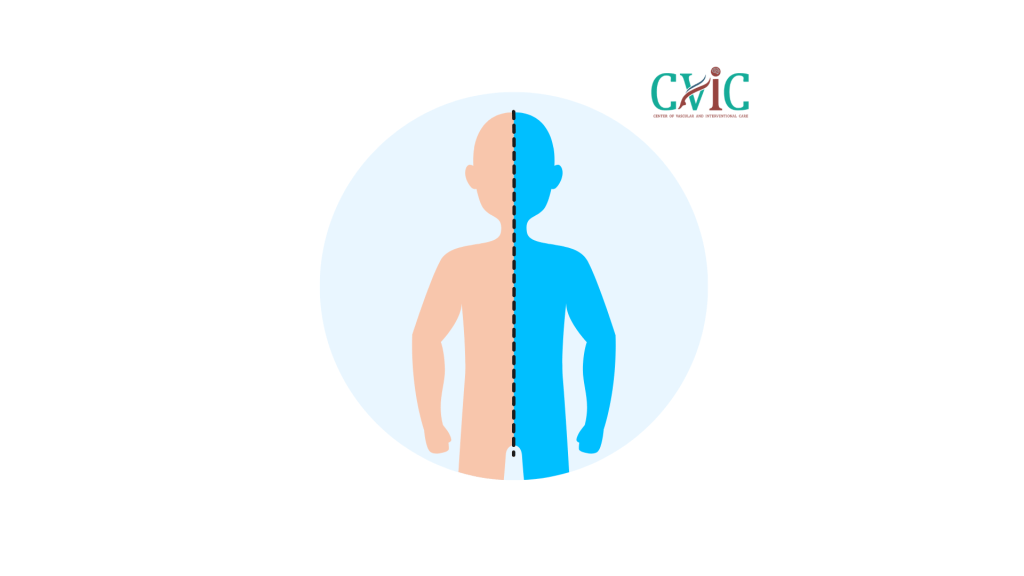
One-side body weakness means that the muscles on either the left side or the right side of your body — or just one limb or your face — are not working as strongly or as normally as they should. You may notice:
- Difficulty lifting your arm on one side
- Your leg feeling heavy or dragging when you walk
- One hand losing grip strength — dropping things unexpectedly
- One side of your face drooping or feeling numb
- Difficulty speaking clearly along with the weakness
- Loss of coordination on one side — bumping into things, losing balance
The weakness may come on suddenly (within seconds or minutes) or gradually (over days or weeks). Both patterns are important — but sudden onset is almost always a medical emergency.
Also Read: Symptoms Before Brain Aneurysm Rupture: What You Must Never Ignore
Why Does Weakness Occur on Only One Side?
This is the key question — and understanding the answer will help you appreciate why this symptom is so significant.
Your brain is divided into two halves — the left hemisphere and the right hemisphere. Here’s the crucial fact: the left side of the brain controls the right side of the body, and the right side of the brain controls the left side of the body.
So when there is damage, pressure, or disruption to one side of the brain — due to a stroke, tumor, injury, or other condition — the opposite side of the body is affected. This is called contralateral weakness.
Additionally, the brain communicates with the body through a network of nerves running down the spinal cord. Damage anywhere along this pathway — in the brain, brainstem, or spinal cord — can produce one-sided weakness.
Major Causes of One-Side Body Weakness
Let’s go through the most important causes in detail. Some are emergencies requiring immediate hospital care, while others are more gradual in onset.
1. Stroke — The Number One Cause
Stroke is by far the most common and most urgent cause of one-side body weakness. In fact, sudden weakness or numbness on one side of the body is THE classic warning sign of a stroke.
A stroke occurs when the blood supply to part of the brain is either blocked (ischemic stroke — due to a clot) or when a blood vessel ruptures (hemorrhagic stroke — due to bleeding). In both cases, brain cells begin to die within minutes due to lack of oxygen.
Stroke-related one-side weakness comes on suddenly — often within seconds. It may be accompanied by:
- Sudden drooping of one side of the face
- Arm weakness — one arm drifts downward when raised
- Speech difficulty — slurred words or inability to speak
- Sudden confusion or difficulty understanding
- Sudden vision problems
- Sudden severe headache
The medical community uses the FAST test to help people recognize stroke:
- F — Face drooping (ask the person to smile — is one side drooping?)
- A — Arm weakness (ask them to raise both arms — does one drift down?)
- S — Speech difficulty (ask them to repeat a simple sentence — is it slurred?)
- T — Time to call emergency services immediately
Every minute counts in a stroke. The treatment window for a clot-dissolving drug (thrombolysis) is just 4.5 hours from symptom onset. At CVIC Indore, Dr. Nishant Bhargava leads an experienced team that handles acute stroke cases with rapid imaging and intervention protocols. The earlier you arrive, the better your chances of full recovery.
Also Read: Brain Stroke Treatment Cost in India: A Complete Guide by CVIC Indore
2. Transient Ischemic Attack (TIA) — The “Mini Stroke”
A TIA is often called a “mini stroke” — it produces the same symptoms as a stroke (including one-side weakness), but the symptoms resolve on their own, usually within minutes to an hour, leaving no permanent damage.
This might sound reassuring. But a TIA is a serious warning sign — it means a full stroke could follow within hours or days. Studies show that 10–15% of TIA patients suffer a major stroke within 3 months — and the highest risk is in the first 48 hours.
If someone experiences temporary one-side weakness — even if it completely resolves — they must seek emergency medical evaluation immediately. Do not wait for symptoms to come back before acting.
3. Brain Tumor
A growing brain tumor can press on the motor areas of the brain — the regions responsible for controlling movement on the opposite side of the body. Unlike stroke, tumor-related weakness usually develops gradually over weeks or months.
You might first notice that one hand is slightly clumsier than usual. Then over time the weakness progresses — the arm becomes harder to lift, the leg starts dragging, fine motor tasks become difficult.
Other features that point to a brain tumor include:
- Morning headaches that are progressively worsening
- Seizures (new-onset fits)
- Personality or memory changes
- Nausea and vomiting
At CVIC Indore, Dr. Alok K Udiya has extensive experience in diagnosing brain tumors through advanced MRI imaging, including cases where one-side weakness was the first presenting symptom.
4. Brain Abscess
A brain abscess is a collection of pus inside the brain, caused by a bacterial, fungal, or parasitic infection. It can arise from a dental infection, ear infection, sinus infection, or infection elsewhere in the body that travels to the brain through the bloodstream.
Like a tumor, a brain abscess takes up space inside the skull and can press on motor pathways, causing one-side weakness. It is often accompanied by:
- Fever and chills
- Severe headache
- Nausea and vomiting
- In some cases, seizures
Brain abscess is a medical emergency that requires immediate hospitalization, imaging, and often surgical drainage.
5. Subdural Hematoma
A subdural hematoma occurs when blood collects between the brain and its outer protective covering (the dura) — usually after a head injury. As the blood clot grows, it presses on the brain, causing increasing one-side weakness, confusion, and headaches.
What makes subdural hematomas particularly dangerous is that they can be chronic — meaning symptoms appear slowly, days or even weeks after a seemingly minor head injury. An elderly person who took a minor fall may develop progressive weakness and confusion over the following weeks — and the connection to the fall may not seem obvious.
If you or a family member has had a head injury — even a minor one — and later develops one-side weakness, headache, or confusion, get evaluated immediately. Dr. Shailesh Gupta at CVIC Indore emphasizes that elderly patients in particular should never dismiss symptoms following a fall.
Also Read: Memory Loss – Normal or Serious? A Complete Guide by CVIC Indore
6. Multiple Sclerosis (MS)
Multiple sclerosis is an autoimmune disease in which the body’s immune system attacks the protective covering of nerve fibers (myelin) in the brain and spinal cord. This disrupts the normal flow of nerve signals.
MS can cause episodes of one-side weakness that come and go — called relapses. During a relapse, a person may experience weakness, numbness, or tingling on one side of the body, vision problems, coordination difficulties, and fatigue. These episodes may resolve partially or fully, only to return later.
MS typically affects younger adults, particularly women between the ages of 20 and 40. Diagnosis requires MRI of the brain and spinal cord, showing characteristic white matter lesions. Early diagnosis and treatment can significantly slow the disease’s progression.
7. Cerebral Venous Sinus Thrombosis (CVST)
CVST is a rare but serious condition in which a blood clot forms in the veins that drain blood from the brain. Unlike arterial strokes, CVST is more common in young women, particularly those on oral contraceptive pills, pregnant women, or women in the postpartum period.
Symptoms include severe headache, one-side weakness, seizures, and altered consciousness. It can be easily missed because it affects a younger, seemingly healthy population. MRI venography is needed to confirm the diagnosis — a test readily available at CVIC Indore.
8. Todd’s Paralysis (After a Seizure)
Sometimes, after a focal seizure (a seizure affecting one part of the brain), a person experiences temporary weakness or paralysis on one side of the body — lasting from minutes to hours. This is called Todd’s paralysis or Todd’s paresis.
It is not a stroke — the weakness resolves on its own. However, it is still a significant finding because it tells you the person is having seizures originating in a specific area of the brain, which itself needs investigation.
9. Hemiplegic Migraine
This is a rare but real type of migraine in which one-side weakness — sometimes including speech difficulty — occurs as part of the migraine “aura” before the headache begins. The weakness typically resolves within an hour.
Hemiplegic migraine can be extremely difficult to distinguish from a TIA or stroke on clinical grounds alone. Imaging and careful history-taking are essential. This condition should always be evaluated by a neurologist — self-diagnosing and assuming it’s “just a migraine” can be dangerous.
10. Spinal Cord Conditions
While most causes of one-side body weakness originate in the brain, conditions affecting the spinal cord can also produce unilateral weakness. These include:
- Cervical myelopathy — compression of the spinal cord in the neck due to disc disease or bone spurs
- Spinal cord tumors
- Transverse myelitis — inflammation of the spinal cord
Spinal cord causes often produce weakness along with back or neck pain, bladder or bowel problems, and sensory changes below the level of damage.
One-Side Weakness in Indore — A Growing Concern
Indore is a thriving urban center, but like most Indian cities, it is seeing a rapid rise in lifestyle diseases — hypertension, diabetes, obesity, and high cholesterol — all of which are major risk factors for stroke and other neurological conditions. Smoking and tobacco use remain prevalent. Stress levels are high.
These factors, combined with low awareness about neurological warning signs, mean that many people in Indore and surrounding areas are at elevated risk for conditions that cause one-side body weakness — and many don’t act quickly enough when symptoms appear.
CVIC (Comprehensive Vascular and Interventional Centre), Indore is one of the most advanced centers in central India for the diagnosis and treatment of neurological and vascular conditions. With a team led by Dr. Alok K Udiya, Dr. Shailesh Gupta, and Dr. Nishant Bhargava, the center offers rapid stroke evaluation, advanced neuroimaging, and comprehensive neurovascular care — all under one roof.
How Is One-Side Body Weakness Diagnosed?
When a patient arrives at CVIC Indore with one-side weakness, the diagnostic process is structured and rapid:
Clinical Examination The neurologist assesses the pattern of weakness, reflexes, sensation, speech, and coordination to localize where in the nervous system the damage is occurring.
CT Scan (Emergency) In acute cases, a CT scan is done immediately to detect bleeding inside the brain — critical for deciding stroke treatment.
MRI Brain MRI provides detailed imaging of brain tissue and is essential for detecting strokes, tumors, abscesses, MS lesions, and other structural abnormalities.
MR Angiography (MRA) Images the blood vessels of the brain — helps identify blockages or aneurysms contributing to stroke.
CT Angiography (CTA) Rapid, detailed imaging of brain and neck blood vessels — crucial in acute stroke evaluation.
Blood Tests To check for clotting disorders, infections, diabetes, cholesterol, and other contributing factors.
EEG (Electroencephalogram) If seizures are suspected as a contributing cause.
What to Do When You Notice One-Side Body Weakness
If the weakness is sudden — treat it as a stroke emergency:
- Call emergency services immediately (dial 112)
- Do not give food or water
- Note the exact time symptoms started — this determines treatment options
- Get to the nearest equipped hospital without delay
If the weakness is gradual — book an urgent appointment:
- Do not assume it is “just tiredness” or aging
- Visit a neurologist as soon as possible
- Bring a list of all medications and medical history
- Ask for an MRI Brain to be done
Prevention — Protecting Yourself From the Leading Causes
Many causes of one-side body weakness are preventable. Here’s what you can do:
- Control blood pressure — hypertension is the single biggest risk factor for stroke
- Manage diabetes and cholesterol through diet, exercise, and medication
- Quit smoking — it doubles your stroke risk
- Exercise regularly — even 30 minutes of brisk walking daily makes a difference
- Eat a heart and brain-healthy diet — less salt, less saturated fat, more fruits and vegetables
- Take prescribed medications regularly — especially blood thinners or antiplatelet drugs if recommended
- Go for regular health check-ups — catch risk factors before they cause damage
Conclusion: One Side Weak — Act Fast, Think Brain
One-side body weakness is never a symptom to dismiss, delay, or self-diagnose. Whether it comes on suddenly in seconds or creeps up over weeks, it is your body signaling that something is wrong with the most vital organ you have — your brain.
The good news is that with timely medical care, many conditions causing one-side weakness — including stroke, brain tumors, and infections — can be treated effectively. The key word is timely.
At CVIC Indore, the dedicated team of Dr. Alok K Udiya, Dr. Shailesh Gupta, and Dr. Nishant Bhargava stands ready to provide the fastest, most accurate diagnosis and the best possible treatment for all neurological and vascular emergencies. Whether you are in Indore or anywhere in Madhya Pradesh, CVIC is your trusted partner for brain and vascular health.
If you or anyone in your family has experienced one-side weakness — even briefly — do not wait. Contact CVIC Indore today.
CVIC Indore — Comprehensive Vascular & Interventional Centre Advanced Stroke Care | Expert Neurology | Rapid Diagnosis & Treatment
For appointments and emergencies, contact CVIC Indore today.
Disclaimer: This blog is for educational purposes only and does not replace professional medical advice, diagnosis, or treatment. Always consult a qualified neurologist or medical professional for any health concerns.