Quick answer: Yes — Piles Treatment without surgery is available in Indore through Hemorrhoidal Artery Embolization (HAE), offered at CVIC Indore (Center Of Vascular And Interventional Care). HAE treats hemorrhoids by blocking the specific arteries that over-supply blood to swollen hemorrhoidal tissue, causing them to shrink — performed through a single pinhole in the wrist or groin, with same-day discharge, no cutting, no stitches, and dramatically less post-procedure pain than surgical hemorrhoidectomy. It works best for chronic bleeding piles and is not the right fit for every case; this guide explains exactly how it works, who qualifies, and what the evidence actually shows.
Piles — medically known as hemorrhoids — are one of the most common conditions people quietly live with for years before seeking treatment, often out of embarrassment or fear of surgery. Yet hemorrhoidal disease is genuinely common: pooled data from a large global analysis puts the point prevalence at roughly one in four adults, with India’s own figures sitting in almost exactly the same range, around 25%. For most people, piles are a manageable, treatable condition — but for those with persistent bleeding or prolapse that hasn’t responded to diet and lifestyle changes, the traditional next step has long been surgery.
Hemorrhoidal Artery Embolization changes that equation. By addressing the blood supply feeding the problem rather than cutting the hemorrhoidal tissue itself, HAE offers a genuinely different approach — one built on interventional radiology techniques rather than traditional colorectal surgery. This guide covers what piles actually are, how HAE works, who is a good candidate, and what published outcomes actually show, so you can have an informed conversation with your doctor about Piles Treatment at CVIC Indore.
Understanding Piles (Hemorrhoids)
Hemorrhoids are cushions of blood vessels, connective tissue, and muscle that sit naturally within the anal canal and play a genuine role in normal continence — everyone has them. “Piles” or hemorrhoidal disease refers to what happens when these cushions become abnormally swollen, engorged, or displaced downward, causing bleeding, discomfort, or prolapse.
Common causes and contributing factors include:
- Chronic straining during bowel movements, often from constipation
- Low-fiber diets that lead to hard stools
- Prolonged sitting, including long hours at a desk or on the toilet
- Pregnancy, due to increased pelvic pressure
- Chronic increased abdominal pressure — from obesity, chronic cough, or heavy lifting
- Aging, as the connective tissue supporting these vascular cushions naturally weakens over time
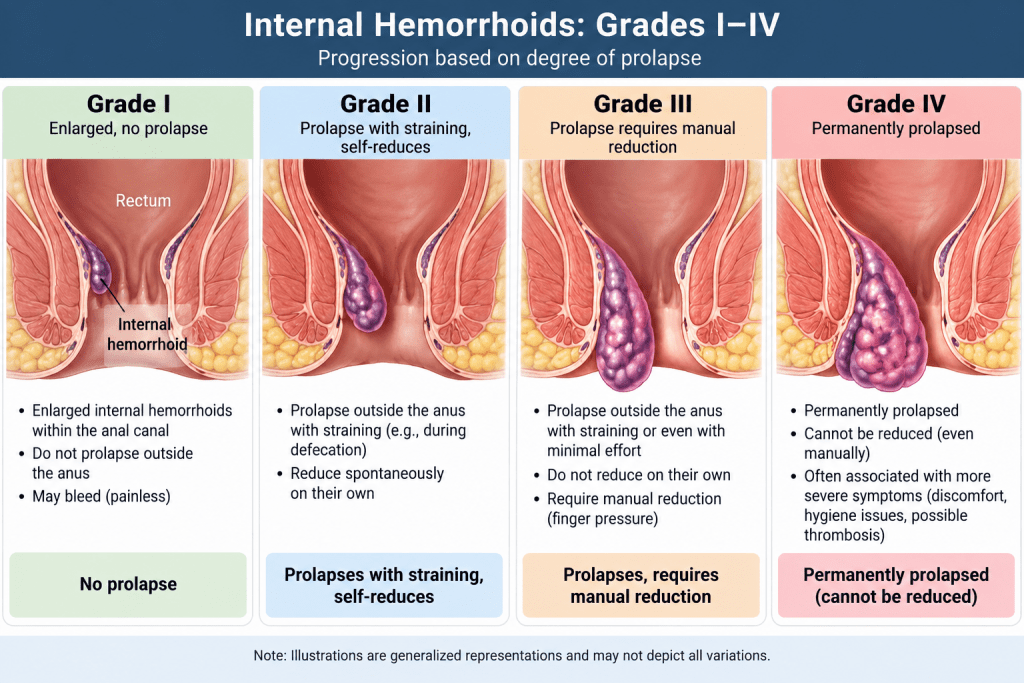
Hemorrhoids are typically classified as internal (originating above the dentate line, inside the anal canal, generally painless unless complicated) or external (below the dentate line, closer to the anal opening, which can become painful if a clot forms). Internal hemorrhoids are further graded by severity using the Goligher classification:
| Grade | Description |
|---|---|
| Grade I | Bulge into the anal canal; do not prolapse outside |
| Grade II | Prolapse during bowel movements but reduce (go back in) on their own |
| Grade III | Prolapse and require manual pushing back in |
| Grade IV | Prolapged and cannot be pushed back in at all |
Common symptoms include bright red bleeding (classically noticed at the end of a bowel movement, on the stool or on toilet paper), itching, a sense of fullness or prolapse, mucus discharge, and — particularly with external hemorrhoids or a thrombosed vein — pain and swell
Also Read: Enlarged Prostate (BPH) Treatment Without Surgery in Indore: What Is Prostate Artery Embolization?
When Rectal Bleeding Needs Urgent Evaluation, Not Assumption
It is worth being direct about something many patients get wrong: not all rectal bleeding is piles, and assuming it is without proper evaluation can delay diagnosis of something more serious. Dark or maroon-colored blood, blood mixed into the stool rather than coating its surface, a significant change in bowel habits, unexplained weight loss, or new symptoms after age 45–50 all warrant prompt medical evaluation — typically including a colonoscopy — before treatment for “piles” begins. This is precisely why a proper workup, not a home assumption, is the appropriate first step whenever bleeding is new, persistent, or doesn’t fit the classic bright-red, end-of-bowel-movement pattern.
Why Consider Treatment Without Surgery?
For milder cases, dietary fiber, adequate hydration, topical treatments, and lifestyle changes remain the correct first step, and most people improve without ever needing a procedure. When symptoms persist, especially bleeding, the next tier has traditionally included office-based procedures like rubber band ligation, sclerotherapy, or infrared coagulation, followed by surgery — either conventional hemorrhoidectomy or stapled hemorrhoidopexy — for cases that don’t respond.
Surgical hemorrhoidectomy is effective, but it is genuinely painful — patients undergoing surgery often report significant pain during the first bowel movement afterward, along with a recovery period that can extend to around six weeks, plus real (if generally low) risks of bleeding, infection, and, in a small number of cases, longer-term issues with anal sphincter function or narrowing. Office-based procedures like rubber band ligation are quicker and less invasive, but recurrence rates are meaningfully higher — commonly cited in the range of 15% to 60% depending on the study and hemorrhoid grade.
Hemorrhoidal Artery Embolization was developed specifically to fill the gap between these options — a procedure with surgery-level effectiveness for the right patients, but with a side-effect and pain profile far closer to a simple outpatient procedure.
What Is Hemorrhoidal Artery Embolization (HAE)?
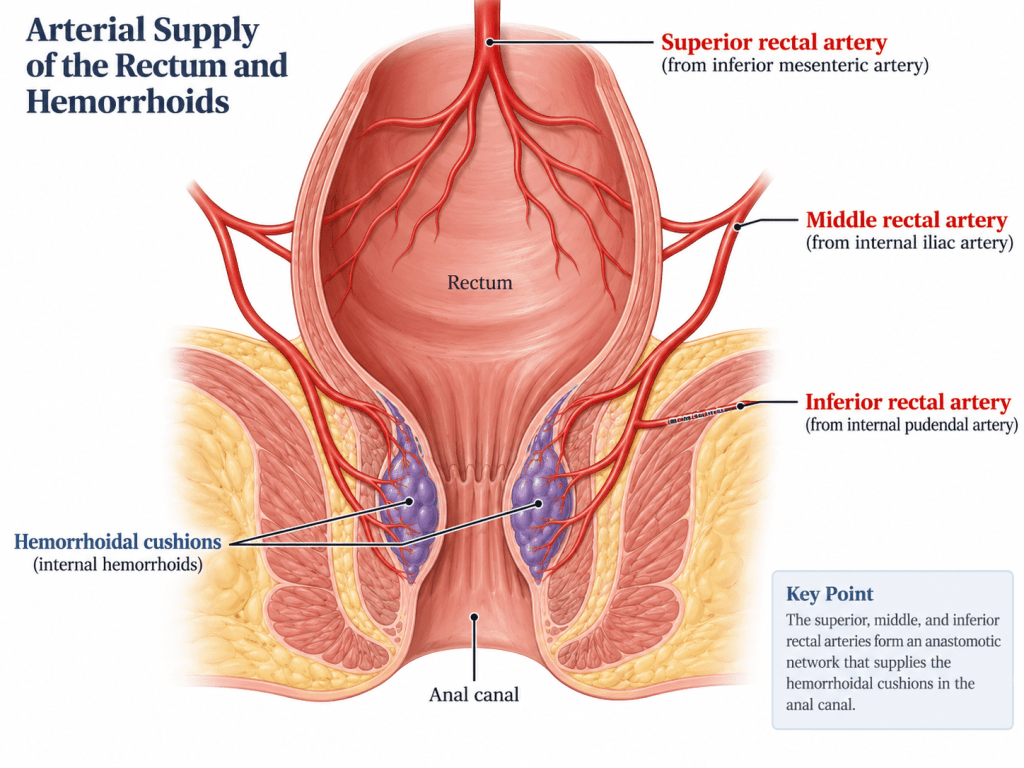
Hemorrhoidal tissue is supplied primarily by branches of the superior rectal artery (a continuation of the inferior mesenteric artery), with contributions from the middle and inferior rectal arteries as well. In hemorrhoidal disease, blood flow through these vessels increases and the hemorrhoidal cushions become abnormally engorged — swollen with excess blood — which is part of why they bleed so readily and can prolapse.
HAE works by selectively blocking the specific hypertrophied (enlarged) artery branches feeding this excess blood supply, reducing arterial inflow to the engorged hemorrhoidal cushions. Deprived of their excess blood supply, the hemorrhoidal tissue gradually shrinks and bleeding typically resolves — all without cutting, cauterizing, or removing any tissue. Because the procedure targets the vascular root cause rather than the tissue itself, it also avoids any risk to the anal sphincter muscles that control continence — a structure that surgical procedures must carefully work around.
How HAE Differs From Other Non-Surgical Options
Rubber band ligation, sclerotherapy, and infrared coagulation all work locally, directly on the hemorrhoidal tissue itself, typically through an anoscope in an office setting. HAE instead works upstream, through the bloodstream, via a catheter — similar in concept to embolization procedures used elsewhere in the body for fibroids, prostate enlargement, or knee osteoarthritis. This is why HAE is performed by an interventional radiologist rather than a colorectal surgeon or gastroenterologist, and why it requires angiography suite equipment rather than an office anoscope.
Who Is a Good Candidate for HAE?
Based on the clinical criteria used to select patients for HAE, good candidates generally include:
- Chronic hemorrhoidal bleeding that has not adequately responded to conservative management — dietary fiber, topical treatments, and lifestyle changes.
- Bleeding as the predominant symptom, rather than pain or prolapse alone — HAE has its strongest evidence base specifically for bleeding-predominant hemorrhoidal disease.
- Goligher grade I–IV internal hemorrhoids, though historically office-based embolization pathways have focused on grade I–III disease.
- A meaningful bleeding severity score on standardized bleeding assessment scales used in clinical practice.
- Patients who want to avoid surgery, or who are poor candidates for surgical anesthesia due to other health conditions.
- A recent colonoscopy or equivalent evaluation ruling out other causes of rectal bleeding, since HAE treats hemorrhoidal bleeding specifically and should not be used as a default answer to unexplained bleeding without first excluding other anorectal or colonic pathology.
Who Should Not Consider HAE
- Anorectal cancer or other malignancy as the cause of symptoms — this must be excluded, not treated with embolization.
- A history of pelvic radiation therapy, which can compromise the collateral blood circulation that keeps surrounding tissue safe during embolization.
- Hemorrhoids where prolapse or pain, rather than bleeding, is the dominant problem — these patients often do better with a treatment that directly addresses the tissue bulk and support structures, such as banding or surgery.
- Unclear or unconfirmed diagnosis — any patient with rectal bleeding who has not had appropriate evaluation to rule out other causes should complete that workup first.
At CVIC Indore, candidacy is confirmed through a clinical history, examination, review of prior treatment, and confirmation that other causes of bleeding have been appropriately excluded before HAE is recommended.
Piles Treatment Options Compared
| Treatment | Setting | Invasiveness | Typical Recurrence | Pain Level |
|---|---|---|---|---|
| Diet, fiber, topical treatment | Home | None | Common if underlying cause persists | None |
| Rubber band ligation / sclerotherapy | Office-based | Minimal (local, no anesthesia) | Moderate-to-high (commonly 15–60%) | Mild |
| Hemorrhoidal Artery Embolization (HAE) | Angiography suite | Minimally invasive (catheter-based) | Lower than banding; around 1 in 5 patients | Minimal (near-zero in comparative pain scoring) |
| Stapled hemorrhoidopexy | Operating room | Surgical | Moderate | Moderate |
| Conventional hemorrhoidectomy | Operating room | Surgical (tissue excision) | Lowest of all options | Significant, especially first bowel movement |
Preparing for HAE
Once candidacy is confirmed, preparation is generally straightforward compared with major surgery. Patients are typically asked to complete routine blood tests beforehand, review current medications with the team — blood thinners are often adjusted under medical guidance — and fast for a short period (commonly around six hours) before the procedure, given the use of sedation. Since bowel evaluation to exclude other causes of bleeding is a prerequisite for HAE, that workup (colonoscopy or equivalent) should already be complete and its results available before the procedure date. Arranging for someone to accompany you home afterward is recommended, since sedation can affect alertness for the remainder of the day.
Step-by-Step: The HAE Procedure at CVIC Indore
- Clinical evaluation — History, examination, review of prior conservative treatment, and confirmation (via colonoscopy or equivalent) that other causes of bleeding have been excluded.
- Access — A small puncture in the femoral artery (groin), under local anesthesia, with the patient sedated but comfortable throughout.
- Mapping angiogram — A flush aortogram and selective catheterization identify the inferior mesenteric artery and, from there, the superior rectal artery.
- Selective catheterization — A microcatheter is advanced into the superior rectal artery and its branches, with angiography used to identify the specific hypertrophied branches showing abnormal blood flow into the hemorrhoidal cushions.
- Embolization — Calibrated embolic microspheres, sometimes combined with small coils, are carefully injected into the identified branches until the abnormal blood flow pattern resolves. When indicated by the anatomy, the middle rectal artery is also treated.
- Confirmation — A final angiogram confirms the abnormal blood flow pattern has resolved.
- Recovery — The patient is monitored for a few hours before same-day discharge — no incision, no stitches, and no packing required.
The entire procedure typically takes around one to two hours, depending on arterial anatomy.
Results: What the Evidence Actually Shows
Rather than vague reassurance, here is what the published clinical evidence on HAE actually reports:
- Technical success (successful embolization of at least one target artery) is achieved in 93–100% of procedures.
- Clinical success, measured as a meaningful reduction in bleeding scores, is reported in 63–94% of patients across studies, with an average reduction of roughly 2.7 points on standardized bleeding severity scales.
- More than 40% improvement has been reported in hemorrhoid size, associated pain, and prolapse in responding patients.
- The recurrence rate is approximately 20% — meaningfully lower than the 15–60% recurrence range reported for rubber band ligation.
- In direct pain comparisons, patients undergoing HAE reported dramatically less pain during their first bowel movement after the procedure compared with those undergoing surgical hemorrhoidectomy, and recovery is measured in days rather than the roughly six-week recovery period often associated with surgery.
It is also fair to note that recurrence with HAE, while lower than banding, remains higher than with surgical hemorrhoidectomy — surgery still offers the lowest long-term recurrence of any option, which is part of why it remains appropriate for some patients, particularly those with very advanced (grade IV) or prolapse-dominant disease.
Also Read: What Are the Causes of Brain Blood Clots? Symptoms & Treatment | CVIC Indore
Safety and Complications: An Honest Look
HAE has a strong safety profile, particularly compared with surgery, but no procedure is without risk:
- No sphincter damage or anal stenosis (narrowing) has been reported with HAE — a meaningful advantage, since these are recognized risks of surgical hemorrhoid procedures.
- No fecal incontinence has been reported in the published HAE literature, again distinguishing it from a recognized, if uncommon, surgical risk.
- Mild, transient pelvic or anal discomfort is common in the days after the procedure and typically resolves with simple pain relief.
- Small, superficial ulcerations at the treated site have been reported in up to 45% of patients — importantly, these are frequently asymptomatic and self-resolving, discovered on follow-up examination rather than causing patient-reported problems.
- Severe pain is rare.
- Serious ischemic complications are very rare — isolated case reports exist in the wider published literature, underscoring why careful patient selection, appropriately sized embolic particles, and meticulous angiographic technique matter throughout the procedure.
Overall, the complication profile is low-grade and self-limited in the large majority of patients, which is precisely why HAE has gained traction as a genuine alternative for appropriately selected patients rather than a niche or experimental option.
Also Read: Stroke Specialist Near Me | Advanced Stroke Treatment at CVIC Indore
HAE vs. Surgical Hemorrhoidectomy: A Closer Comparison
| Factor | Hemorrhoidal Artery Embolization | Surgical Hemorrhoidectomy |
|---|---|---|
| Access | Pinhole puncture (groin) | Direct surgical excision |
| Anesthesia | Local + light sedation | General or spinal |
| Tissue removed | None | Hemorrhoidal tissue excised |
| Hospital stay | Same-day | Often requires admission |
| Pain after first bowel movement | Minimal | Significant |
| Recovery to normal activity | Days | Around six weeks |
| Sphincter risk | None reported | Small but real risk |
| Recurrence | Lower than banding, higher than surgery (~20%) | Lowest of all options |
| Best suited for | Bleeding-predominant disease, grades I–IV, patients wanting to avoid surgery | Advanced prolapse-dominant disease, or where embolization has failed |
Why Choose CVIC Indore for Hemorrhoidal Artery Embolization
CVIC Indore (Center Of Vascular And Interventional Care) applies the same catheter-based, image-guided precision used across its broader vascular and interventional radiology practice to piles treatment:
- Dedicated interventional radiology expertise in selective microcatheter techniques — the same core skill set used across the clinic’s embolization procedures for conditions ranging from fibroids to prostate enlargement to knee pain.
- Advanced angiographic imaging to precisely map each patient’s rectal artery anatomy before treatment, since this anatomy varies meaningfully from patient to patient.
- A thorough, honest evaluation process — confirming bleeding-predominant disease, reviewing prior treatment, and ensuring other causes of bleeding have been appropriately excluded before recommending HAE.
- A day-care model, meaning patients go home the same day, without a surgical hospital stay.
- Care coordinated with colorectal and gastroenterology evaluation where needed, so that patients who are not ideal HAE candidates are guided toward the option genuinely best suited to their case.
Myths vs. Facts About Hemorrhoidal Artery Embolization
Myth: Piles always eventually need surgery. Fact: Most piles improve with conservative treatment, and for those that don’t, HAE now offers a non-surgical option with a strong evidence base specifically for bleeding-predominant disease.
Myth: Embolization means cutting off blood supply to the whole rectal area. Fact: HAE selectively targets only the specific hypertrophied artery branches feeding the abnormal hemorrhoidal cushions, preserving normal blood flow to the rest of the rectum and anal canal.
Myth: Non-surgical treatment can’t be as effective as surgery. Fact: For bleeding-predominant hemorrhoidal disease, HAE achieves clinical success in the majority of appropriately selected patients, with dramatically less pain than surgery, even though its recurrence rate is somewhat higher than surgical excision.
Myth: Recovery takes as long as hemorrhoid surgery. Fact: Most HAE patients resume normal activity within days, compared with a recovery period of around six weeks commonly associated with surgical hemorrhoidectomy.
Myth: HAE risks bowel control problems, like some hemorrhoid surgeries can. Fact: No cases of fecal incontinence or anal sphincter damage have been reported in the published HAE literature, since the procedure never involves the sphincter muscles at all.
Frequently Asked Questions
1. Is Hemorrhoidal Artery Embolization painful? The procedure itself is performed under local anesthesia with sedation, so patients are comfortable throughout. Any discomfort afterward is typically mild and short-lived, and notably less than the pain reported after surgical hemorrhoid removal.
2. How long do the results of HAE last? Published data shows durable improvement in the majority of patients, with a recurrence rate of around 20% — lower than office-based banding, though somewhat higher than surgical hemorrhoidectomy.
3. Will HAE work for external hemorrhoids or a thrombosed hemorrhoid? HAE’s evidence base is strongest for internal, bleeding-predominant hemorrhoids. External hemorrhoids and thrombosed veins are generally managed differently, and your doctor can advise which approach fits your specific presentation.
4. How is HAE different from rubber band ligation? Rubber band ligation treats the hemorrhoidal tissue directly and locally in an office setting, while HAE works upstream through the arterial blood supply using catheter-based techniques. HAE is associated with a lower recurrence rate than banding in comparative data.
5. Do I need general anesthesia for HAE at CVIC Indore? No. HAE is performed under local anesthesia at the access site combined with light sedation for comfort — general or spinal anesthesia is not required.
6. How soon can I return to normal activity after HAE? Most patients resume normal daily activity within a few days, a substantially shorter recovery than the weeks typically needed after surgical hemorrhoid removal.
7. Is Hemorrhoidal Artery Embolization available in Indore? Yes. CVIC Indore offers Hemorrhoidal Artery Embolization for eligible patients with bleeding-predominant piles, performed by the clinic’s interventional radiology team using selective angiographic technique.
Final Thoughts
Piles are common, treatable, and nothing to be embarrassed about — but persistent bleeding deserves a proper evaluation rather than indefinite home management or an automatic assumption that surgery is the only next step. Hemorrhoidal Artery Embolization offers appropriately selected patients a genuinely effective, minimally invasive path to relief, addressing the blood supply driving the problem rather than removing tissue, with a fraction of the pain and recovery time associated with surgical hemorrhoidectomy.
The right next step is a proper evaluation — including making sure other causes of bleeding have been ruled out — so the team at CVIC Indore can tell you honestly whether Hemorrhoidal Artery Embolization is the right fit for your specific case, or whether another option would serve you better.
Visit CVIC Indore
CVIC — Center Of Vascular And Interventional Care 403, Panama Tower, Gita Bhawan Road, near Crown Palace, South Tukoganj, Indore, Madhya Pradesh 452008
Phone: 0731 4675670 / +91-8103727728
Team: Dr. Alok K. Udiya (MD Radiology, Fellowship in Neuro Intervention Radiology, Switzerland), Dr. Shailesh Gupta (MD Radiology, PDCC in Interventional Radiology), Dr. Nishant Bhargava (MD Radiology, Fellowship in Neuro Intervention Radiology, Switzerland)
Disclaimer
This article is intended for general educational purposes only and does not constitute medical advice. Suitability for Hemorrhoidal Artery Embolization depends on individual symptoms, hemorrhoid grade, and prior evaluation to exclude other causes of bleeding, and can only be determined through an in-person clinical evaluation by a qualified interventional radiologist, gastroenterologist, or colorectal specialist. If you are experiencing rectal bleeding, please consult a doctor promptly for personalized assessment and treatment planning.