

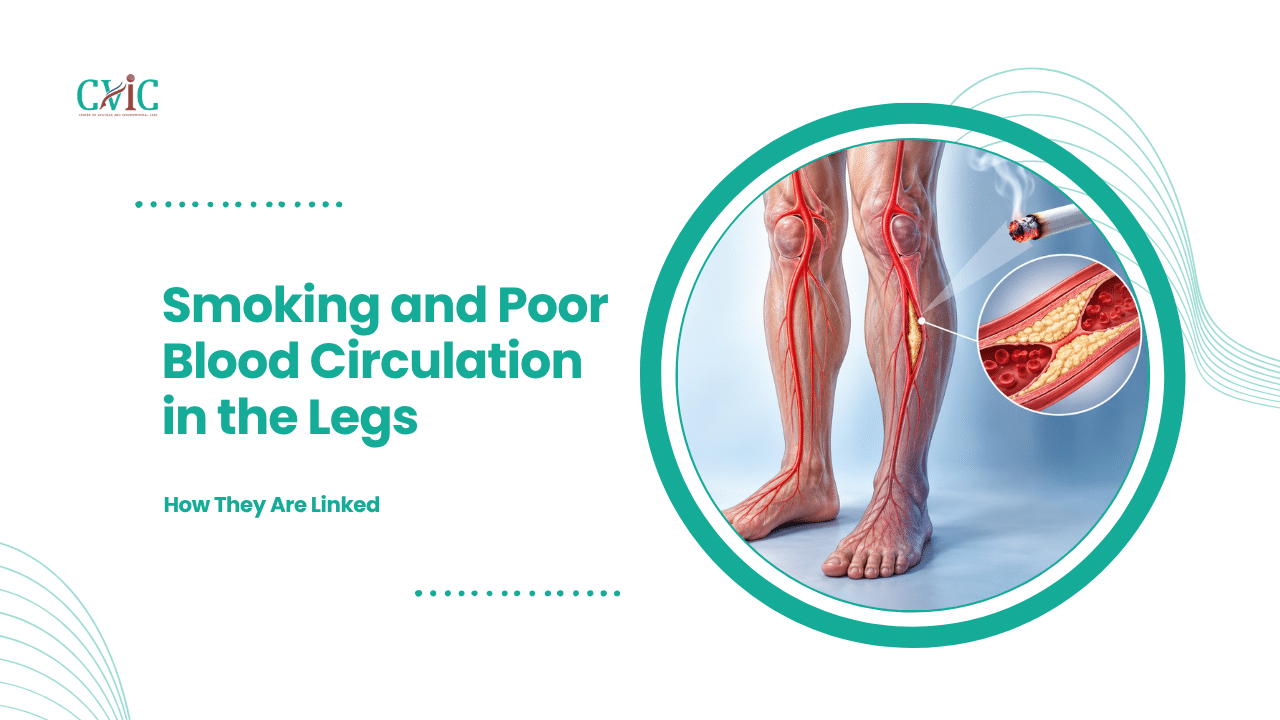
Do your legs ache or cramp when you walk, then feel better when you stop? Do your feet often feel cold, or does a small cut on your foot take weeks to heal? If you smoke, these may be signs of poor blood circulation in the legs.
Smoking is one of the strongest causes of damaged leg arteries. It narrows blood vessels, makes blood more likely to clot, and slowly starves the legs and feet of oxygen. Many people only notice the problem once it is already advanced.
At CVIC Indore, we see many patients whose leg pain, numbness, or non-healing wounds are linked to smoking. In this guide, we explain in simple words how smoking affects leg circulation, the warning signs to watch for, how it is diagnosed and treated, and why quitting is the single most powerful step you can take.
Key Takeaways
Smoking damages the inner lining of arteries, speeds up plaque build-up, and makes blood stickier.
It is a major cause of peripheral artery disease (PAD), the most common reason for poor blood circulation in the legs.
Early signs include leg pain while walking, cold feet, numbness, and slow-healing sores.
Quitting smoking slows the disease, improves walking distance, and lowers the risk of amputation.
Modern, minimally invasive procedures can restore blood flow when arteries are badly blocked.
What Is Poor Blood Circulation in the Legs?
Your heart pumps oxygen-rich blood through arteries all the way down to your legs and feet. Veins then carry the used blood back to the heart. When this flow is reduced, the muscles, nerves, and skin of the legs do not get enough oxygen and nutrients. This is called poor blood circulation in the legs.
There are two main types:
- Arterial problems: The arteries carrying blood to the legs become narrow or blocked. This is the type most strongly linked to smoking.
- Venous problems: The veins struggle to return blood to the heart, causing swelling and heaviness. Smoking also raises the risk of blood clots in veins.
Poor circulation is not a disease by itself. It is a sign that something is affecting your blood vessels, and smoking is one of the most common and most preventable causes.
Also Read: What Happens If a Biopsy Report Is Inconclusive?
How Does Smoking Cause Poor Blood Circulation in the Legs?
Tobacco smoke contains thousands of harmful chemicals. Several of them attack your blood vessels at the same time:
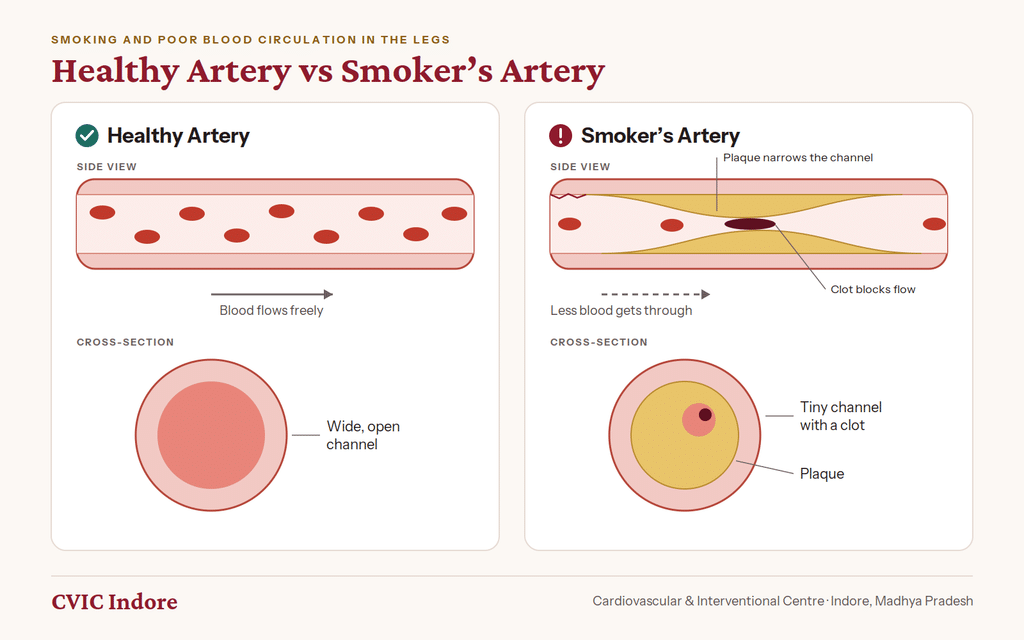
- Damages the artery lining: Chemicals in smoke injure the smooth inner lining of arteries (the endothelium). Damaged lining lets fat and cholesterol stick to the walls more easily.
- Speeds up plaque build-up: Plaque is a sticky mix of fat, cholesterol, and other substances. Over time it hardens and narrows the arteries. This process is called atherosclerosis.
- Narrows blood vessels: Nicotine makes blood vessels tighten (constrict), reducing blood flow even more, especially to the hands and feet.
- Makes blood sticky: Smoking makes platelets (tiny blood cells that help clotting) clump together more easily and raises clotting factors. This increases the risk of clots that can suddenly block an artery or vein.
- Reduces oxygen in the blood: Carbon monoxide from smoke takes the place of oxygen in red blood cells. So even the blood that does reach your legs carries less oxygen.
- Raises blood pressure and heart rate: This puts extra strain on already damaged vessels.
The effect builds up with every cigarette. The more you smoke and the longer you smoke, the higher the risk. Beedis, chewing tobacco, and other forms of tobacco are also harmful to blood vessels.
Leg Conditions Linked to Smoking
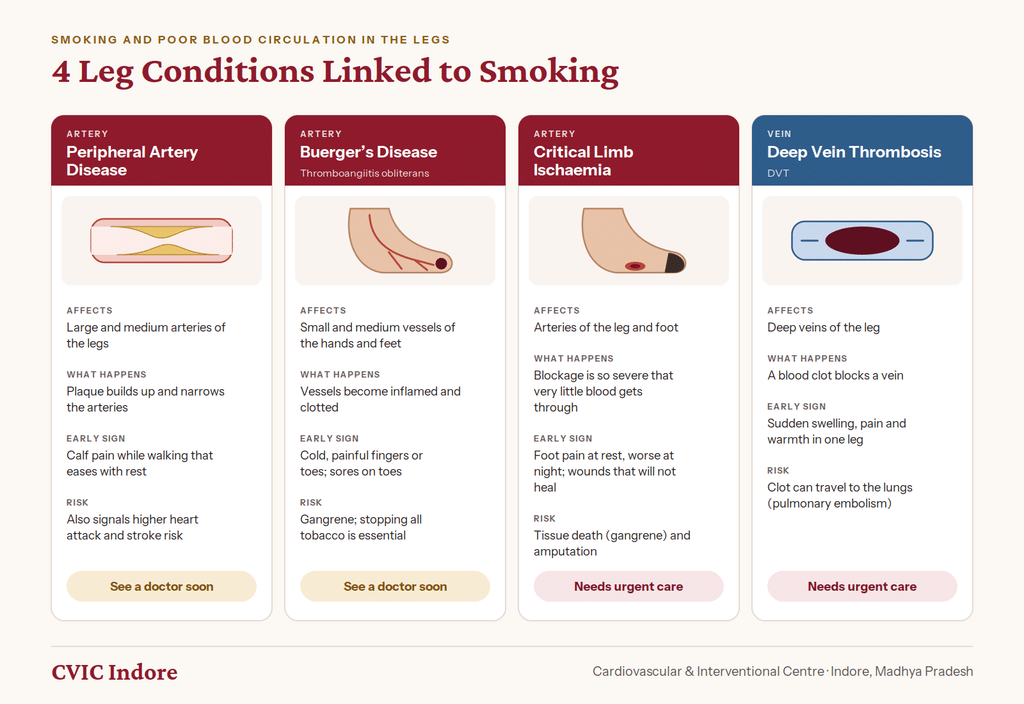
Peripheral Artery Disease (PAD)
PAD is the narrowing or blockage of arteries that supply the legs, usually due to plaque. Smoking is one of its strongest risk factors, and people who smoke tend to develop PAD earlier and more severely. PAD is also a warning sign that the arteries of the heart and brain may be affected, raising the risk of heart attack and stroke.
Buerger’s Disease (Thromboangiitis Obliterans)
This is a rare disease that causes swelling and clots in small and medium blood vessels of the hands and feet. It is very closely linked to tobacco use, often affects younger people, and can lead to painful sores and gangrene. Stopping tobacco completely is the most important treatment.
Critical Limb Ischaemia
This is the most severe stage of PAD. Blood flow becomes so poor that the foot hurts even at rest, and wounds do not heal. Without treatment, it can lead to tissue death (gangrene) and amputation.
Blood Clots in Leg Veins
Smoking makes blood more likely to clot, which raises the risk of deep vein thrombosis (DVT), especially when combined with other risks like long travel, surgery, or hormone medicines.
Also Read: Varicose Veins vs DVT (Deep Vein Thrombosis): How to Tell the Difference
Quick Comparison
| Condition | What happens | Typical early sign |
|---|---|---|
| Peripheral artery disease | Plaque narrows leg arteries | Calf pain while walking that eases with rest |
| Buerger’s disease | Inflamed, clotted small vessels in hands and feet | Cold, painful fingers or toes; sores on toes |
| Critical limb ischaemia | Severe blockage, very little blood flow | Foot pain at rest, especially at night; non-healing wounds |
| Deep vein thrombosis | Clot in a deep leg vein | Sudden swelling, pain and warmth in one leg |
Symptoms of Poor Blood Circulation in the Legs
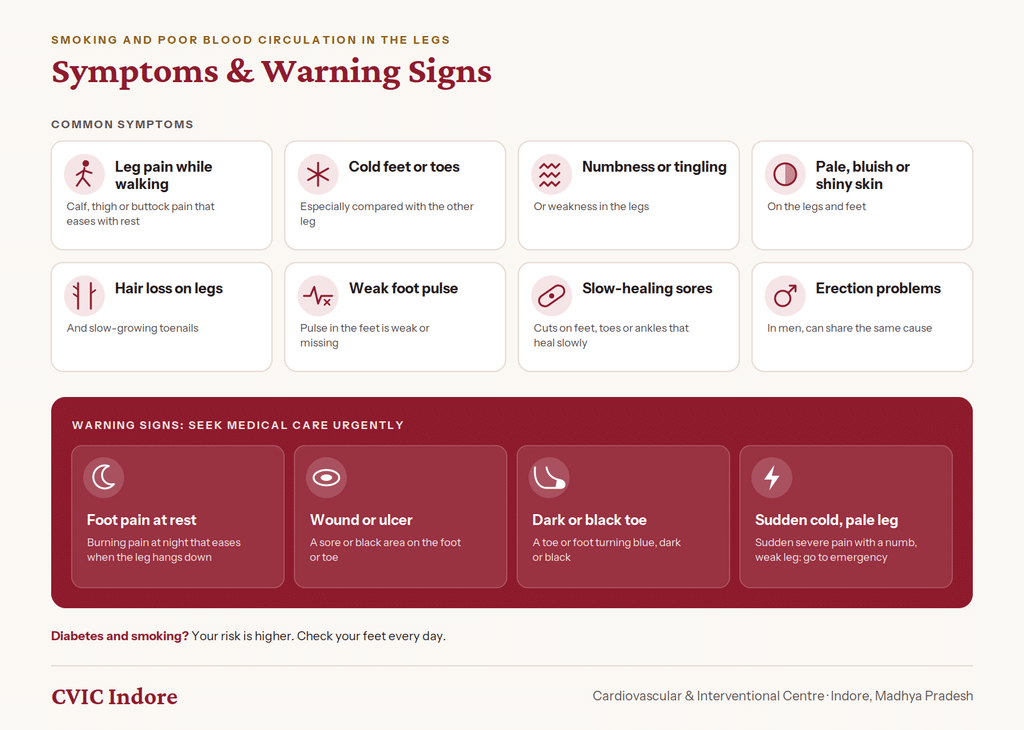
Many people have no symptoms in the early stages. As blood flow drops further, you may notice:
- Claudication: Cramping, aching, or tiredness in the calf, thigh, or buttock while walking or climbing stairs, which eases after a few minutes of rest
- Cold feet or toes, especially compared to the other leg
- Numbness, tingling, or weakness in the legs
- Pale, bluish, or shiny skin on the legs and feet
- Hair loss on the legs and feet, and slow-growing toenails
- Weak or missing pulse in the feet
- Sores or cuts on the feet, toes, or ankles that heal slowly
- In men, difficulty with erections, which can share the same cause
Warning Signs: Seek Medical Care Urgently
- Burning pain in the foot or toes at rest, especially at night, that eases when the leg hangs down
- A wound, ulcer, or black area on the foot or toe
- A toe or foot turning dark, blue, or black
- Sudden severe leg pain with a cold, pale, numb, or weak leg. This may mean an artery is suddenly blocked. Go to emergency care immediately.
People with diabetes who also smoke are at especially high risk and should check their feet every day.
How Is Poor Blood Circulation in the Legs Diagnosed?
Diagnosis is usually simple and painless. Your doctor will ask about your symptoms, smoking history, and other risks like diabetes, high blood pressure, and cholesterol. Tests may include:
- Physical examination: Checking the pulses in your legs and feet, skin colour, temperature, and any wounds.
- Ankle-brachial index (ABI): Blood pressure is measured at the ankle and the arm and compared. A low ratio suggests narrowed leg arteries. It takes only a few minutes.
- Arterial Doppler ultrasound: Uses sound waves to show the arteries and how blood flows through them. It can find where an artery is narrowed or blocked.
- CT angiography or MR angiography: Detailed scans that create a map of the arteries from the abdomen down to the feet. They help plan treatment.
- Catheter angiography: A thin tube is placed into an artery and dye is injected while X-ray images are taken. It is often done together with treatment.
- Blood tests: To check sugar, cholesterol, and kidney function.
Finding PAD early gives you the best chance to protect your legs, and also your heart and brain.
Also Read: Piles (Hemorrhoids) Treatment Without Surgery in Indore: Hemorrhoidal Artery Embolization
Treatment for Poor Blood Circulation in the Legs
Treatment aims to relieve symptoms, improve walking, heal wounds, protect the leg, and lower the risk of heart attack and stroke.
1. Stop Smoking Completely
This is the most important treatment. No medicine or procedure works as well if you keep smoking. Even arteries that have been opened with a procedure are more likely to block again in people who continue to smoke.
2. Supervised Walking Exercise
Regular walking, especially a structured programme, helps the body grow small new blood vessels around blockages. Walk until the pain is moderate, rest until it eases, then walk again. Over weeks, walking distance usually improves.
3. Medicines
Your doctor may prescribe medicines to:
- Reduce the risk of clots (antiplatelet medicines)
- Lower cholesterol and stabilise plaque
- Control blood pressure and blood sugar
- In some cases, improve walking distance
Take medicines exactly as advised and never stop them without speaking to your doctor.
4. Foot Care
Wash and dry your feet daily, moisturise dry skin (not between toes), wear well-fitting footwear, and never walk barefoot. Check your feet daily for cuts or colour changes.
5. Minimally Invasive Procedures
When blockages cause severe symptoms, rest pain, or non-healing wounds, blood flow can often be restored through a small needle puncture, usually in the groin, under local anaesthesia (numbing only the area):
- Balloon angioplasty: A small balloon is guided to the narrowed artery and inflated to open it.
- Stenting: A small mesh tube (stent) is placed to keep the artery open.
- Drug-coated balloons and stents: These release medicine to reduce the chance of re-narrowing.
- Atherectomy: A special catheter removes or shaves away plaque inside the artery.
6. Surgery
For long or complex blockages, bypass surgery may be needed. A surgeon creates a new route for blood to flow around the blocked artery, using a vein or a synthetic tube.
What Happens When You Quit Smoking?
It is never too late to quit. Your blood vessels start to benefit soon after your last cigarette:
- Within hours to days: Carbon monoxide levels fall and more oxygen reaches your legs. Blood becomes less sticky.
- Within weeks to months: Circulation and lung function improve. Walking often becomes easier.
- Over the long term: The disease slows down, and the risk of heart attack, stroke, and amputation drops steadily. Treatments like stents and bypasses also last longer.
Quitting cannot fully reverse existing plaque, but it is the most powerful way to stop the damage from getting worse.
Tips to Help You Quit
- Set a quit date and tell family and friends.
- Remove cigarettes, beedis, lighters, and ashtrays from your home and vehicle.
- Identify your triggers, such as tea breaks or stress, and plan alternatives.
- Ask your doctor about nicotine replacement therapy or medicines that reduce cravings.
- Use counselling or quit-smoking support services; your doctor can guide you to them.
- Stay busy with walking, which also helps your legs.
- If you slip, do not give up. Many people need several attempts before they quit for good.
Switching to chewing tobacco, gutkha, or e-cigarettes is not a safe alternative for your blood vessels.
Questions to Ask Your Doctor
- Is my leg pain caused by poor blood circulation?
- Do I have peripheral artery disease?
- Should I have an ABI test or Doppler ultrasound?
- How much damage has smoking already done?
- Which medicines do I need, and for how long?
- What kind of walking programme is right for me?
- Am I a candidate for angioplasty or stenting?
- How should I care for my feet every day?
- Should my heart and brain arteries also be checked?
- What support is available to help me quit smoking?
Why Choose CVIC Indore for Poor Blood Circulation in the Legs
Poor leg circulation is a blood vessel problem, and treating it well needs accurate vascular imaging and skilled, minimally invasive intervention. CVIC Indore is built around these strengths, serving patients from Indore and across Madhya Pradesh.
Our Specialist Team
- Dr. Alok K Udiya — Neuroradiology and Vascular Imaging: Dr. Udiya brings deep expertise in vascular imaging, helping map exactly where and how badly the leg arteries are narrowed so that treatment can be planned precisely.
- Dr. Shailesh Gupta — Interventional Neurology and Stroke Management: Because smoking damages arteries throughout the body, Dr. Gupta’s experience in stroke prevention and management supports a complete look at your blood vessel health, not just your legs.
- Dr. Nishant Bhargava — Cerebrovascular Intervention: Dr. Bhargava specialises in minimally invasive, catheter-based procedures inside blood vessels, the same core skills used in angioplasty and stenting.
What You Can Expect
- ABI testing, Doppler ultrasound, and advanced angiography to find the cause
- Image-guided, minimally invasive treatment such as angioplasty and stenting when needed
- Guidance and support to quit smoking
- Foot care advice and long-term follow-up
- Clear, simple explanations at every step
If you smoke and have leg pain, cold feet, or slow-healing wounds, our team is here to help protect your legs.
Frequently Asked Questions
Does smoking cause poor blood circulation in the legs?
Yes. Smoking damages artery walls, speeds up plaque build-up, narrows blood vessels, and makes blood more likely to clot, all of which reduce blood flow to the legs.
What are the first signs of poor circulation from smoking?
Common early signs are calf pain while walking that eases with rest, cold feet, numbness, and cuts on the feet that heal slowly.
Can poor circulation from smoking be reversed?
Quitting cannot remove existing plaque, but it stops further damage, improves blood flow, and helps treatments work. Blocked arteries can often be reopened with procedures.
How soon does circulation improve after quitting smoking?
Oxygen levels in the blood improve within days, and circulation often improves within weeks to months. The long-term risks keep falling the longer you stay smoke-free.
Is chewing tobacco or vaping safer for blood vessels?
No. Chewing tobacco, gutkha, and e-cigarettes also contain nicotine and harmful chemicals that affect blood vessels.
What is claudication?
Claudication is pain, cramping, or tiredness in the leg muscles while walking that goes away with rest. It is a classic sign of peripheral artery disease.
What is Buerger’s disease?
It is a rare disease of small blood vessels in the hands and feet that is closely linked to tobacco use. Stopping tobacco completely is essential.
Can poor circulation lead to amputation?
In severe, untreated cases, very poor blood flow can cause gangrene and may lead to amputation. Early diagnosis, quitting smoking, and treatment greatly lower this risk.
Which test checks blood circulation in the legs?
The ankle-brachial index (ABI) and arterial Doppler ultrasound are common first tests. CT or MR angiography may be used to plan treatment.
Where can I get poor blood circulation in the legs treated in Indore?
CVIC Indore offers ABI testing, Doppler ultrasound, advanced angiography, and minimally invasive treatments like angioplasty and stenting. Book a consultation to get checked.
Conclusion
The link between smoking and poor blood circulation in the legs is strong and well established. Every cigarette adds to the damage in your arteries, often silently, until walking becomes painful or wounds stop healing.
The good news is that quitting smoking at any age helps, and modern diagnosis and minimally invasive treatments can restore blood flow and protect your legs. If you notice leg pain while walking, cold feet, or slow-healing sores, do not ignore them.
Worried about the circulation in your legs? Book a consultation at CVIC Indore with our specialist team, including Dr. Alok K Udiya, Dr. Shailesh Gupta, and Dr. Nishant Bhargava, for a thorough check and expert care.
Medical disclaimer: This article is for general information only and is not a substitute for professional medical advice, diagnosis, or treatment. Please consult a qualified doctor about your own condition before starting or stopping any treatment.