Leg pain when you walk. Swollen, bulging veins. A wound on the foot that will not heal. A sudden weakness on one side of the body. These problems may seem unrelated, but they all have one thing in common: they involve your blood vessels.
When something goes wrong with your arteries or veins, you need a specialist who understands the body’s entire circulation system. That is where a vascular doctor comes in. If you are searching for a vascular doctor in Indore, this guide will help you understand what these specialists do, when you should see one, and how to choose the right team for your care.
At CVIC Indore, our specialists focus on blood vessel conditions using advanced imaging and minimally invasive, image-guided treatments, serving patients from Indore and across Madhya Pradesh.
Key Takeaways
A vascular doctor diagnoses and treats diseases of the arteries, veins, and blood vessels throughout the body.
Common reasons to visit include leg pain while walking, varicose veins, leg swelling, blood clots, non-healing foot wounds, and stroke risk.
Many vascular conditions can now be treated through a small needle puncture instead of open surgery.
Early diagnosis with Doppler ultrasound and angiography can prevent serious complications like stroke and amputation.
Choose a vascular doctor in Indore with strong imaging, interventional expertise, and a clear, patient-first approach.
What Does a Vascular Doctor Do?
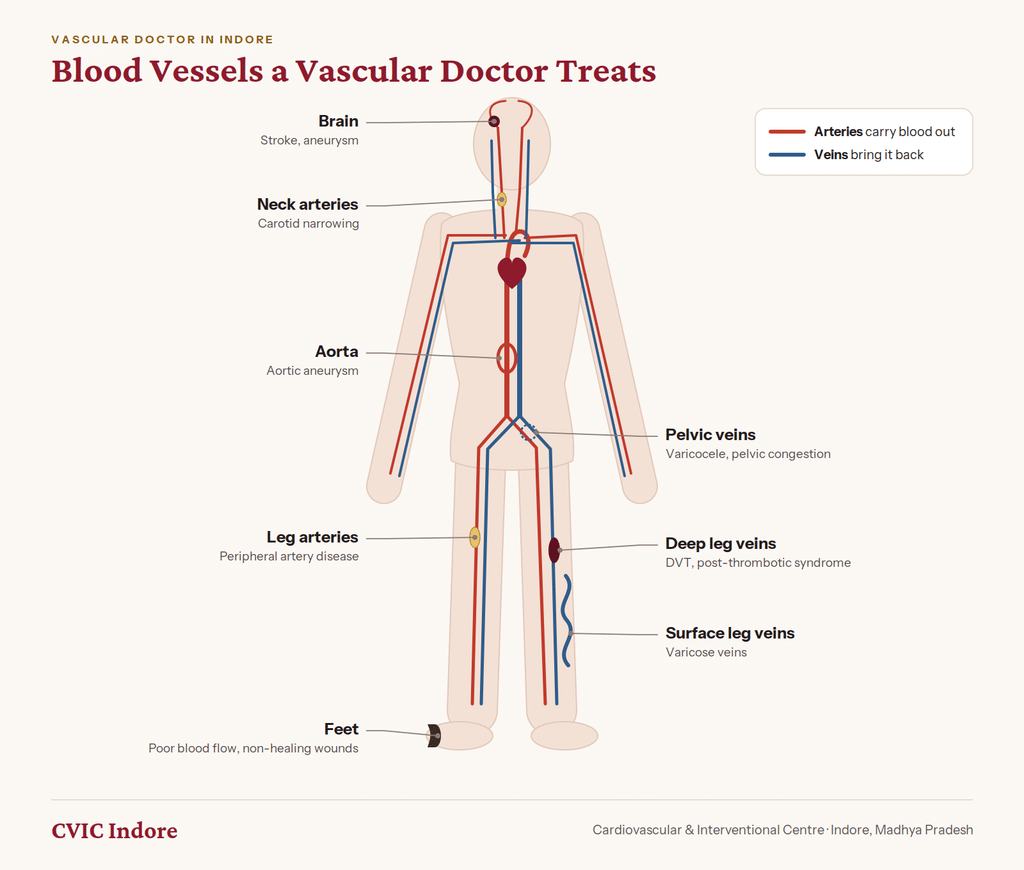
A vascular doctor is a specialist who diagnoses and treats problems of the blood vessels: the arteries that carry blood away from the heart, the veins that bring it back, and the lymph vessels. They work on blood vessels throughout the body, from the brain and neck to the abdomen, arms, and legs.
The term “vascular doctor” can include several types of specialists:
- Vascular surgeons: Treat blood vessel problems with open surgery as well as minimally invasive procedures.
- Interventional radiologists: Use imaging such as X-ray, ultrasound, and CT to guide thin tubes (catheters) and wires through blood vessels to treat problems from the inside, usually without a large cut.
- Neuro-interventional specialists: Focus on blood vessels of the brain and spine, treating conditions like stroke, brain aneurysms, and abnormal blood vessel connections.
- Vascular imaging experts: Specialise in tests like Doppler ultrasound, CT angiography, and MR angiography that show the inside of blood vessels clearly.
Modern vascular care often brings these skills together. Accurate imaging finds the problem, and image-guided treatment fixes it through a small needle puncture, with faster recovery and less pain than traditional surgery.
Also Read: Best Neuro Interventional Radiologist in Indore | Advanced Neurovascular Care at CVIC Indore
Conditions a Vascular Doctor Treats
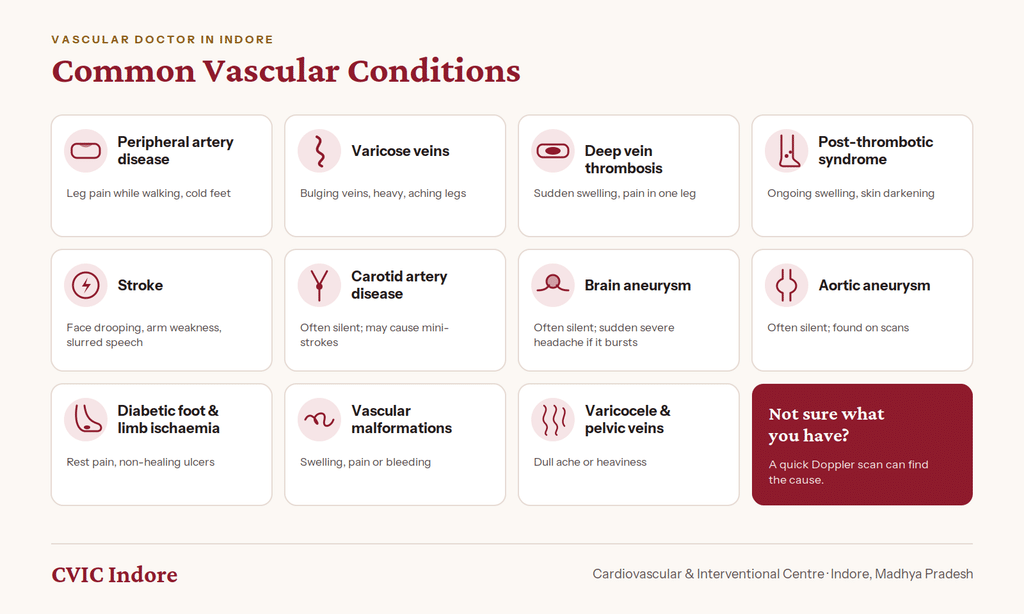
Vascular specialists manage a wide range of conditions. Here are some of the most common:
| Condition | What it is | Common signs |
|---|---|---|
| Peripheral artery disease (PAD) | Narrowed or blocked leg arteries, often due to plaque | Leg pain while walking, cold feet, slow-healing wounds |
| Varicose veins | Swollen, twisted veins due to weak valves | Bulging veins, heavy or aching legs, swelling |
| Deep vein thrombosis (DVT) | Blood clot in a deep vein, usually in the leg | Sudden swelling, pain, and warmth in one leg |
| Post-thrombotic syndrome | Long-term vein damage after DVT | Ongoing leg swelling, skin darkening, ulcers |
| Stroke | Blocked or burst blood vessel in the brain | Face drooping, arm weakness, slurred speech |
| Carotid artery disease | Narrowing of the neck arteries that supply the brain | Often silent; may cause mini-strokes (TIA) |
| Brain aneurysm | A weak, bulging spot in a brain artery | Often silent; sudden severe headache if it bursts |
| Aortic aneurysm | Bulging of the body’s main artery | Often silent; found on scans |
| Diabetic foot and critical limb ischaemia | Very poor blood flow to the foot | Rest pain, non-healing ulcers, gangrene |
| Vascular malformations | Abnormal tangles of blood vessels | Swelling, pain, bleeding, or neurological symptoms |
| Varicocele and pelvic vein problems | Enlarged veins in the scrotum or pelvis | Dull ache, heaviness, or fertility concerns |
Your exact care plan depends on which blood vessels are affected and how severe the problem is.
Also Read: Vascular Surgeon in Indore | Expert Diagnosis and Advanced Vascular Treatment at CVIC Indore
When Should You See a Vascular Doctor in Indore?
Book a consultation with a vascular doctor if you notice:
- Pain, cramping, or tiredness in the legs while walking that eases with rest
- Cold, pale, or bluish feet or toes
- Wounds on the feet or legs that heal slowly
- Swollen, bulging, or painful veins
- Leg swelling that does not go away, especially after a blood clot
- Skin darkening or thickening around the ankles
- A previous mini-stroke (TIA) or a known narrowing in the neck arteries
- Heaviness or aching in the scrotum or pelvis that worsens on standing
You should also consider a check-up if you have risk factors such as smoking, diabetes, high blood pressure, high cholesterol, a family history of vascular disease, or are over 50.
Emergencies: Do Not Wait
Call emergency services or go to the nearest emergency department immediately if you notice:
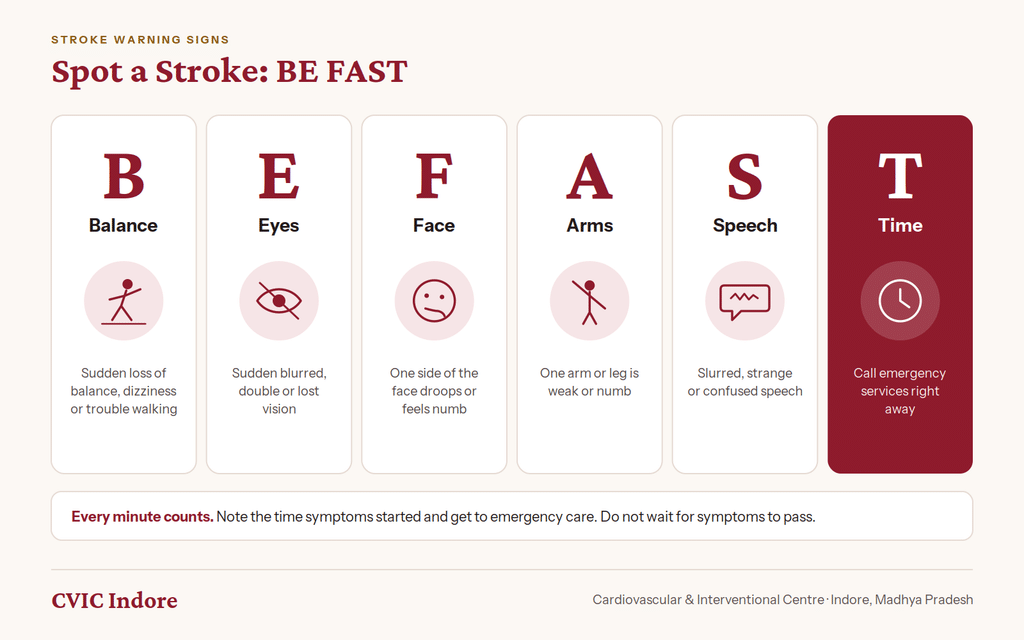
- Signs of stroke: Sudden face drooping, arm or leg weakness, slurred speech, loss of vision, or severe dizziness. Remember BE FAST: Balance, Eyes, Face, Arm, Speech, Time.
- Sudden cold, pale, painful leg: This may mean an artery is suddenly blocked.
- Breathlessness or chest pain with a swollen leg: This may mean a clot has travelled to the lungs.
- Sudden, severe headache described as the worst ever.
In a stroke, every minute counts. Faster treatment saves more brain tissue.
Tests a Vascular Doctor May Recommend
Accurate diagnosis is the foundation of good vascular care. Most tests are quick, painless, and non-invasive:
- Doppler ultrasound: Uses sound waves to show blood flow in arteries and veins. It detects narrowing, blockages, clots, and leaky vein valves.
- Ankle-brachial index (ABI): Compares blood pressure at the ankle and arm to check for leg artery disease. It takes only a few minutes.
- Carotid Doppler: Checks the neck arteries for narrowing that could lead to stroke.
- CT angiography: A CT scan with contrast dye that creates a detailed 3D map of blood vessels.
- MR angiography: Uses magnets and radio waves to show blood vessels, often without radiation.
- Digital subtraction angiography (DSA): A thin tube is placed in a blood vessel and dye is injected while X-ray images are taken. It gives the clearest picture and is often combined with treatment in the same sitting.
- Blood tests: Check sugar, cholesterol, kidney function, and clotting.
Your doctor will recommend only the tests you need, starting with the simplest.
Also Read: Vascular Radiology Clinic in Indore: Advanced, Non-Surgical Care | CVIC Indore
Minimally Invasive Vascular Treatments
Many vascular problems that once needed major surgery can now be treated through a small needle puncture, usually in the groin or wrist, under local anaesthesia (numbing only the area). Benefits often include less pain, smaller scars, shorter hospital stays, and faster recovery.
For Arteries
- Balloon angioplasty: A small balloon opens a narrowed artery.
- Stenting: A tiny mesh tube keeps the artery open after angioplasty.
- Atherectomy: A special catheter removes plaque from inside the artery.
- Carotid stenting: Opens a narrowed neck artery to lower the risk of stroke.
Veins
- Endovenous thermal ablation: Heat from laser or radiofrequency energy seals faulty varicose veins from inside.
- Sclerotherapy: A medicine injected into small veins makes them close and fade.
- Catheter-directed clot treatment: Dissolves or removes large clots in deep veins.
- Venoplasty and venous stenting: Opens narrowed or blocked veins that cause long-term leg swelling.
For the Brain and Head
- Mechanical thrombectomy: In a stroke caused by a large clot, a catheter is guided to the brain to remove it and restore blood flow. This is time-critical.
- Aneurysm coiling and flow diversion: Tiny coils or special stents seal off a brain aneurysm from inside the blood vessel.
- Embolisation: Blocks abnormal or bleeding blood vessels using special materials.
Other Procedures
- Varicocele embolisation: Closes enlarged veins in the scrotum without surgery.
- Embolisation for bleeding: Stops internal bleeding by blocking the bleeding vessel.
Not every patient needs a procedure. Many vascular conditions are first managed with lifestyle changes, medicines, and compression. Your doctor will explain all the options suited to you.
How to Choose the Right Vascular Doctor in Indore
Choosing a vascular specialist is an important decision. Here are the key things to look for:
- Specialised training: Look for doctors with formal training in vascular imaging, interventional radiology, neuro-intervention, or vascular surgery.
- Advanced imaging on site: Doppler ultrasound, CT angiography, and a catheterisation lab (cath lab) for angiography make diagnosis and treatment faster and more accurate.
- Minimally invasive options: A centre that offers image-guided procedures can often treat you without open surgery.
- Emergency readiness: For stroke and acute limb blockage, round-the-clock availability can make a life-changing difference. Ask whether emergency services are available at all hours.
- Team-based care: Complex cases benefit when imaging specialists and interventional doctors discuss your case together.
- Clear communication: Your doctor should explain your condition, options, risks, and costs in simple language and answer your questions patiently.
- Follow-up and prevention: Good vascular care continues after the procedure, with regular check-ups and help controlling risk factors.
- Convenient access: A centre that is easy to reach in Indore matters, especially for follow-up visits.
Do not hesitate to ask questions or seek a second opinion before a major procedure. A good doctor will welcome it.
Your First Visit to a Vascular Doctor
What to Expect
- Conversation: The doctor asks about your symptoms, medical history, medicines, and lifestyle, including smoking.
- Examination: Checking pulses, skin, swelling, veins, and any wounds.
- Quick tests: Often a Doppler ultrasound or ABI on the same day.
- Explanation and plan: Your doctor explains the findings and discusses options, from lifestyle changes and medicines to procedures if needed.
What to Bring
- All previous reports, scans, and CDs
- A list of current medicines, including blood thinners
- Discharge summaries from any past hospital stays
- Blood sugar and cholesterol reports, if available
- A family member, if you would like support
Questions to Ask Your Doctor
- What is causing my symptoms?
- Which blood vessels are affected, and how serious is it?
- Which tests do I need?
- Can this be managed with medicines and lifestyle changes?
- Do I need a procedure? Is a minimally invasive option possible?
- What are the benefits and risks of each option?
- How long is the recovery?
- What is the approximate cost, and is it covered by insurance?
- What warning signs should make me come back immediately?
- How can I prevent this from getting worse?
Meet the Vascular Specialists at CVIC Indore
CVIC Indore is a cardiovascular and interventional centre focused on diagnosing and treating blood vessel conditions with advanced imaging and minimally invasive, image-guided care. Our team brings together expertise in vascular imaging, interventional neurology, and cerebrovascular intervention.
Dr. Alok K Udiya — Neuroradiology and Vascular Imaging
Dr. Alok K Udiya specialises in neuroradiology and vascular imaging. His expertise in reading complex scans of the brain, neck, and blood vessels helps pinpoint the exact location and severity of a problem, which is the first step to the right treatment. He plays a key role in planning precise, image-guided procedures.
Dr. Shailesh Gupta — Interventional Neurology and Stroke Management
Dr. Shailesh Gupta specialises in interventional neurology and stroke management. He treats conditions affecting the blood vessels of the brain and nervous system, including acute stroke, and focuses on preventing future strokes through careful, long-term care.
Dr. Nishant Bhargava — Cerebrovascular Intervention
Dr. Nishant Bhargava specialises in cerebrovascular intervention: minimally invasive, catheter-based procedures on the blood vessels of the brain. These include treatments for stroke, aneurysms, and abnormal blood vessel connections, performed through a small puncture rather than open surgery.
Why Patients Choose CVIC Indore
- Specialist-led care focused on blood vessel conditions
- Advanced vascular imaging including Doppler ultrasound and angiography
- Minimally invasive, image-guided procedures with faster recovery
- Team-based decisions for complex cases
- Clear, honest explanations in simple language
- Patient-centric care for people from Indore and across Madhya Pradesh
Location: [CVIC INDORE ADDRESS]
Appointments: [PHONE NUMBER]
Timings: [OPD TIMINGS]
Frequently Asked Questions
What does a vascular doctor treat?
A vascular doctor treats diseases of the arteries and veins, such as peripheral artery disease, varicose veins, DVT, carotid artery disease, aneurysms, and stroke-related blood vessel problems.
When should I see a vascular doctor in Indore?
See a vascular doctor if you have leg pain while walking, swollen or bulging veins, leg swelling, slow-healing foot wounds, or a history of stroke or blood clots.
Do I need a referral to see a vascular doctor?
You can usually book directly. A referral from your family doctor can help by sharing your history and reports.
What is the difference between a vascular surgeon and an interventional specialist?
A vascular surgeon may treat with open surgery or procedures. An interventional specialist treats from inside the blood vessel using catheters and imaging, usually without a large cut.
Are vascular procedures painful?
Most minimally invasive procedures are done under local anaesthesia through a small puncture. Patients usually feel only mild discomfort and recover quickly.
How long is recovery after angioplasty or stenting?
Many patients go home within a day or two and return to light activity within a few days. Your doctor will give you specific advice.
Which test is best to check blood circulation?
Doppler ultrasound is usually the first test. ABI checks leg arteries, and CT or MR angiography gives a detailed map when needed.
Can vascular disease be prevented?
You can lower your risk by not smoking, staying active, eating healthily, and controlling blood pressure, sugar, and cholesterol.
Does CVIC Indore treat stroke?
Yes. CVIC Indore’s team includes specialists in interventional neurology, stroke management, and cerebrovascular intervention.
How do I book an appointment with a vascular doctor at CVIC Indore?
You can call [PHONE NUMBER] or visit [CVIC INDORE ADDRESS] to book a consultation with our specialist team.
Conclusion
Your blood vessels keep every part of your body alive. When they are narrowed, blocked, or damaged, the effects can range from leg pain to stroke. The good news is that most vascular conditions can be diagnosed early with simple tests and treated effectively, often without open surgery.
If you are looking for a vascular doctor in Indore, choose a team with strong imaging, minimally invasive expertise, and a clear, patient-first approach.
Book a consultation at CVIC Indore with Dr. Alok K Udiya, Dr. Shailesh Gupta, and Dr. Nishant Bhargava for expert, specialist-led vascular care.
Medical disclaimer: This article is for general information only and is not a substitute for professional medical advice, diagnosis, or treatment. In an emergency, call emergency services immediately. Please consult a qualified doctor about your own condition.