
title: “Varicose Veins vs DVT (Deep Vein Thrombosis):
Varicose Veins vs DVT (Deep Vein Thrombosis): How to Tell the Difference
Quick answer: Both varicose veins and DVT (deep vein thrombosis) can cause a swollen, aching, or discolored leg — but they are not the same kind of problem, and mistaking one for the other matters. Varicose veins are a chronic, usually gradual condition caused by faulty valves in superficial veins, and while uncomfortable, they are rarely dangerous. DVT is a blood clot inside a deep vein, often develops suddenly in one leg, and can be a medical emergency because part of the clot can break off and travel to the lungs (pulmonary embolism). The clearest way to tell them apart — sudden one-sided swelling, pain, and warmth points toward DVT and needs same-day evaluation, while gradual bulging veins that ache after standing point toward varicose veins — is explained in detail below, along with how CVIC Indore (Center Of Vascular And Interventional Care) diagnoses and treats both conditions using the same venous duplex ultrasound technology.
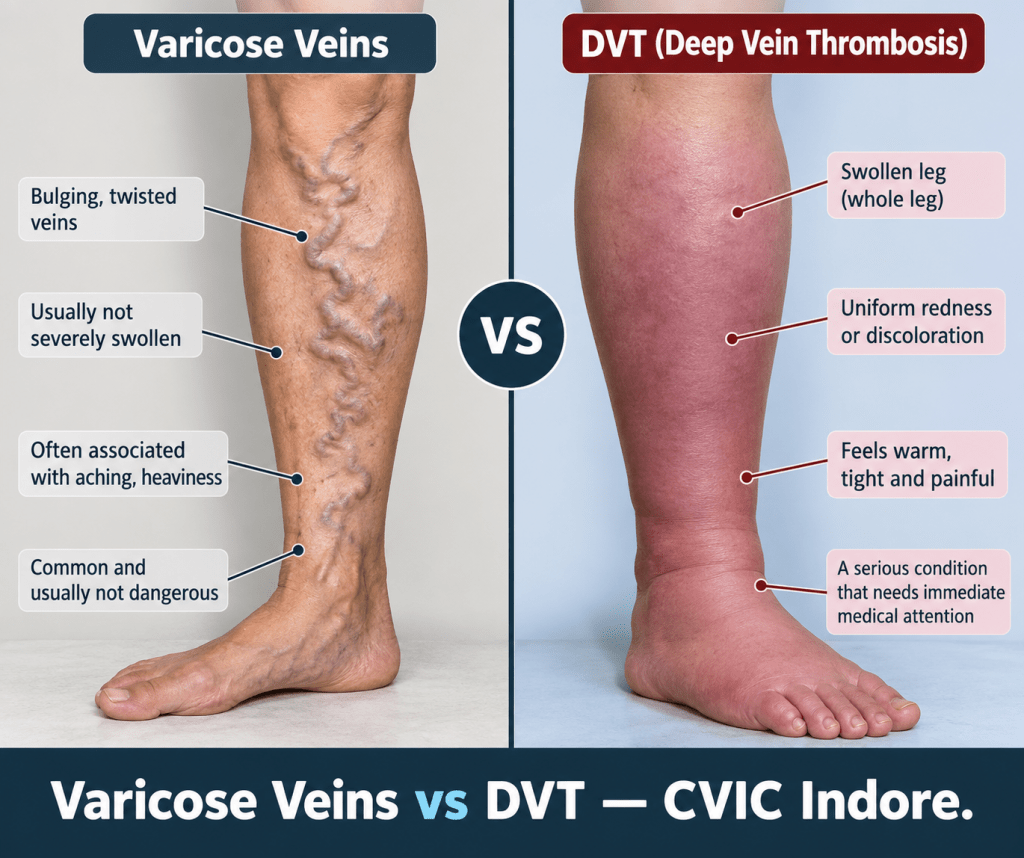
A swollen, heavy, or painful leg sends most people straight to the internet, and the search results are not always reassuring. Two conditions come up again and again — varicose veins and DVT (deep vein thrombosis) — and because both involve the leg veins and both can cause swelling and discomfort, it’s genuinely easy to confuse them. That confusion isn’t just academic. One of these conditions is a long-term, manageable issue. The other can, in a worst-case scenario, be life-threatening within hours if missed. This guide walks through exactly how the two differ — in cause, in symptoms, in urgency, and in how a doctor actually confirms which one you have — so that a swollen leg gets the right kind of attention, at the right speed.
Also Read: Chronic Knee Pain Treatment Without Surgery in Indore: Genicular Artery Embolization Explained
Two Different Problems in the Same Leg Veins
To understand why these two conditions look similar on the surface but behave so differently underneath, it helps to know what each one actually is.
Varicose veins are a problem with the superficial venous system — the veins just under the skin. Tiny one-way valves inside healthy veins normally keep blood moving upward, against gravity, back toward the heart. When these valves weaken or fail, blood pools backward and downward instead, stretching the vein over time until it becomes enlarged, twisted, and visible under the skin. This condition is formally called chronic venous insufficiency (CVI), and varicose veins are its most visible sign. It develops gradually, often over years, and while it can become painful and occasionally leads to skin complications if neglected, it is not, by itself, an emergency.
Also Read: Headache vs Aneurysm Headache: How to Tell the Difference That Could Save Your Life
DVT (deep vein thrombosis) is a fundamentally different event: a blood clot forms inside a deep vein, most often in the calf or thigh. Deep veins carry the majority of blood returning from the leg, and a clot there partially or completely blocks that flow. Unlike varicose veins, DVT frequently develops over hours to days rather than years, and it carries a risk that varicose veins simply do not: a piece of the clot can dislodge, travel through the bloodstream, and lodge in the lungs — a pulmonary embolism, which can be fatal without prompt treatment.
Put simply: varicose veins are a plumbing problem — valves that no longer close properly. DVT is a clotting problem — blood that has solidified where it shouldn’t. Both can make a leg look and feel different than normal, which is exactly where the confusion starts.
Why These Two Conditions Get Mixed Up
Several overlapping features explain the confusion:
- Both can cause leg swelling.
- Both can cause aching, heaviness, or pain.
- Both can cause skin discoloration over time.
- Both become more common with age, obesity, pregnancy, and prolonged immobility.
- Both are, at their core, conditions of the venous system.
But the underlying mechanism, the typical speed of onset, and — most importantly — the urgency of each condition are entirely different, and those differences show up in fairly specific, learnable patterns once you know what to look for.
Also Read: Can an Aneurysm Heal Without Surgery? | Expert Guide by CVIC Indore
Symptom-by-Symptom Comparison
| Feature | Varicose Veins | DVT (Deep Vein Thrombosis) |
|---|---|---|
| Onset | Gradual, over months to years | Often sudden, over hours to days |
| Which leg | Can be one or both legs | Almost always one leg |
| Visible veins | Bulging, twisted, rope-like veins clearly visible under skin | Usually no visible surface veins; the deep clot is not visible at all |
| Swelling pattern | Mild to moderate, worse by end of day, improves overnight/with elevation | Often marked, persistent swelling that does not improve with rest |
| Pain character | Dull ache, heaviness, throbbing after standing | Deep, cramp-like pain, tenderness when the calf is squeezed |
| Skin temperature | Usually normal | Often warm to the touch over the affected area |
| Skin color | Bluish-purple visible veins; brownish discoloration only in advanced, long-standing cases | Redness or a dusky discoloration of the whole limb |
| What makes it worse | Prolonged standing or sitting | Not particularly position-dependent; pain may worsen with walking or flexing the foot |
| What makes it better | Leg elevation, walking, compression stockings | Elevation may help swelling somewhat, but does not resolve the underlying clot |
| Associated danger signs | None typically | Chest pain, breathlessness, rapid heartbeat if the clot embolizes |
The Red Flags That Mean “Seek Care Now, Not Later”
This is the single most important distinction in this entire comparison, so it deserves to be stated plainly and separately from everything else.
Seek same-day medical evaluation if you notice, in one leg:
- Sudden swelling that wasn’t there yesterday
- Pain or tenderness, especially in the calf, that doesn’t match an injury
- Warmth or redness over a specific area of the leg
- A feeling of tightness or fullness that is new and progressing
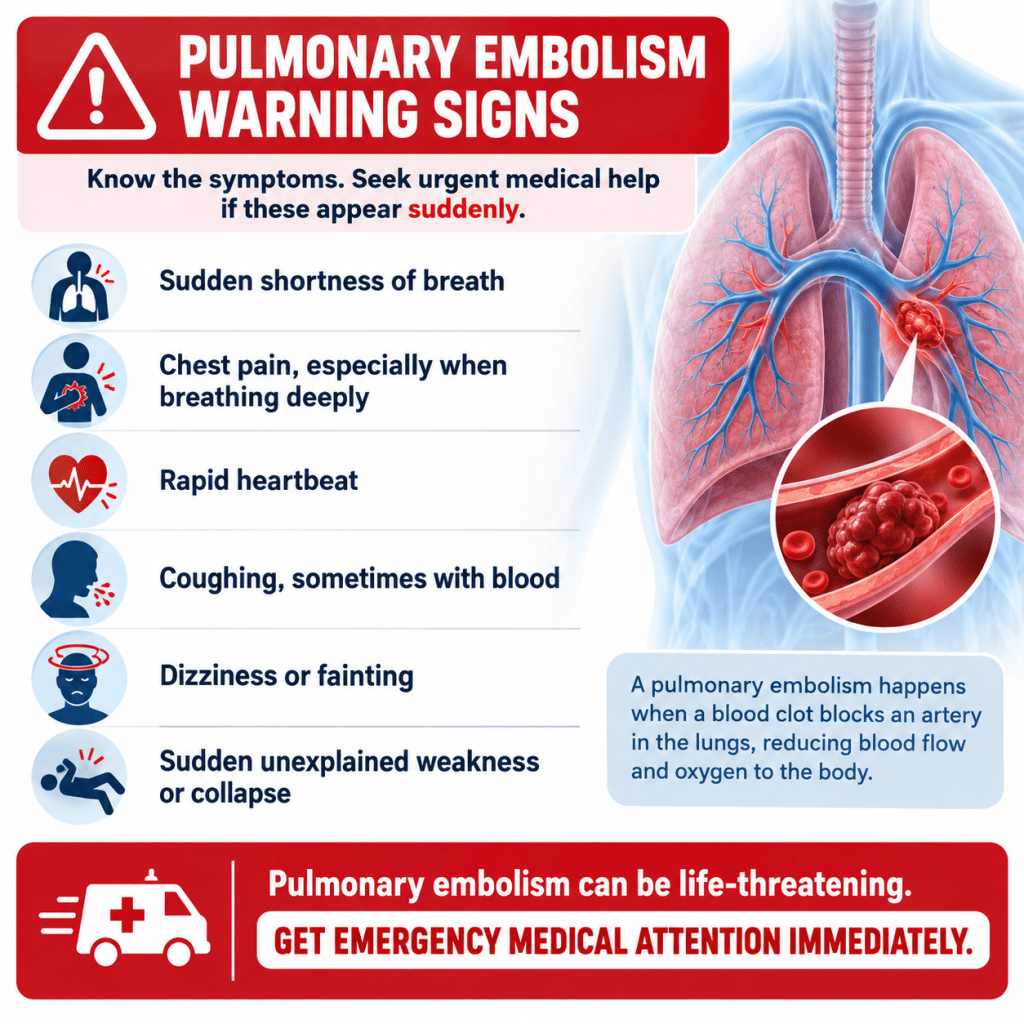
Seek emergency care immediately (this may indicate a pulmonary embolism) if you experience:
- Sudden shortness of breath or difficulty breathing
- Sharp chest pain that worsens with a deep breath or coughing
- A rapid or irregular heartbeat
- Coughing up blood
- Lightheadedness, dizziness, or fainting
None of these are typical features of ordinary varicose veins. If any of them are present, the priority is urgent evaluation first — working out exactly which condition it is comes second. This is not a symptom pattern to self-diagnose from a blog post, including this one; it’s a pattern to act on.
Risk Factors: Overlapping, But Not Identical
| Risk Factor | Varicose Veins | DVT |
|---|---|---|
| Prolonged standing or sitting | Strong risk factor | Risk factor (especially long-haul travel, bed rest) |
| Pregnancy | Strong risk factor | Increased risk, particularly postpartum |
| Obesity | Strong risk factor | Risk factor |
| Family history / genetics | Strong risk factor | Strong risk factor (inherited clotting disorders) |
| Increasing age | Risk factor | Risk factor, rises sharply after 60 |
| Recent surgery or hospitalization | Not directly relevant | Major risk factor |
| Cancer or active malignancy | Not directly relevant | Significant risk factor |
| Hormonal contraceptives / hormone therapy | Minor association | Significant risk factor |
| Smoking | Minor association | Risk factor |
| Long-haul flights or immobilization | Worsens symptoms | Well-established trigger |
| Personal history of prior clot | Not applicable | Strong risk factor for recurrence |
Notice that a few factors — prolonged immobility, obesity, pregnancy — genuinely raise the risk of both conditions at once, which is part of why they can occasionally occur together in the same patient, discussed further below.
The Confusing Middle Ground: Superficial Thrombophlebitis
There is a third condition worth knowing about specifically because it sits right between the two and causes a lot of the confusion: superficial thrombophlebitis, sometimes called superficial vein thrombosis. This is a blood clot that forms inside a varicose (superficial) vein itself, rather than in the deep system.
It typically presents as a firm, tender, warm, reddish cord along the path of an already-visible varicose vein — understandably alarming, since “clot” and “vein” appear in the same sentence, which sounds a lot like DVT. The important distinction is location: superficial thrombophlebitis is generally less dangerous than DVT because it isn’t in the deep venous system that leads more directly toward the lungs. That said, it isn’t entirely without risk — the clot can occasionally extend into the deep system, particularly if it forms close to where a superficial vein joins a deep one, which is exactly why a lump or tender cord along a varicose vein should still be evaluated rather than assumed to be “just” a varicose vein flare-up. In practice, this is one of the more common real-world reasons a duplex ultrasound is ordered: not because DVT is obvious, but because it needs to be confidently ruled out.
How Doctors Actually Tell Them Apart
Guessing from symptoms alone is not considered reliable enough for a condition with DVT’s potential consequences — which is exactly why a structured diagnostic process exists rather than relying on how a leg looks or feels.
Step 1: Clinical Assessment and a Probability Score
A doctor takes a history (onset, risk factors, recent surgery or travel, prior clots) and examines the leg for swelling, tenderness, warmth, and visible veins. Many clinicians formalize this into a Wells score, a point-based system that estimates the probability of DVT before any test is run:
| Clinical Feature | Points |
|---|---|
| Active cancer (treatment within 6 months) | +1 |
| Paralysis, paresis, or recent leg immobilization | +1 |
| Recently bedridden 3+ days or major surgery within 12 weeks | +1 |
| Localized tenderness along the deep venous system | +1 |
| Entire leg swollen | +1 |
| Calf swelling 3 cm greater than the other leg | +1 |
| Pitting edema confined to the symptomatic leg | +1 |
| Collateral (non-varicose) superficial veins present | +1 |
| Previously documented DVT | +1 |
| Alternative diagnosis at least as likely as DVT | −2 |
A score of 2 or higher is generally treated as “DVT likely,” prompting imaging; a lower score is “DVT unlikely,” often prompting a blood test first rather than jumping straight to imaging.
Step 2: D-dimer Blood Test (Selectively Used)
D-dimer measures a breakdown product of blood clots. It is most useful as a rule-out tool: a normal D-dimer in a patient with a low Wells score makes DVT quite unlikely, often avoiding the need for further imaging. However, D-dimer is not specific — it can be elevated for many reasons unrelated to DVT (recent surgery, pregnancy, infection, older age), so a high result does not confirm DVT on its own. It answers “can we safely rule this out?” far better than it answers “is this DVT?”
Step 3: Venous Duplex Ultrasound — The Test Both Conditions Share
Here is the detail that surprises most patients: the same core imaging tool — venous duplex ultrasound — is used to evaluate both varicose veins and suspected DVT, but the radiologist is looking for entirely different things depending on which question is being asked.
- For varicose veins: The ultrasound assesses valve function — specifically, how long blood flows backward (reflux) when gentle pressure is applied and released. Prolonged reflux confirms valve failure and helps map exactly which veins are affected, which matters for planning treatment.
- For suspected DVT: The ultrasound checks vein compressibility. A healthy, clot-free vein collapses completely under gentle probe pressure. A vein that fails to compress is the classic, highly reliable sign of a clot inside it. The scan also assesses blood flow patterns and, sometimes, direct visualization of clot material within the vein.
Because CVIC Indore’s interventional radiology team performs both types of duplex assessment routinely, a patient who is genuinely uncertain which condition they’re dealing with can have that question answered definitively during a single visit, on the same equipment, without being sent elsewhere for a second test.
Treatment Approaches Are Entirely Different
| Aspect | Varicose Veins | DVT |
|---|---|---|
| Urgency | Elective; can be scheduled | Time-sensitive; treatment typically starts the same day as diagnosis |
| First-line approach | Compression stockings, leg elevation, activity modification | Anticoagulation (“blood thinners”) started promptly |
| Minimally invasive procedures | Endovenous laser ablation (EVLA/EVLT), radiofrequency ablation, foam sclerotherapy, vein glue | Catheter-directed thrombolysis or mechanical thrombectomy for selected severe/extensive cases |
| Medication | Not typically required | Oral or injectable anticoagulants, often for 3+ months |
| Devices | Not applicable | IVC filter, reserved for patients who cannot safely take anticoagulants |
| Surgery | Vein stripping — now uncommon, reserved for select cases | Surgical thrombectomy — rare, reserved for limb-threatening clots |
| Goal of treatment | Relieve symptoms, improve appearance, prevent skin complications | Prevent clot growth, prevent pulmonary embolism, reduce long-term leg damage |
| Follow-up | Periodic review, mostly for symptom control | Structured monitoring of anticoagulation, duration decided by cause and recurrence risk |
The single biggest practical difference: varicose vein treatment is something a patient chooses to pursue, on their own schedule, once they’ve decided the symptoms or appearance bother them enough. DVT treatment is not optional and not something to schedule for “whenever is convenient” — delay directly increases the risk of pulmonary embolism.
What Happens If Each Condition Is Left Untreated
Untreated varicose veins, over years, can progress to chronic skin changes: persistent swelling, brownish skin discoloration (hemosiderin staining), hardened skin (lipodermatosclerosis), venous eczema, and in advanced cases, venous leg ulcers that are notoriously slow to heal. Occasionally, a varicose vein can bleed if injured, or develop superficial thrombophlebitis as described above. These are real, quality-of-life-affecting consequences — but they develop over a long timeline and are not sudden emergencies.
Untreated DVT carries a materially different risk profile. Without treatment, a substantial proportion of proximal (thigh-level) DVT cases lead to symptomatic pulmonary embolism, which can be sudden and, in a meaningful fraction of cases, fatal. Even when PE doesn’t occur, roughly a third to half of patients with an inadequately managed proximal DVT go on to develop post-thrombotic syndrome — chronic pain, swelling, skin changes, and sometimes ulceration in the affected leg, essentially a lasting injury to the vein from the clot having been there. DVT can also recur; a meaningful proportion of patients experience a second clot within a decade of the first, which is part of why some patients remain on longer-term anticoagulation.
Can You Have Both Varicose Veins and DVT? Yes — Here’s the Relationship
These conditions are not mutually exclusive, and understanding how they connect actually clears up more confusion than treating them as entirely separate topics.
Chronic venous insufficiency (varicose veins) modestly raises DVT risk. Sluggish, pooled blood flow in an already-compromised venous system is one of the classic ingredients (venous stasis) in clot formation, so longstanding, untreated varicose veins are a mild but real risk factor for DVT — one more reason not to ignore them indefinitely.
DVT can cause varicose-vein-like changes afterward. When a deep vein has been damaged by a clot, the body sometimes reroutes blood flow through superficial veins to compensate, and the valve damage left behind by the clot (part of post-thrombotic syndrome) can produce secondary varicose veins and chronic swelling that looks, superficially, just like “ordinary” varicose veins — except the underlying cause and long-term management are different.
This is exactly why an accurate diagnosis at the outset matters beyond just the immediate question of “is this dangerous right now”: it also shapes how a patient’s veins are managed for years afterward.
Why Choose CVIC Indore for Varicose Veins vs DVT Evaluation
CVIC Indore (Center Of Vascular And Interventional Care) is positioned specifically to answer the “which one is this?” question, not just to treat one condition in isolation:
- One team, one ultrasound suite, both diagnostic questions answered — venous duplex ultrasound for reflux (varicose veins) and compressibility (DVT) performed by the same interventional radiology team, avoiding delays from being referred between departments.
- Same-day urgency recognition for suspected DVT, with prompt anticoagulation initiation and, when clinically indicated, catheter-directed thrombolysis or mechanical thrombectomy for extensive clots.
- A full range of non-surgical varicose vein treatments — including endovenous laser ablation and foam sclerotherapy — for patients whose diagnosis turns out to be chronic venous insufficiency rather than an urgent clot.
- Honest triage — patients are told plainly when something needs emergency-level urgency versus when it can be scheduled electively, rather than treating every visit the same way.
For patients who want deeper detail on either condition individually once the differentiation question is settled, CVIC Indore’s dedicated articles on varicose vein causes, symptoms, and treatment options and what DVT is and how it’s treated go into each condition on its own. This article exists specifically to answer the question that comes before either of those: which one am I actually dealing with?
Myths vs. Facts
Myth: If it’s not painful, it’s not DVT. Fact: A meaningful proportion of DVT cases cause little to no pain, particularly smaller or partial clots. Absence of pain does not rule out DVT, especially when swelling or one-sided warmth is present.
Myth: Pressing on the calf to check for pain (“Homans’ sign”) is a reliable way to test for DVT at home. Fact: This classic bedside test is now known to be unreliable, with poor accuracy in either direction, and current guidelines do not recommend relying on it. It has been replaced by structured scoring (Wells score) plus objective testing.
Myth: Varicose veins always eventually turn into DVT. Fact: Varicose veins modestly raise DVT risk over the long term but do not directly transform into DVT. The two are related but distinct processes.
Myth: A swollen leg after a long flight is always just “poor circulation” and will resolve on its own. Fact: Long-haul travel is a recognized DVT trigger. New one-sided leg swelling after prolonged immobility deserves evaluation rather than being assumed to be ordinary travel swelling, especially if it doesn’t improve within a day.
Myth: You can tell varicose veins from DVT just by whether the veins are visible. Fact: DVT occurs in deep veins that are never visible at the skin surface, regardless of whether the person also happens to have separate, visible varicose veins. Visible bulging veins and a hidden deep clot can coexist in the same leg.
Frequently Asked Questions
1. I have varicose veins — does that mean I’m at high risk of DVT? Chronic venous insufficiency modestly increases DVT risk over time, but it is only one of several risk factors, and most people with varicose veins never develop DVT. Longstanding, severe varicose veins are still worth having evaluated and, if appropriate, treated.
2. How fast can DVT symptoms appear? Often within hours to a few days, which is part of what distinguishes it from varicose veins, which typically develop and worsen gradually over months or years.
3. Can I just get an ultrasound to check, without waiting for a doctor’s appointment? A venous duplex ultrasound is the key test for both conditions, but interpreting new leg symptoms — especially possible DVT — should start with a clinical assessment so the urgency is correctly triaged; at CVIC Indore, this evaluation and imaging can typically happen during the same visit.
4. Is DVT more common in one leg or can it affect both? DVT overwhelmingly affects one leg at a time. Sudden swelling or pain in both legs simultaneously points toward a different cause, though it still warrants evaluation.
5. If my D-dimer test is normal, does that mean I definitely don’t have DVT? In a patient with a low pre-test probability (low Wells score), a normal D-dimer makes DVT very unlikely and often avoids the need for further imaging. It is a rule-out tool, most reliable in lower-risk patients.
6. Are compression stockings used for both conditions? Compression is a mainstay for managing varicose vein symptoms and is sometimes used to help swelling after a DVT diagnosis, but it does not treat or dissolve an active clot — anticoagulation does that. The two uses shouldn’t be confused with each other.
7. What should I do right now if I suspect DVT? Seek same-day medical evaluation for new one-sided leg swelling, pain, or warmth, and seek emergency care immediately if you also have chest pain, breathlessness, or a rapid heartbeat. This is not a symptom pattern to wait out at home.
Final Thoughts
Varicose veins vs DVT (deep vein thrombosis) is not just a vocabulary distinction — it’s the difference between a chronic condition that can be managed on your own schedule and one that occasionally needs attention within hours. The reliable way to tell them apart isn’t guesswork from how the leg looks, but a structured process: recognizing the red-flag pattern of sudden, one-sided swelling and warmth, using a probability score and D-dimer testing where appropriate, and confirming the answer with venous duplex ultrasound — the same core tool used for both conditions, aimed at two different questions.
If you’re dealing with a swollen, aching, or changed-looking leg and aren’t sure which of these you’re facing, that uncertainty itself is a reason to get it properly evaluated rather than guess. CVIC Indore can assess, image, and — depending on what’s actually found — either start urgent DVT treatment the same day or set up a plan for lasting varicose vein relief.
Visit CVIC Indore
CVIC — Center Of Vascular And Interventional Care 403, Panama Tower, Gita Bhawan Road, near Crown Palace, South Tukoganj, Indore, Madhya Pradesh 452008
Phone: 0731 4675670 / +91-8103727728
Team: Dr. Alok K. Udiya (MD Radiology, Fellowship in Neuro Intervention Radiology, Switzerland), Dr. Shailesh Gupta (MD Radiology, PDCC in Interventional Radiology), Dr. Nishant Bhargava (MD Radiology, Fellowship in Neuro Intervention Radiology, Switzerland)
Disclaimer
This article is intended for general educational purposes only and does not constitute medical advice. Leg swelling, pain, or discoloration can have several causes and should be evaluated in person by a qualified physician or radiologist. If you experience sudden breathlessness, chest pain, or a rapid heartbeat alongside leg symptoms, seek emergency medical care immediately rather than waiting for a scheduled appointment.
{
“@context”: “https://schema.org”,
“@graph”: [
{
“@type”: “MedicalWebPage”,
“@id”: “https://cvicvascular.com/varicose-veins-vs-dvt-deep-vein-thrombosis-how-to-tell-the-difference/#webpage”,
“url”: “https://cvicvascular.com/varicose-veins-vs-dvt-deep-vein-thrombosis-how-to-tell-the-difference/”,
“name”: “Varicose Veins vs DVT (Deep Vein Thrombosis): How to Tell the Difference”,
“description”: “Swollen or painful leg — is it varicose veins or DVT (deep vein thrombosis)? Learn the real differences in symptoms, risk, and urgency, and how CVIC Indore diagnoses both correctly.”,
“about”: [
{
“@type”: “MedicalCondition”,
“name”: “Varicose Veins”
},
{
“@type”: “MedicalCondition”,
“name”: “Deep Vein Thrombosis (DVT)”
}
],
“mentions”: [
{
“@type”: “MedicalProcedure”,
“name”: “Venous Duplex Ultrasound”
},
{
“@type”: “MedicalProcedure”,
“name”: “Catheter-Directed Thrombolysis”
},
{
“@type”: “MedicalProcedure”,
“name”: “Endovenous Laser Ablation”
}
],
“author”: {
“@type”: “MedicalOrganization”,
“name”: “CVIC Indore – Center Of Vascular And Interventional Care”,
“url”: “https://cvicvascular.com”,
“address”: {
“@type”: “PostalAddress”,
“streetAddress”: “403, Panama Tower, Gita Bhawan Road, near Crown Palace, South Tukoganj”,
“addressLocality”: “Indore”,
“addressRegion”: “Madhya Pradesh”,
“postalCode”: “452008”,
“addressCountry”: “IN”
},
“telephone”: [“+91-731-4675670”, “+91-8103727728”]
},
“publisher”: {
“@type”: “MedicalOrganization”,
“name”: “CVIC Indore – Center Of Vascular And Interventional Care”,
“url”: “https://cvicvascular.com”
}
},
{
“@type”: “FAQPage”,
“mainEntity”: [
{
“@type”: “Question”,
“name”: “I have varicose veins — does that mean I’m at high risk of DVT?”,
“acceptedAnswer”: {
“@type”: “Answer”,
“text”: “Chronic venous insufficiency modestly increases DVT risk over time, but it is only one of several risk factors, and most people with varicose veins never develop DVT. Longstanding, severe varicose veins are still worth having evaluated and, if appropriate, treated.”
}
},
{
“@type”: “Question”,
“name”: “How fast can DVT symptoms appear?”,
“acceptedAnswer”: {
“@type”: “Answer”,
“text”: “Often within hours to a few days, which is part of what distinguishes it from varicose veins, which typically develop and worsen gradually over months or years.”
}
},
{
“@type”: “Question”,
“name”: “Is DVT more common in one leg or can it affect both?”,
“acceptedAnswer”: {
“@type”: “Answer”,
“text”: “DVT overwhelmingly affects one leg at a time. Sudden swelling or pain in both legs simultaneously points toward a different cause, though it still warrants evaluation.”
}
},
{
“@type”: “Question”,
“name”: “If my D-dimer test is normal, does that mean I definitely don’t have DVT?”,
“acceptedAnswer”: {
“@type”: “Answer”,
“text”: “In a patient with a low pre-test probability (low Wells score), a normal D-dimer makes DVT very unlikely and often avoids the need for further imaging. It is a rule-out tool, most reliable in lower-risk patients.”
}
},
{
“@type”: “Question”,
“name”: “Are compression stockings used for both conditions?”,
“acceptedAnswer”: {
“@type”: “Answer”,
“text”: “Compression is a mainstay for managing varicose vein symptoms and is sometimes used to help swelling after a DVT diagnosis, but it does not treat or dissolve an active clot — anticoagulation does that.”
}
},
{
“@type”: “Question”,
“name”: “What should I do right now if I suspect DVT?”,
“acceptedAnswer”: {
“@type”: “Answer”,
“text”: “Seek same-day medical evaluation for new one-sided leg swelling, pain, or warmth, and seek emergency care immediately if you also have chest pain, breathlessness, or a rapid heartbeat.”
}
},
{
“@type”: “Question”,
“name”: “Can I just get an ultrasound to check, without waiting for a doctor’s appointment?”,
“acceptedAnswer”: {
“@type”: “Answer”,
“text”: “A venous duplex ultrasound is the key test for both conditions, but new leg symptoms, especially possible DVT, should start with a clinical assessment so the urgency is correctly triaged; at CVIC Indore this evaluation and imaging can typically happen during the same visit.”
}
}
]
}
]
}

