

Quick answer: Yes — Chronic Knee Pain Treatment without surgery is available in Indore through Genicular Artery Embolization (GAE), offered at CVIC Indore (Center Of Vascular And Interventional Care). GAE is a same-day, catheter-based procedure that blocks the abnormal blood vessels feeding inflamed knee tissue, reducing osteoarthritis pain scores by roughly 50–56% within a year in pooled clinical data. It is not a replacement for knee surgery in every case, and this guide goes deeper than a typical overview — covering the actual science of why knees hurt, how doctors decide who qualifies, and the real published numbers behind the procedure.
Chronic knee pain from osteoarthritis is one of the most common reasons Indori adults over 45 quietly start avoiding stairs, skipping their morning walk, or postponing that trip that involves a lot of standing. For decades, the medical conversation around knee osteoarthritis has offered two endpoints: manage it indefinitely with medication and injections, or eventually undergo total knee replacement surgery. Genicular Artery Embolization, now available at CVIC Indore, has opened a genuine middle path — one grounded in a specific, well-studied biological mechanism rather than general symptom management.
This article is written to go beyond the basics. Rather than simply describing what the procedure looks like, it explains the actual science of why an arthritic knee hurts, how interventional radiologists grade and select candidates, what the published outcome data actually shows — with real percentages, not vague reassurances — and where the evidence still has limits. If you have already read a general overview of knee pain embolization and want the clinical detail behind it, this is that resource.
Also Read: Knee Pain Embolization in Indore – A Modern, Non-Surgical Solution for Chronic Knee Pain
Understanding Chronic Knee Pain and Osteoarthritis
Knee osteoarthritis (OA) is a degenerative joint condition in which the cartilage cushioning the knee gradually wears down, bone surfaces change shape, and the joint lining (synovium) becomes chronically inflamed. It is extraordinarily common with age. According to a StatPearls clinical review, roughly 13% of women and 10% of men aged 60 and older have symptomatic knee osteoarthritis, and that figure climbs to approximately 40% of people by age 70. Interestingly, the same review notes that only about 15% of people with radiographic evidence of knee OA (visible changes on an X-ray) actually experience significant symptoms — meaning the pain itself, not just the imaging findings, has to guide treatment decisions.
Typical symptoms of chronic knee osteoarthritis include:
- Aching or throbbing pain that worsens with activity and improves with rest, at least in earlier stages
- Morning stiffness that eases within about 30 minutes of moving around
- Swelling around the joint, especially after extended activity
- A grinding, crackling, or catching sensation (crepitus) during movement
- Reduced range of motion, difficulty fully bending or straightening the knee
- Pain that eventually persists even at rest or disturbs sleep, in more advanced cases
- Visible joint enlargement or a sense of instability when standing or climbing stairs
Chronic knee pain treatment decisions in Indore, as anywhere, should start with an accurate diagnosis — X-rays to grade the arthritis, a clinical exam, and often an MRI when the picture is unclear — rather than treating every knee pain complaint identically.
Also Read: Best Gynecology Interventions for Fibroids, PCOS & Heavy Bleeding
Why Chronic Knee Pain Happens: The Neovascularity Science
This is the part most patient-facing articles skip, and it is the key to understanding why embolization — a technique borrowed from vascular medicine — works on a joint problem at all.
In a healthy knee, the synovium (the thin membrane lining the joint) has a modest, stable blood supply. In an osteoarthritic knee, however, chronic inflammation triggers a process called synovial neovascularization — the abnormal growth of new, fragile blood vessels within the inflamed synovial tissue and the tissue immediately surrounding the joint. Inflammatory cytokines released in the arthritic joint stimulate this aberrant vascular proliferation, and these new vessels bring with them a dense network of accompanying sensory nerve fibers.
This matters because it creates what researchers describe as a self-perpetuating loop: inflammation drives new vessel growth, the new vessels carry pain-signaling nerve fibers directly into the inflamed tissue, and the resulting nerve irritation and ongoing inflammatory mediator release generate the pain signal the patient actually feels — often disproportionate to how “worn out” the joint looks on an X-ray. Studies have found a correlation between the severity of this pre-procedure synovial hypervascularity and how much pain relief a patient experiences after treatment, which is part of why imaging assessment matters so much in patient selection.
Genicular Artery Embolization intervenes directly in this loop. Using microcatheters, an interventional radiologist selectively blocks the small, hypertrophied genicular artery branches feeding this abnormal, hypervascular synovial tissue — not the knee’s entire blood supply, but specifically the abnormal component of it. This is often described as “vascular pruning” rather than blunt occlusion: normal arterial supply to the knee is preserved, while the pathological neovascularity that is driving inflammation and pain signaling is selectively reduced.
Also Read: Best Interventional Radiology Hospital Indore | CVIC Indore
What Is Genicular Artery Embolization (GAE)?
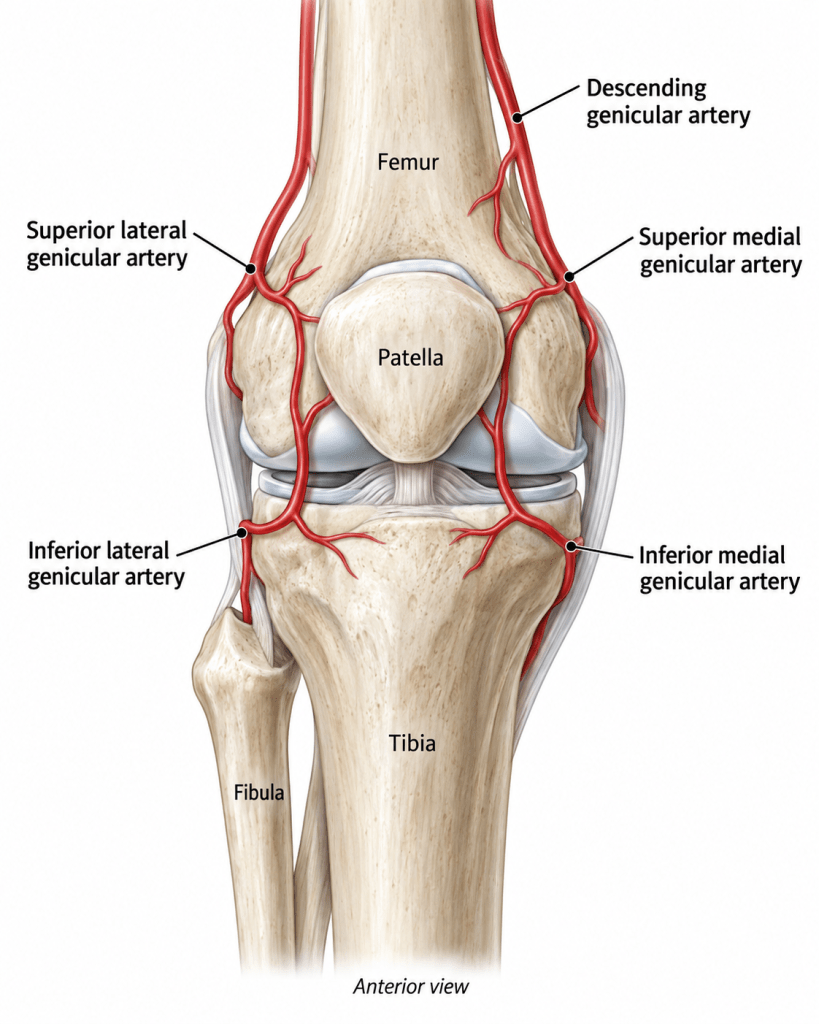
The knee receives blood through a network of small arteries branching around the joint — collectively called the genicular arteries, including the superior lateral, superior medial, inferior lateral, inferior medial, and descending genicular arteries. In an arthritic knee, several of these branches feeding the inflamed synovium become abnormally enlarged and hypervascular.
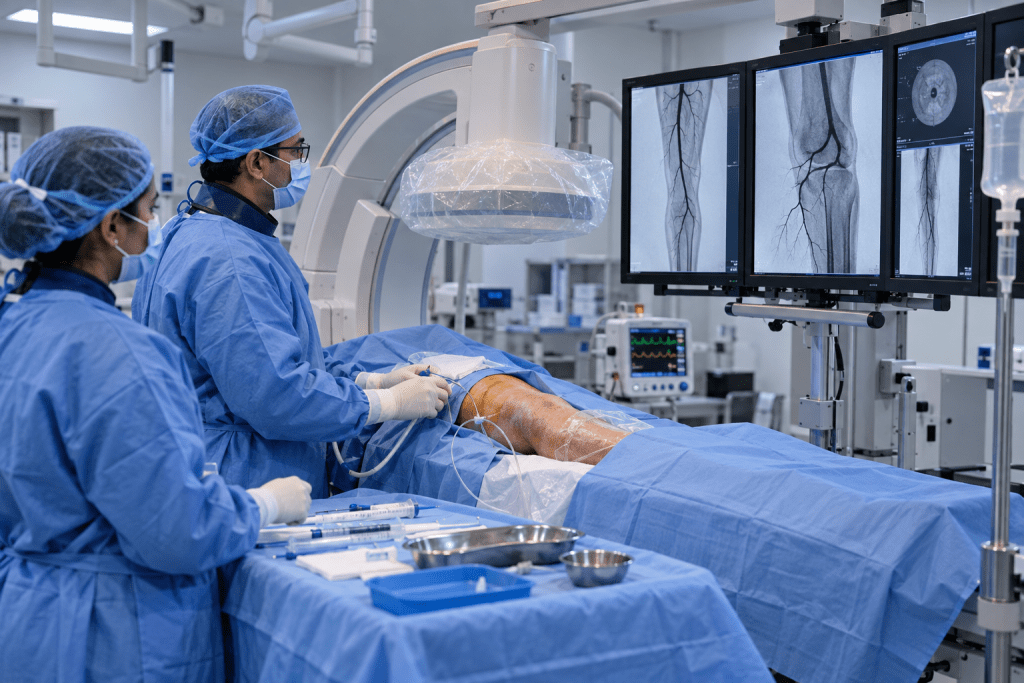
During GAE, the interventional radiologist gains access to the arterial system — typically through the common or superficial femoral artery in the same leg — using a small 4–5 French sheath, under local anesthesia with light sedation. Using X-ray guidance and digital subtraction angiography (DSA), a base catheter is used to select the origin of each genicular artery, and a much finer microcatheter (roughly 1.7–2 French) and microwire are then advanced selectively into the target branches. Selective angiography at this point confirms the characteristic hypervascular “blush” pattern that marks abnormal synovial tissue.
Once confirmed, calibrated embolic material is injected to block these specific abnormal branches. Depending on the clinical situation and physician judgment, this may use temporary, resorbable agents (such as gelatin sponge particles or imipenem/cilastatin suspension) or permanent embolic microspheres, since there remains no single universal consensus on the ideal agent — the choice is guided by a risk-benefit assessment for each patient. The endpoint of the procedure is resolution of the abnormal hypervascular blush while preserving normal vessel patency elsewhere in the knee, not complete arterial occlusion.
The entire procedure typically takes about 45–90 minutes, and most patients go home the same day.
Grading Your Osteoarthritis: Why the Kellgren-Lawrence Scale Matters
Not all “knee osteoarthritis” is the same, and candidacy for GAE depends heavily on how advanced the joint damage is. Radiologists grade knee OA severity on X-rays using the Kellgren-Lawrence (KL) classification, a five-point scale:
| KL Grade | Description | Typical GAE Suitability |
|---|---|---|
| Grade 0 | No radiographic features of osteoarthritis | Not applicable — no OA present |
| Grade 1 | Doubtful joint space narrowing, possible small osteophytes | Usually treated conservatively first |
| Grade 2 | Definite osteophytes, possible mild joint space narrowing | Good candidate range |
| Grade 3 | Moderate osteophytes, definite joint space narrowing, mild sclerosis | Good candidate range |
| Grade 4 | Large osteophytes, marked joint space narrowing, severe sclerosis, bone deformity | Variable — often better addressed with knee replacement, though some studies report meaningful relief even here |
Clinical trials such as the GENESIS trial have specifically demonstrated benefit in KL grade II and III knees, while some later studies — including a 2-year IDE trial — found that even a substantial proportion of patients with more advanced KL grade II–IV structural degeneration achieved clinically meaningful pain relief. In general, though, patients with mild-to-moderate radiographic disease (KL II–III) who still have significant pain represent the sweet spot for GAE, since the joint is inflamed and hypervascular enough to respond to embolization, but not yet so structurally destroyed that mechanical bone-on-bone symptoms dominate the picture.
Who Is a Good Candidate for Genicular Artery Embolization?
Based on the published patient selection criteria used across GAE clinical studies, ideal candidates generally include:
- Adults roughly 40–80 years old with chronic knee pain attributable to osteoarthritis.
- Persistent pain of at least moderate-to-severe intensity (commonly defined as ≥40mm on a 100mm Visual Analogue Scale) that has not adequately resolved after 3–6 months of optimized conservative management — medications, physiotherapy, weight and activity modification.
- Radiographically confirmed osteoarthritis, generally KL grade II–III, ideally with imaging evidence (ultrasound or MRI) of synovial hypervascularity.
- Patients who are medically unfit for surgery, such as those with significant cardiac or other comorbidities that make anesthesia risky.
- Patients who are eligible for surgery but wish to avoid or delay it, whether due to the recovery time, sexual/mobility concerns, or simply wanting to try a less invasive option first.
- No dominant mechanical cause of pain (such as a large meniscal tear or ligament instability) that would require surgical correction regardless.
Who Should Not Consider GAE, or May Need a Different Approach
Just as importantly, GAE is not appropriate for everyone, and an honest evaluation will say so directly:
- Severe peripheral arterial disease in the leg, since the genicular arteries can serve as important collateral circulation that should not be sacrificed in patients with compromised blood flow elsewhere in the limb.
- Active joint infection or systemic infection, which must be treated first.
- Severe kidney impairment, which limits the safe use of the iodinated contrast dye required for angiography.
- Prior knee replacement on the same knee — the altered anatomy and hardware change the procedure’s risk-benefit profile substantially; GAE for persistent pain after knee replacement is a distinct, separately studied application, not routine primary treatment.
- Pain caused by something other than osteoarthritis — inflammatory arthritis, septic arthritis, or a clear mechanical/structural problem needing surgical repair — since GAE specifically targets OA-related synovial hypervascularity, not every cause of knee pain.
- Very advanced (KL grade 4) disease with major bone deformity, where the mechanical damage itself, not inflammation, is usually the dominant pain driver — these patients are often better served by knee replacement.
At CVIC Indore, candidacy is determined through clinical history, a physical exam, weight-bearing X-rays for KL grading, and — where needed — MRI or ultrasound assessment of synovial hypervascularity, rather than offering the same procedure to every patient who asks for it.
Non-Surgical and Surgical Knee Pain Treatment Options Compared
| Treatment | What It Does | Invasiveness | Typical Duration of Relief | Anesthesia |
|---|---|---|---|---|
| Oral medications (NSAIDs, analgesics) | Manages pain/inflammation symptomatically | None | Requires ongoing use | None |
| Physiotherapy & weight management | Strengthens supporting muscles, reduces joint load | None | Ongoing, ideally ongoing habit | None |
| Corticosteroid injections | Reduces inflammation locally | Minimal (injection) | Weeks to a few months | Local |
| Hyaluronic acid (viscosupplementation) | Lubricates joint | Minimal (injection) | A few months | Local |
| Genicular Artery Embolization (GAE) | Blocks abnormal blood vessels driving inflammation and pain | Minimally invasive (catheter-based) | 12+ months in responders, per current data | Local + light sedation |
| Total Knee Replacement (TKA) | Replaces damaged joint surfaces with an implant | Major surgery | Typically long-term/durable | General/spinal |
Step-by-Step: The GAE Procedure at CVIC Indore
- Clinical evaluation — History, physical exam, and weight-bearing X-rays for Kellgren-Lawrence grading; MRI or ultrasound may be used to assess synovial hypervascularity.
- Confirming failed conservative therapy — A review of prior medication, physiotherapy, and injection history to confirm GAE is an appropriate next step, not a first-line treatment.
- Access — A small needle puncture in the groin (common or superficial femoral artery) under local anesthesia, with the patient comfortably sedated but awake.
- Angiographic mapping — Digital subtraction angiography outlines the leg’s arterial anatomy; cone-beam CT may be used for additional precision, particularly if prior knee hardware is present.
- Selective catheterization — A microcatheter is guided into each genicular artery branch supplying the inflamed synovium, confirmed by the characteristic hypervascular “blush” on selective angiography.
- Embolization — Calibrated embolic material is carefully injected until the abnormal hypervascular blush resolves, while normal arterial supply to the rest of the knee is preserved.
- Closure and recovery — The access site is closed with manual compression or a closure device, and the patient rests for a few hours before going home the same day.
Patients are typically advised to avoid strenuous activity for about a week. A temporary increase in knee discomfort during the first few days is common and expected — this reflects the treated tissue’s response to reduced blood flow, not a complication — and usually settles before the improvement phase begins. Physical therapy is generally recommended for patients who respond well, to help maintain and build on the gains.
Results: What the Evidence Actually Shows
Rather than vague reassurance, here is what a recent systematic review and meta-analysis of genicular artery embolization outcomes for knee osteoarthritis actually reports, pooling data across the available published studies:
- Visual Analogue Scale (VAS) pain scores dropped by approximately 54% at 12 months (a mean reduction of roughly 37 points on a 100-point scale) — comfortably exceeding the threshold generally considered a clinically important difference (20 points), and this level of improvement was sustained from the first month through twelve months.
- WOMAC scores (a composite measure of pain, stiffness, and physical function) improved by roughly 44–59% across follow-up timepoints.
- KOOS-Pain scores improved by up to 56% at 12 months.
- Clinical success, defined as at least a 50% reduction in VAS pain score, was achieved in 71% of patients.
It is worth being transparent about the limitations of this evidence, exactly as a rigorous clinical review would be: most of the studies feeding into these figures are single-arm, uncontrolled trials rather than large randomized controlled trials against a sham procedure, so the certainty of evidence is currently rated low to very low by formal GRADE assessment standards, even though the consistency of benefit across studies is encouraging. Emerging Indian-population research — including a recently published Indian observational cohort study on GAE outcomes in knee osteoarthritis — is beginning to add locally relevant data to this picture, which matters for patients in Indore who want to know these results are not purely drawn from Western populations.
Safety and Complications: An Honest Look
No procedure is risk-free, and the pooled safety data on GAE is genuinely reassuring without being oversold. According to the same meta-analysis, the most commonly reported adverse events were:
- Transient skin discoloration near the treated area — reported in roughly 11% of patients, and self-resolving.
- Subcutaneous hematoma (minor bruising under the skin at or near the access site) — reported in roughly 3% of patients.
Importantly, no complications of CIRSE grade 3 or higher (the interventional radiology classification threshold for a major, clinically significant complication) were reported across the pooled studies. A temporary increase in knee pain during the first week after the procedure is expected in most patients and is considered a normal part of the treatment response — the treated synovial tissue is responding to reduced blood flow — rather than an adverse event requiring concern.
GAE vs. Total Knee Replacement: A Closer Comparison
| Factor | Genicular Artery Embolization | Total Knee Replacement (TKA) |
|---|---|---|
| Access | Pinhole puncture in the groin | Open surgical incision |
| Anesthesia | Local + light sedation | General or spinal |
| Procedure time | ~45–90 minutes | 1–2+ hours |
| Hospital stay | Same-day, outpatient | Several days |
| Return to normal activity | Days to about a week | Weeks to a few months |
| Joint preserved | Yes — patient’s own knee joint | No — replaced with an implant |
| Best suited for | KL grade II–III OA with pain unresponsive to conservative care, or poor surgical candidates | Advanced structural damage (often KL grade IV) where mechanical deformity, not inflammation, dominates |
| Evidence base | Growing, mostly single-arm studies to date | Decades of long-term outcome data |
Neither option is a universal answer. GAE is best understood as a genuine, evidence-backed option for a specific window of patients — not a replacement for knee surgery in every case, and not something to attempt before conservative treatment has had a fair try.
Why Choose CVIC Indore for Genicular Artery Embolization
CVIC Indore (Center Of Vascular And Interventional Care) brings the same catheter-based, image-guided precision used across its vascular and interventional radiology practice to chronic knee pain treatment:
- Dedicated interventional radiology expertise in selective microcatheter techniques — the same skill set that makes procedures like GAE technically demanding is the core specialty of the CVIC Indore team, part of the clinic’s broader MSK & Ortho Interventions practice.
- Advanced angiographic imaging, including cone-beam CT, to precisely map each patient’s genicular artery anatomy before treating it.
- A comprehensive, honest evaluation process — weight-bearing X-rays for Kellgren-Lawrence grading, review of prior conservative treatment, and imaging assessment of synovial hypervascularity before recommending GAE, consistent with the clinic’s broader range of non-surgical, image-guided treatments and vascular radiology services.
- A day-care model, meaning most patients are home the same day without a hospital admission.
- For a general overview of the procedure and what to expect as a patient, CVIC Indore’s dedicated guide, Knee Pain Embolization in Indore, is a good companion read alongside this clinical deep-dive.
Myths vs. Facts About Genicular Artery Embolization
Myth: GAE is only for people who can’t have knee replacement surgery. Fact: While GAE is well suited to patients who are poor surgical candidates, many eligible patients actively choose GAE first specifically to preserve their own joint and avoid the recovery time of surgery, provided their KL grade and symptom profile fit.
Myth: Embolizing blood vessels in the knee will damage the joint. Fact: GAE uses “vascular pruning” to selectively target abnormal, hypervascular vessels feeding inflamed synovium, while preserving normal arterial supply to the rest of the joint — it is not a blunt cutoff of blood flow to the knee.
Myth: The pain relief is just a placebo effect. Fact: Pooled clinical data shows pain and function score improvements well above the threshold considered clinically meaningful, sustained through 12 months, and the effect correlates with the degree of pre-treatment synovial hypervascularity seen on imaging — a specific, measurable biological pattern, not a generic response.
Myth: If GAE doesn’t work, you’ve lost the option of knee replacement. Fact: GAE does not alter the joint’s structure or remove any future surgical option. Patients who do not respond adequately, or whose arthritis progresses, remain fully eligible for knee replacement later.
Myth: This procedure is brand-new and unproven. Fact: GAE has been studied since the early 2010s, with multiple prospective trials, an IDE trial with 2-year follow-up, and a systematic review and meta-analysis of pooled outcomes now published — the evidence base, while still maturing, is substantial and growing.
Frequently Asked Questions
1. Is Genicular Artery Embolization painful? The procedure itself is performed under local anesthesia with sedation, so patients are comfortable throughout. Some increased knee discomfort in the first few days afterward is common and expected, and typically manageable with simple pain medication.
2. How long does pain relief from GAE last? Pooled clinical data shows sustained pain and function improvement through at least 12 months in the majority of responders. Longer-term durability beyond that is still being studied, since the evidence base, though encouraging, remains relatively young.
3. Will GAE definitely work for my knee pain? Not every patient responds. Pooled data shows a 71% clinical success rate (at least 50% pain score reduction), which means a meaningful minority do not achieve that threshold — a proper evaluation of your Kellgren-Lawrence grade and imaging findings helps set realistic expectations before proceeding.
4. How is GAE different from a cortisone or hyaluronic acid injection? Injections manage symptoms temporarily by reducing inflammation or lubricating the joint but do not address the abnormal blood vessel growth driving chronic inflammation. GAE targets that underlying vascular process directly, which is associated with more durable relief in the available data.
5. Can I have GAE if I’ve already had a knee replacement on that knee? Routine GAE for osteoarthritis is intended for the native (non-replaced) joint. GAE for persistent pain specifically after knee replacement is a separate, distinct application that is evaluated differently — discuss this specific situation directly with the CVIC Indore team.
6. How soon can I walk normally after the procedure? Most patients are up and moving the same day, with most returning to normal daily activity within about a week, following a brief period of expected mild discomfort.
Final Thoughts
Chronic knee pain treatment no longer has to mean choosing between “live with it” and “have it replaced.” Genicular Artery Embolization offers a scientifically grounded, minimally invasive option for the right patient — one based on directly interrupting the neovascularity that drives osteoarthritic pain, backed by a growing body of published outcome data rather than anecdote.
That said, the evidence is genuinely strongest for a specific patient profile — moderate-to-severe pain, KL grade II–III changes, conservative treatment already tried — and an honest clinic will tell you plainly if you fall outside that window. The right next step is a proper evaluation, including imaging-based OA grading, so the team at CVIC Indore can tell you candidly whether Genicular Artery Embolization is likely to help your specific knee.
Visit CVIC Indore
CVIC — Center Of Vascular And Interventional Care 403, Panama Tower, Gita Bhawan Road, near Crown Palace, South Tukoganj, Indore, Madhya Pradesh 452008
Phone: 0731 4675670 / +91-8103727728
Team: Dr. Alok K. Udiya (MD Radiology, Fellowship in Neuro Intervention Radiology, Switzerland), Dr. Shailesh Gupta (MD Radiology, PDCC in Interventional Radiology), Dr. Nishant Bhargava (MD Radiology, Fellowship in Neuro Intervention Radiology, Switzerland)
Disclaimer
This article is intended for general educational purposes only and does not constitute medical advice. Suitability for Genicular Artery Embolization depends on individual imaging findings, symptom severity, and overall health, and can only be determined through an in-person clinical evaluation by a qualified interventional radiologist or orthopedic specialist. If you are experiencing chronic knee pain, please consult a doctor for personalized assessment and treatment planning.