When your doctor says you need a blood vessel procedure, the first question on your mind is often: who is the best vascular surgeon in Indore? It is a fair question. The right specialist can mean a safer procedure, a quicker recovery, and a better long-term result.
But “best” is not about a title or a ranking. It is about finding the right expertise for your specific condition. Today, many blood vessel problems that once needed open surgery can be treated through a small needle puncture by interventional specialists, using advanced imaging to guide every step.
This guide explains what vascular surgeons and interventional specialists do, how open surgery compares with minimally invasive treatment, what to look for when choosing, and the questions you should ask. It also introduces the specialist team at CVIC Indore.
Key Takeaways
The best vascular surgeon or specialist for you depends on your condition, not just a name or title.
Vascular surgeons perform open and minimally invasive procedures; interventional specialists treat from inside the blood vessel using imaging.
Many artery and vein problems can now be treated without a large cut, with faster recovery.
Look for specialised training, advanced imaging, team-based care, emergency readiness, and honest communication.
Always ask about all your options, their risks, and the expected recovery before agreeing to a procedure.
What Does a Vascular Surgeon Do?
A vascular surgeon is a specialist trained to treat diseases of the arteries and veins, both with open surgery and with minimally invasive procedures. They manage conditions such as blocked leg arteries, aneurysms, varicose veins, and blood clots.
Today, vascular care is often shared between vascular surgeons and interventional specialists. These doctors, including interventional radiologists and neuro-interventional specialists, use live imaging to guide thin wires and tubes (catheters) through blood vessels and treat the problem from the inside, usually without a large cut.
Also Read: Vascular Surgeon in Indore | Expert Diagnosis and Advanced Vascular Treatment at CVIC Indore
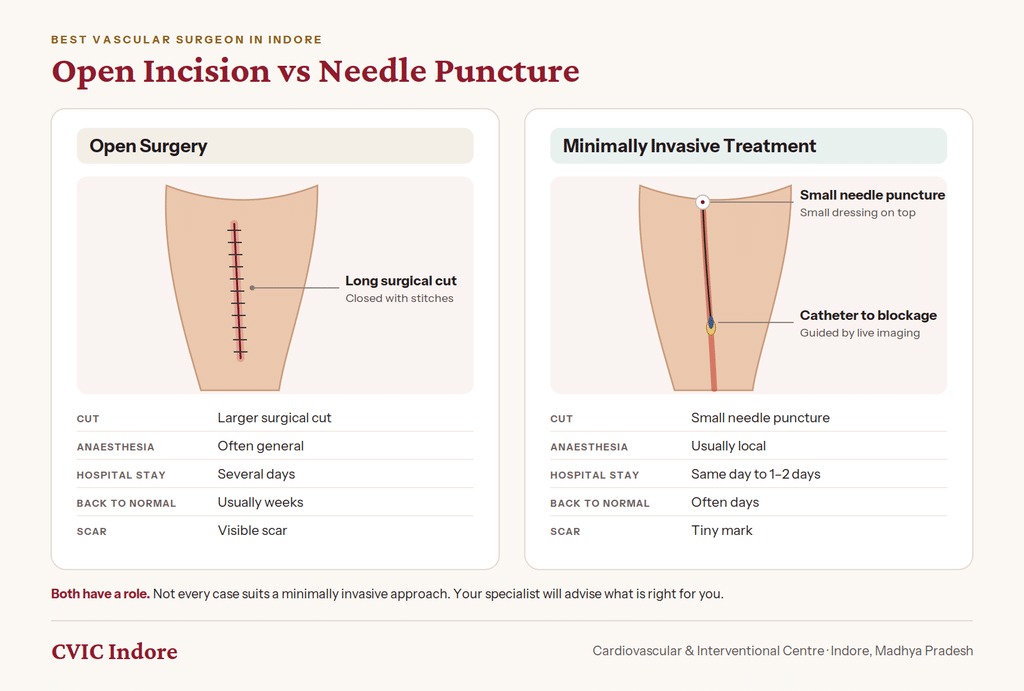
Vascular Surgeon vs Interventional Specialist
| Vascular surgeon | Interventional specialist | |
|---|---|---|
| Main approach | Open surgery and minimally invasive procedures | Minimally invasive, image-guided procedures from inside the blood vessel |
| Typical access | Surgical incision, or needle puncture | Small needle puncture in the groin or wrist |
| Common treatments | Bypass surgery, open aneurysm repair, endarterectomy, vein surgery | Angioplasty, stenting, clot removal, embolisation, aneurysm coiling, vein ablation |
| Anaesthesia | General, regional, or local | Usually local, sometimes with light sedation |
| Recovery | Days to weeks, depending on surgery | Often same day to a few days |
Both have an important role. The best choice depends on your condition, its location and severity, and your overall health. For many patients, a minimally invasive procedure is the first option, with open surgery reserved for cases where it offers a clear advantage.
When Do You Need a Vascular Specialist?
You may be referred to a vascular surgeon or interventional specialist if you have:
- Peripheral artery disease (PAD): Leg pain while walking, cold feet, or slow-healing foot wounds due to narrowed arteries.
- Critical limb ischaemia: Severe pain at rest, ulcers, or gangrene from very poor blood flow, often linked to diabetes or smoking.
- Carotid artery narrowing: Narrowed neck arteries that raise the risk of stroke.
- Aneurysms: A weak, bulging section of an artery in the brain, abdomen, or elsewhere.
- Varicose veins and chronic venous problems: Bulging veins, leg heaviness, swelling, or skin changes.
- Deep vein thrombosis and post-thrombotic syndrome: Clots in deep veins or long-term swelling after a clot.
- Stroke: Blockage of a brain artery that may need urgent clot removal.
- Vascular malformations: Abnormal tangles of blood vessels.
- Varicocele or pelvic vein problems: Enlarged veins in the scrotum or pelvis.
If you have sudden stroke symptoms, a suddenly cold and painful leg, or breathlessness with a swollen leg, do not wait to choose a specialist. Go to emergency care immediately.
Also Read: Vascular Radiology Clinic in Indore: Advanced, Non-Surgical Care | CVIC Indore
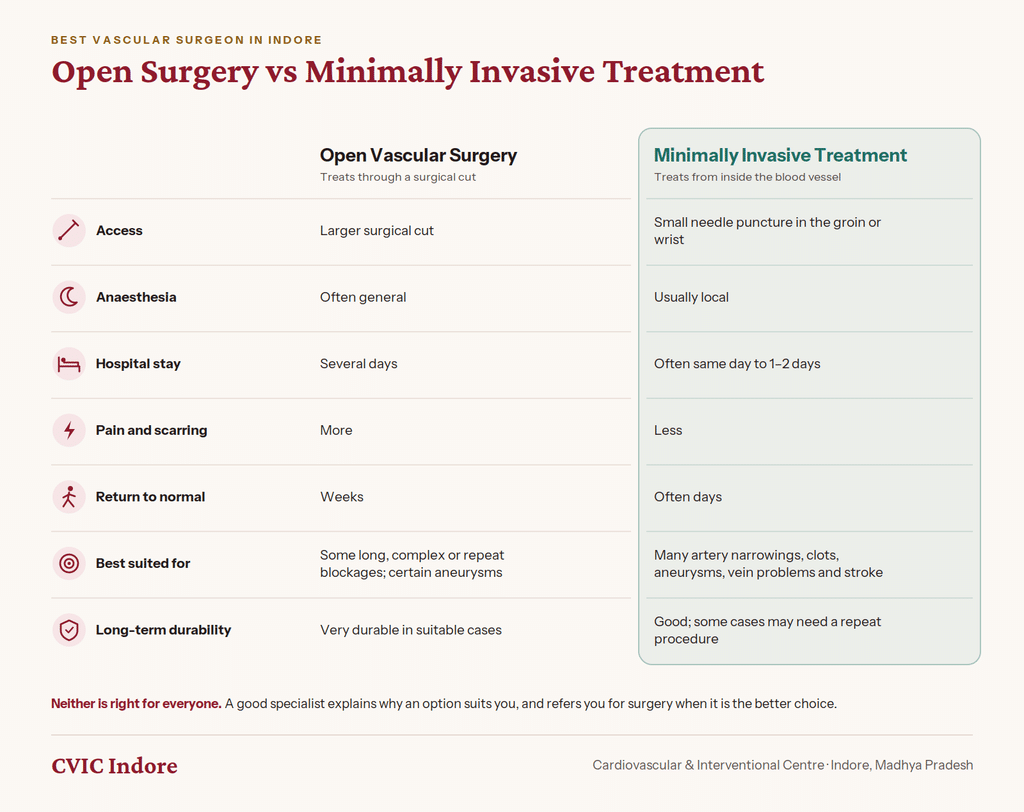
Open Surgery vs Minimally Invasive Treatment
One of the biggest changes in vascular care is the shift towards minimally invasive (endovascular) treatment. Here is how the two approaches generally compare:
| Factor | Open vascular surgery | Minimally invasive (endovascular) treatment |
|---|---|---|
| Access | Larger surgical cut | Small needle puncture |
| Anaesthesia | Often general | Usually local |
| Hospital stay | Several days | Often same day to 1 or 2 days |
| Pain and scarring | More | Less |
| Return to normal activity | Weeks | Often days |
| Best suited for | Some long, complex, or repeat blockages; certain aneurysms | Many artery narrowings, clots, aneurysms, vein problems, and stroke |
| Long-term durability | Very durable in suitable cases | Good, may need repeat procedures in some cases |
Neither approach is right for everyone. A good specialist explains why a particular option suits you, and refers you for surgery if that is the better choice.
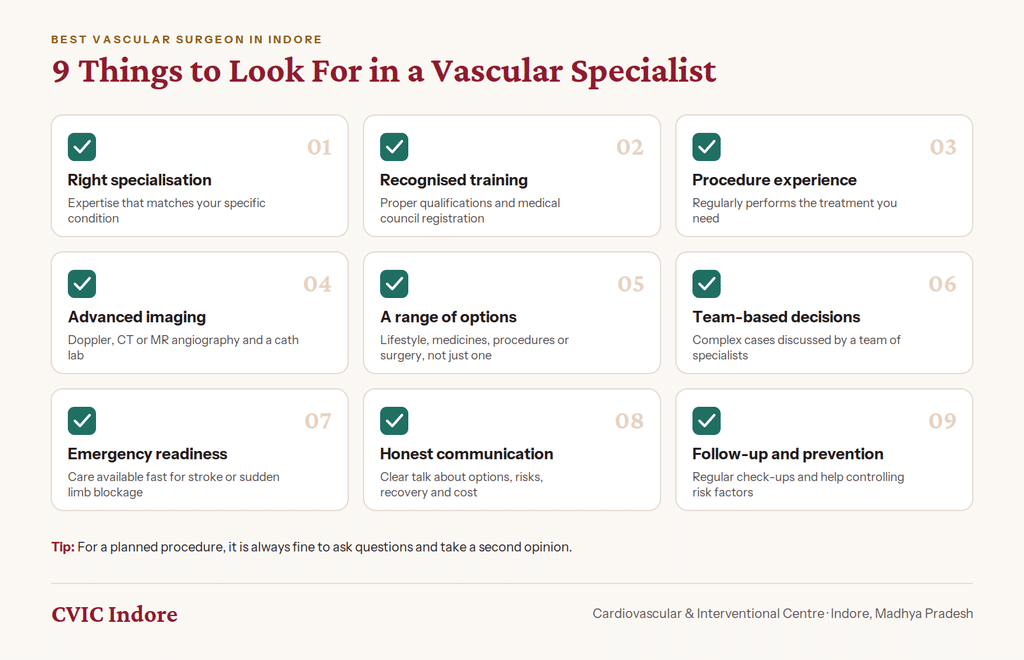
What Makes the Best Vascular Surgeon in Indore?
When patients search for the best vascular surgeon in Indore, they are really looking for safe, effective, and caring treatment. These are the qualities that matter most:
1. The Right Specialisation for Your Condition
Vascular care is broad. A specialist in brain blood vessels is ideal for stroke or a brain aneurysm, while leg artery or vein problems may need a different focus. Ask what proportion of the doctor’s work involves conditions like yours.
2. Recognised Training and Qualifications
Check that the doctor holds recognised medical qualifications and specialised training in vascular surgery, interventional radiology, or neuro-intervention, and is registered with the appropriate medical council.
3. Experience with Your Procedure
Experience matters. It is reasonable to ask how often the doctor performs the procedure you need.
4. Advanced Imaging and Facilities
Accurate imaging is the backbone of vascular care. Look for Doppler ultrasound, CT or MR angiography, and a catheterisation lab (cath lab) for image-guided procedures.
5. A Range of Options
The best specialists do not offer only one solution. They consider lifestyle changes, medicines, minimally invasive procedures, and surgery, and recommend what fits you best.
6. Team-Based Decisions
Complex cases benefit when imaging experts, interventional specialists, and surgeons discuss them together.
7. Emergency Readiness
Stroke and sudden limb blockage need treatment within hours. Ask whether emergency care is available at all times.
8. Honest, Clear Communication
Your doctor should explain your condition, options, risks, recovery, and cost in simple words, and welcome your questions.
9. Follow-Up and Prevention
Good care continues after the procedure, with regular check-ups, medicine reviews, and help controlling risk factors like smoking, diabetes, and blood pressure.
Also Read: Stroke Treatment in Indore: Endovascular Thrombectomy & Expert Care
Questions to Ask Before Choosing a Vascular Specialist
- What exactly is my diagnosis, and how serious is it?
- What are all my treatment options, including not having a procedure?
- Why do you recommend this option for me?
- Is a minimally invasive procedure possible in my case?
- How often do you perform this procedure?
- What are the risks and possible complications?
- How long will I stay in hospital, and how long is recovery?
- What follow-up will I need afterwards?
- What is the estimated cost, and what does it include?
- Who do I contact if I have a problem after the procedure?
Red Flags to Watch For
- Pressure to decide on a major procedure immediately when it is not an emergency
- Only one option offered, with no explanation of alternatives
- Unwillingness to answer questions or discuss risks
- Promises of guaranteed results
- No clear plan for follow-up
It is always reasonable to take time to think, discuss with family, or seek a second opinion before a planned procedure.
Recovery and Aftercare
Recovery depends on the procedure. After most minimally invasive treatments:
- You rest for a few hours while the puncture site is checked.
- Many patients go home the same day or within a day or two.
- Mild bruising or soreness at the puncture site is common and settles in a few days.
- Light activity can usually restart within a few days; avoid heavy lifting until your doctor allows it.
After open surgery, the hospital stay and recovery are longer, often a few weeks before normal activity.
Keys to a Lasting Result
- Take prescribed medicines, such as blood thinners or cholesterol medicines, exactly as advised.
- Stop smoking completely.
- Control blood sugar, blood pressure, and cholesterol.
- Walk regularly and stay active.
- Attend all follow-up visits and scans.
- Report warning signs early, such as new pain, swelling, colour change, or wound problems.
What Affects the Cost of Vascular Treatment?
The cost of vascular treatment in Indore varies from patient to patient. The main factors include:
- Type of procedure: Angioplasty, stenting, clot removal, vein ablation, aneurysm treatment, and open surgery all differ.
- Devices used: Stents, balloons, coils, and special catheters add to the cost; drug-coated devices usually cost more.
- Number of areas treated: Treating more than one blockage increases the cost.
- Tests before and after: Doppler, CT or MR angiography, and blood tests.
- Hospital stay and ICU care: Longer stays or intensive care raise the total.
- Emergency vs planned treatment: Emergency procedures may involve additional resources.
- Insurance and government schemes: Coverage depends on your policy or eligibility.
Ask for a written estimate that explains what is included before a planned procedure, and check with your insurer in advance.
Specialist-Led Vascular Care at CVIC Indore
If you are looking for the best vascular surgeon in Indore, consider a centre that combines accurate imaging with minimally invasive, image-guided treatment. CVIC Indore is a cardiovascular and interventional centre focused on exactly this, serving patients from Indore and across Madhya Pradesh.
Our Specialist Team
- Dr. Alok K Udiya — Neuroradiology and Vascular Imaging: Dr. Udiya specialises in reading complex scans of the brain and blood vessels. Precise imaging helps confirm the diagnosis, choose the right treatment, and plan image-guided procedures safely.
- Dr. Shailesh Gupta — Interventional Neurology and Stroke Management: Dr. Gupta treats blood vessel conditions of the brain and nervous system, including acute stroke, and focuses on long-term stroke prevention.
- Dr. Nishant Bhargava — Cerebrovascular Intervention: Dr. Bhargava performs minimally invasive, catheter-based procedures on the blood vessels of the brain, such as treatments for stroke and aneurysms, through a small puncture instead of open surgery.
What Sets CVIC Indore Apart
- Interventional expertise that treats many blood vessel problems without a large cut
- Advanced vascular imaging for accurate diagnosis and planning
- Team-based review of complex cases
- Honest guidance, including referral for surgery when it is the better option
- Clear explanations and long-term follow-up
Location: [CVIC INDORE ADDRESS]
Appointments: [PHONE NUMBER]
Timings: [OPD TIMINGS]
Frequently Asked Questions
How do I find the best vascular surgeon in Indore?
Look for the right specialisation for your condition, recognised training, experience with your procedure, advanced imaging, team-based care, emergency readiness, and clear communication.
What is the difference between a vascular surgeon and an interventional radiologist?
A vascular surgeon treats with open surgery and some minimally invasive procedures. An interventional radiologist treats from inside the blood vessel using imaging and catheters, usually without a large cut.
Is minimally invasive vascular treatment as good as surgery?
For many conditions, minimally invasive treatment works very well with faster recovery. For some long or complex blockages, open surgery may last longer. Your specialist will advise.
Is vascular surgery risky?
All procedures carry some risk, such as bleeding, infection, or re-narrowing. Minimally invasive procedures usually have fewer complications. Your doctor should explain your specific risks.
How long does recovery take after a vascular procedure?
After minimally invasive procedures, many patients go home within a day or two. Open surgery usually needs a longer stay and a few weeks of recovery.
Do I need surgery for varicose veins?
Most varicose veins today are treated with minimally invasive methods like thermal ablation or sclerotherapy, without open surgery.
Can a blocked leg artery be opened without surgery?
Often yes. Balloon angioplasty and stenting can open many blocked leg arteries through a small needle puncture.
Should I get a second opinion before vascular surgery?
For a planned, non-emergency procedure, a second opinion is reasonable and can help you feel confident in your decision.
Does CVIC Indore offer minimally invasive vascular treatment?
Yes. CVIC Indore focuses on advanced vascular imaging and minimally invasive, image-guided procedures, especially for brain and blood vessel conditions.
How do I book a consultation at CVIC Indore?
Call [PHONE NUMBER] or visit [CVIC INDORE ADDRESS] to book an appointment with our specialist team.
Conclusion
The best vascular surgeon in Indore for you is the specialist whose expertise matches your condition, who explains every option honestly, and who supports you before, during, and after treatment. With modern imaging and minimally invasive techniques, many blood vessel problems can now be treated safely, with less pain and faster recovery than ever before.
Book a consultation at CVIC Indore with Dr. Alok K Udiya, Dr. Shailesh Gupta, and Dr. Nishant Bhargava to understand your condition and explore the right treatment for you.
Medical disclaimer: This article is for general information only and is not a substitute for professional medical advice, diagnosis, or treatment. Treatment choices depend on each patient’s condition. In an emergency, call emergency services immediately.