Quick answer: Yes — Liver Tumor Treatment without surgery is possible in Indore through TACE (Transarterial Chemoembolization), also called Chemoembolization, available at CVIC Indore (Center Of Vascular And Interventional Care). TACE delivers chemotherapy directly into the blood vessels feeding a liver tumor while simultaneously blocking that blood supply — attacking the tumor from two directions at once through a single catheter, typically with a 1–2 day hospital stay and no surgical incision. It is not a cure and not right for every patient or every stage of disease; this guide explains exactly what TACE is, how doctors decide who qualifies, what the procedure actually involves, and how it fits alongside surgery, transplant, and ablation in the bigger picture of liver cancer care.
A diagnosis of a liver tumor — most often hepatocellular carcinoma (HCC), the most common type of primary liver cancer — brings an immediate, difficult question: is surgery possible, and if not, what else can actually be done? For a large share of patients, the honest answer is that surgical removal or transplant is not an option, usually because the tumor is too large or multifocal, the liver itself is too compromised by underlying cirrhosis to tolerate removing part of it, or both. This is precisely the gap that TACE (Transarterial Chemoembolization) was developed to fill, and it remains one of the most widely used and extensively studied liver-directed cancer therapies worldwide.
Also Read: Best Gastro Interventions for GI Bleeding, Liver Tumors & Biliary Obstruction
Understanding Liver Tumors: Primary vs. Metastatic
Not every tumor found in the liver is the same disease, and the distinction matters for treatment planning:
- Primary liver cancer originates in the liver itself. The most common form by far is hepatocellular carcinoma (HCC), which typically develops in a liver already damaged by chronic disease — most often cirrhosis caused by chronic hepatitis B or C infection, long-term heavy alcohol use, or increasingly, non-alcoholic fatty liver disease (NAFLD/MASLD) linked to obesity and diabetes.
- Metastatic (secondary) liver tumors are cancers that started elsewhere in the body — commonly the colon, rectum, breast, or pancreas — and spread to the liver. TACE and related liver-directed therapies can play a role here too, particularly for colorectal cancer that has spread to the liver.
Because HCC usually develops in a cirrhotic liver, treatment decisions have to account for two separate problems simultaneously: the tumor itself, and how much healthy liver function remains to safely treat it. This dual concern is central to understanding why TACE exists as a treatment category at all.
How Liver Tumors Are Usually Found
Early-stage liver tumors often cause no symptoms at all, which is why patients with known cirrhosis or chronic hepatitis are typically placed on a surveillance schedule — usually an ultrasound every six months, sometimes combined with a blood marker called AFP (alpha-fetoprotein) — specifically to catch tumors while they are still small and treatable. When symptoms do appear, they tend to be non-specific and easy to attribute to something else at first: unexplained weight loss, loss of appetite, fatigue, a dull ache or fullness in the upper right abdomen, yellowing of the skin or eyes (jaundice), or a swollen abdomen from fluid buildup (ascites). Because these symptoms often only appear once a tumor has grown significantly, regular surveillance imaging for at-risk patients — rather than waiting for symptoms — is what allows many liver tumors to be caught at a stage where TACE, ablation, or even surgery remain realistic options.
What Is TACE (Chemoembolization)?
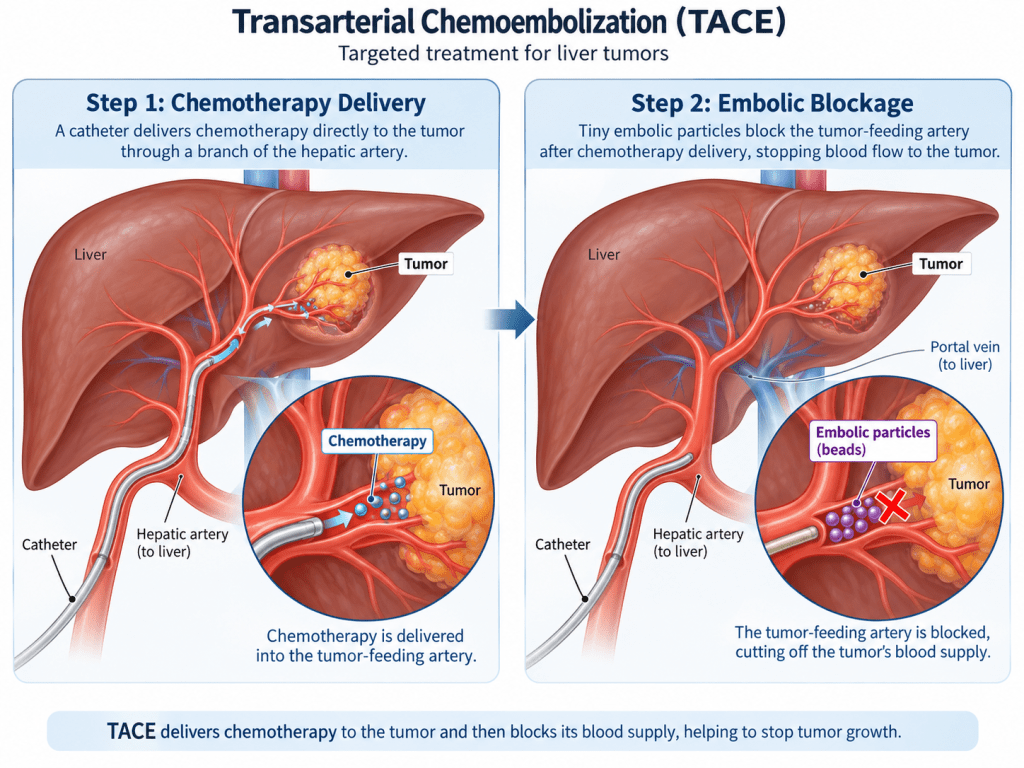
TACE stands for Transarterial Chemoembolization — a mouthful that actually describes the mechanism precisely once broken down: transarterial (delivered through an artery), chemo (chemotherapy), embolization (blocking blood flow).
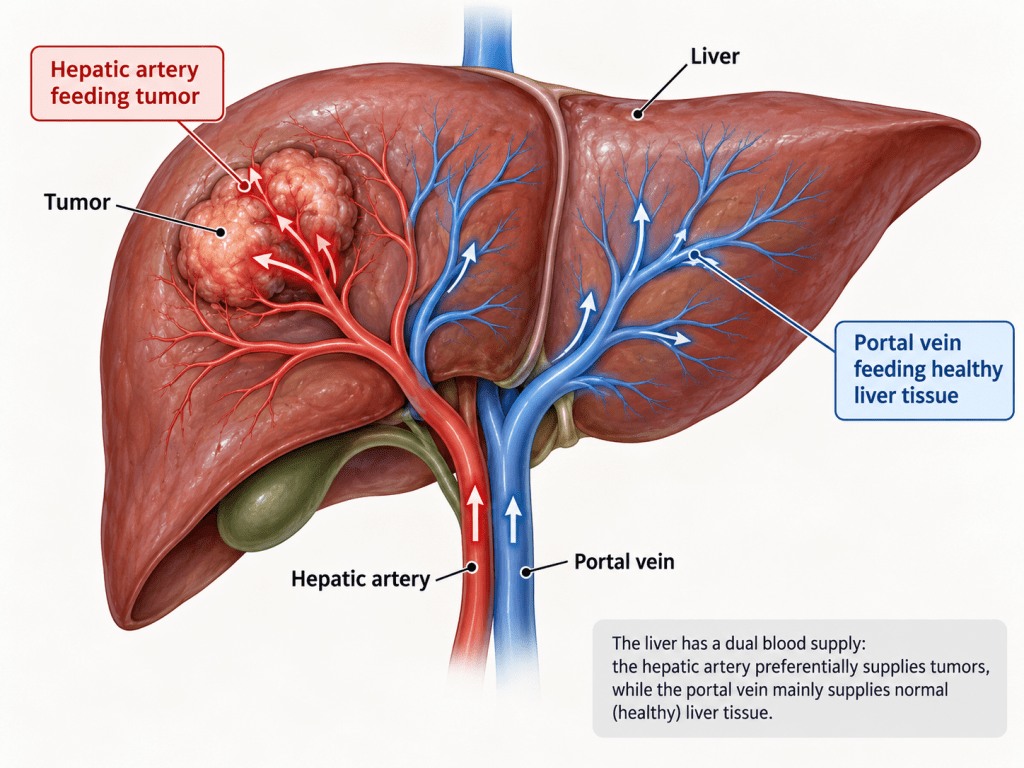
The liver has a somewhat unusual blood supply: healthy liver tissue receives most of its blood from the portal vein, while liver tumors — including HCC — derive the large majority of their blood supply from the hepatic artery. This difference is what makes TACE possible in the first place. By delivering treatment through the hepatic artery, an interventional radiologist can target tumor tissue while relatively sparing the surrounding healthy liver, which continues to receive blood through the portal vein as usual.
TACE works through two combined mechanisms delivered in a single procedure:
- Direct chemotherapy delivery — a chemotherapy drug is infused directly into the artery feeding the tumor, achieving a much higher local drug concentration at the tumor than intravenous chemotherapy could safely achieve throughout the body.
- Arterial embolization — embolic particles are then injected to block that same blood supply, starving the tumor of oxygen and nutrients (ischemia) while also trapping the chemotherapy drug at the tumor site for a longer, more concentrated effect.
Together, this dual attack is more effective than either chemotherapy or embolization alone, while causing meaningfully less systemic (whole-body) toxicity than standard intravenous chemotherapy, since much of the drug’s effect stays concentrated at the tumor rather than circulating throughout the body.
Two Main Types of TACE
- Conventional TACE (cTACE): Combines an oily contrast agent called lipiodol (which tumors selectively retain), a chemotherapy drug — commonly doxorubicin — and separate embolic particles, delivered together through the catheter.
- Drug-Eluting Bead TACE (DEB-TACE): Uses specially engineered microscopic beads that are pre-loaded with chemotherapy and release it slowly and steadily at the tumor site after embolization. This more controlled release is designed to reduce the peak systemic drug concentration compared with conventional TACE. Doxorubicin-eluting beads are commonly used for hypervascular liver tumors, while irinotecan-eluting beads are specifically used for liver metastases from colorectal cancer.
Both approaches achieve the same underlying goal — concentrated chemotherapy plus arterial blockage — and the choice between them is made by the interventional radiologist based on tumor characteristics and individual patient factors.
Also Read: Can Brain Tumor Be Treated Without Surgery? A Complete Guide to Non-Surgical Options
Who Is a Good Candidate for TACE?
Liver cancer treatment decisions are guided internationally by a staging framework called the Barcelona Clinic Liver Cancer (BCLC) system, which categorizes patients from stage 0 (very early) through stage D (terminal), based on tumor burden, liver function, and overall performance status. TACE’s primary, best-established role is for BCLC stage B — intermediate-stage HCC — patients whose tumors are too extensive for surgical removal, transplant, or ablation, but who do not yet have advanced disease such as vascular invasion or spread outside the liver.
Good candidates for TACE generally meet these criteria:
- BCLC intermediate stage (B) disease — multiple tumors confined to the liver, without invasion into major blood vessels or spread beyond the liver.
- Preserved liver function, formally assessed using the Child-Pugh classification, which scores liver function from A (well-compensated) to C (severely decompensated) based on bilirubin, albumin, clotting time, ascites, and encephalopathy. Only Child-Pugh class A or B patients are considered candidates — Child-Pugh class C patients are excluded because their liver reserve is too limited to safely tolerate the temporary reduction in blood supply TACE causes.
- Good performance status, measured by the ECOG scale (a standard 0–5 scale of how well a patient can carry out daily activities) — candidates generally need an ECOG score of 0–2; a score above 2 is considered a contraindication.
- Not currently eligible for surgical resection, transplant, or ablation — TACE is generally reserved for patients whose tumor burden, liver function, or overall health rules out these potentially curative options, since surgery, transplant, or ablation are preferred whenever genuinely feasible.
- No main portal vein thrombosis and no evidence of tumor spread outside the liver, which would typically shift treatment toward systemic therapy instead.
Who Should Not Have TACE
TACE is deliberately not offered to every liver tumor patient, and the contraindications are just as important as the selection criteria:
- Absolute contraindications include: a genuinely better treatment option being available (surgery or ablation), ECOG performance status greater than 2, medical contraindications to chemotherapy (such as significant kidney or heart failure, or low white blood cell counts), Child-Pugh class C cirrhosis, and a high likelihood of being unable to comply with the treatment and follow-up plan.
- Relative contraindications — situations requiring extra caution or a modified approach — include tumor burden exceeding roughly 50% of total liver volume, tumors that are hypovascular (poorly supplying blood, and therefore less responsive to an arterially delivered treatment), main portal vein thrombosis, significantly elevated bilirubin (above 3 mg/dL) without the option of a more limited, segmental treatment approach, visible signs of decompensated cirrhosis such as ascites, jaundice, encephalopathy, or a history of variceal bleeding, and active ongoing alcohol use.
At CVIC Indore, candidacy is determined only after reviewing imaging (CT or MRI), liver function tests, Child-Pugh scoring, and overall staging — not offered as a default treatment regardless of fit.
Also Read: Early Symptoms of Brain Tumor: Signs You Should Never Ignore | CVIC Indore
Liver Tumor Treatment Options Compared
| Treatment | Intent | Invasiveness | Who It’s Typically For |
|---|---|---|---|
| Surgical resection | Potentially curative | Major surgery | Small, solitary tumors with well-preserved liver function |
| Liver transplant | Curative | Major surgery | Early-stage HCC meeting transplant criteria, with a suitable donor liver |
| Ablation (RFA/MWA) | Potentially curative for small tumors | Minimally invasive | Small tumors (generally under 3 cm), limited in number |
| TACE (Chemoembolization) | Disease control / palliative, sometimes a bridge to transplant | Minimally invasive (catheter-based) | Intermediate-stage (BCLC B), multifocal, unresectable tumors with preserved liver function |
| Systemic therapy (targeted/immunotherapy) | Disease control | Non-invasive (IV) | Advanced-stage disease, vascular invasion, or spread beyond the liver |
| Best supportive care | Symptom management | None | Terminal-stage disease |
An important, honest point: TACE is generally not considered a curative treatment on its own. It is a disease-control and, often, life-extension strategy for patients in the intermediate stage — and in carefully selected early-stage patients awaiting a liver transplant, TACE is also used as a “bridge” therapy to keep tumors controlled while the patient waits for a donor organ.
Preparing for TACE
Once candidacy is confirmed, preparation typically involves a few practical steps in the days before the procedure: routine blood tests (including kidney function, since iodinated contrast dye is used), a review of current medications — blood thinners are usually adjusted or paused under medical guidance, and diabetes medications may need timing adjustments around the required fasting period — and instructions to fast, typically for around six to eight hours beforehand, given the use of sedation. Patients are generally advised to arrange for someone to accompany them home after discharge, since sedation affects reaction time and judgment for the remainder of the day. Bringing a clear, current list of medications and allergies, and telling the team about any prior reaction to contrast dye or iodine, helps the procedure go smoothly and safely.
Step-by-Step: The TACE Procedure at CVIC Indore
- Pre-procedure workup — Cross-sectional imaging (CT or MRI) to map tumor number, size, and blood supply; blood tests including liver function and clotting studies; Child-Pugh and BCLC staging to confirm candidacy.
- Access — A small puncture in the femoral (groin) or radial (wrist) artery under local anesthesia, with the patient sedated but not under general anesthesia in most cases.
- Mapping angiography — Contrast dye and X-ray imaging (arteriography) map the hepatic artery and its branches, identifying exactly which vessels feed the tumor.
- Protective embolization, if needed — Where non-target vessels are at risk of receiving stray embolic material, small coils may be placed first to protect them, similar to the protective step used in other embolization procedures.
- Selective catheterization — A microcatheter is guided as close to the tumor’s blood supply as possible — ideally selecting the specific branch or branches feeding the tumor, to spare as much surrounding healthy liver tissue as possible.
- Chemoembolization — The chemotherapy-embolic mixture (cTACE) or drug-eluting beads (DEB-TACE) are slowly injected until blood flow in the target vessel reaches stasis (stops), confirmed on live imaging.
- Confirmation imaging — Follow-up angiography confirms the intended vessels have been treated as planned.
- Recovery and monitoring — The patient is observed in hospital, typically for one to two days, for pain control and monitoring before discharge.
The procedure itself generally takes one to two hours, depending on the number and location of tumors and the complexity of the arterial anatomy.
What Happens After TACE: Recovery and Post-Embolization Syndrome
Most patients experience what is called post-embolization syndrome in the hours to days following TACE — a well-recognized, expected cluster of effects rather than a complication. This typically includes abdominal pain, nausea, vomiting, and a low-grade fever, usually managed with medication during the hospital stay. After discharge, patients often continue to experience low-grade fever for up to a week, along with fatigue and reduced appetite that can persist for several weeks as the body responds to the treated tumor tissue.
Because TACE controls tumors rather than curing the underlying disease in most cases, repeat sessions are common — the interventional radiology team monitors response with follow-up imaging and typically re-treats when a tumor shows signs of regrowth or when new lesions are identified, rather than following a fixed, one-size-fits-all schedule.
Safety and Effectiveness: An Honest Look
Technical success — meaning the procedure achieves its intended embolization of the target vessel — is achieved in more than 98% of TACE procedures, reflecting how well-established and refined the technique has become. That said, a responsible discussion of TACE has to be honest about what the evidence actually shows regarding survival: early landmark trials found that TACE reduces the one-year risk of death by roughly 19–26% compared with supportive care alone in appropriately selected patients, and for BCLC stage B patients specifically, TACE has been shown to extend survival by a more modest three to four months on average in that pivotal evidence base — a meaningful but realistic benefit, not a dramatic one, which is why current research (and CVIC Indore’s own dedicated survival-rate article) increasingly explores combining TACE with newer systemic therapies to improve on these numbers further.
As with any embolization procedure, risks exist beyond the expected post-embolization syndrome, including bleeding or injury at the access site, an allergic reaction to contrast dye, temporary or, rarely, more lasting liver function decline, infection, and — because the treatment relies on precise catheter placement — a small risk of the embolic material affecting non-target tissue, which is exactly why protective coiling and careful selective catheterization are built into the procedure whenever indicated.
Why Choose CVIC Indore for TACE / Chemoembolization
CVIC Indore (Center Of Vascular And Interventional Care) offers TACE as part of its broader Oncology Interventions practice, applying the same catheter-based, image-guided precision used across the clinic’s vascular and interventional radiology work to liver tumor care:
- Dedicated interventional radiology expertise in selective hepatic artery catheterization, the technical core of a safe, effective TACE procedure, delivered by a team recognized among the best interventional radiologists in Indore.
- Thorough, honest candidacy evaluation — BCLC staging, Child-Pugh scoring, and imaging review before recommending TACE, rather than treating every liver tumor referral identically.
- A day-to-two-day care model, with most patients discharged within 24–48 hours of the procedure.
- Integration with the full range of liver-directed and oncologic interventional options, so that patients whose tumors are better suited to ablation, or whose disease has progressed beyond TACE’s intended role, are guided toward the appropriate next step rather than a single default procedure.
- A dedicated, statistics-focused companion resource on TACE survival outcomes for patients and families who want to explore the prognosis data in more depth once they understand the procedure itself.
Myths vs. Facts About TACE
Myth: TACE cures liver cancer. Fact: TACE is primarily a disease-control and life-extension therapy for intermediate-stage disease, and a bridge therapy for some transplant candidates — it is generally not considered curative on its own, and being clear about this distinction is part of honest patient counseling.
Myth: If surgery isn’t possible, nothing else can be done. Fact: TACE exists specifically for this situation — patients whose tumors or liver function rule out surgery, transplant, or ablation still often have a meaningful, evidence-based treatment option in TACE.
Myth: TACE is the same as regular chemotherapy, just delivered differently. Fact: TACE combines targeted, high-concentration local chemotherapy delivery with arterial blockage (ischemia) in a single procedure, producing a different — and for eligible patients, often better-tolerated — effect than systemic intravenous chemotherapy, which circulates throughout the entire body.
Myth: Every liver tumor patient is a TACE candidate. Fact: TACE has specific, well-defined selection criteria — BCLC intermediate stage, Child-Pugh A or B liver function, ECOG 0–2 — and clear contraindications, including advanced cirrhosis (Child-Pugh C) and poor performance status.
Myth: You’ll need general anesthesia and a long hospital stay. Fact: TACE is typically performed under local anesthesia with sedation, with most patients discharged within one to two days — a substantially shorter stay than major liver surgery.
Frequently Asked Questions
1. Is TACE painful? The procedure itself is performed under local anesthesia with sedation, so patients are comfortable during the process. Abdominal pain is a common part of post-embolization syndrome afterward and is managed with pain medication during the hospital stay.
2. How many TACE sessions will I need? This varies by patient and is guided by follow-up imaging. Because TACE controls rather than eliminates tumors in most cases, repeat sessions are common when imaging shows tumor regrowth or new lesions, rather than following a fixed number decided in advance.
3. Is TACE the same as chemotherapy? Not exactly. TACE delivers chemotherapy directly into the artery feeding the tumor and combines it with blocking that blood supply, achieving a concentrated local effect with less of the whole-body side effects associated with standard intravenous chemotherapy.
4. What is the difference between TACE and RFA (radiofrequency ablation)? RFA uses heat delivered directly into a tumor and is generally used for smaller, limited tumors (often under 3 cm). TACE works through the blood supply and is generally used for larger or multiple tumors that are not good candidates for direct ablation. The two are sometimes used in combination.
5. Can TACE be used if I’m waiting for a liver transplant? Yes. In appropriately selected early-stage patients, TACE is commonly used as a “bridge” therapy to help keep tumors controlled while waiting for a suitable donor liver to become available.
6. What liver function tests are needed before TACE? Candidacy assessment typically includes bilirubin, albumin, and clotting studies (used to calculate the Child-Pugh score), along with imaging to determine tumor burden and BCLC stage.
Final Thoughts
A liver tumor diagnosis does not automatically mean surgery is the only path forward — or that nothing can be done when surgery isn’t possible. TACE (Chemoembolization) offers a genuine, image-guided, non-surgical treatment option for appropriately selected patients, working through a well-understood dual mechanism of targeted chemotherapy delivery and arterial blockage.
At the same time, honest counseling matters more here than almost anywhere else in interventional radiology: TACE is not a cure, it is not right for every liver tumor patient or every stage of disease, and realistic expectations about survival benefit should be part of the conversation from the start. The right next step is a thorough evaluation — imaging, liver function testing, and formal BCLC and Child-Pugh staging — so the team at CVIC Indore can tell you plainly whether Liver Tumor Treatment with TACE is an appropriate option for your specific situation.
Visit CVIC Indore
CVIC — Center Of Vascular And Interventional Care 403, Panama Tower, Gita Bhawan Road, near Crown Palace, South Tukoganj, Indore, Madhya Pradesh 452008
Phone: 0731 4675670 / +91-8103727728
Team: Dr. Alok K. Udiya (MD Radiology, Fellowship in Neuro Intervention Radiology, Switzerland), Dr. Shailesh Gupta (MD Radiology, PDCC in Interventional Radiology), Dr. Nishant Bhargava (MD Radiology, Fellowship in Neuro Intervention Radiology, Switzerland)
Disclaimer
This article is intended for general educational purposes only and does not constitute medical advice. Suitability for TACE depends on tumor staging, liver function, and overall health, and can only be determined through an in-person evaluation, including imaging and laboratory testing, by a qualified interventional radiologist, hepatologist, or oncologist. If you or a family member has been diagnosed with a liver tumor, please consult a doctor for personalized assessment and treatment planning.