When a family hears the word “stroke,” the first fear that follows is almost always the same: “Will my loved one need brain surgery?” It is a natural fear. The idea of the skull being opened, of a long operation, of a difficult recovery — it is frightening for anyone.
Here is the reassuring truth that every family searching for stroke treatment in Indore should know: most strokes today do not need open surgery at all. Thanks to advances in interventional neuroradiology, the majority of stroke patients can now be treated through non-surgical and minimally invasive methods — procedures that restore blood flow to the brain without a single cut on the skull.
At CVIC Indore (Center Of Vascular And Interventional Care), Central India’s first dedicated vascular intervention center, this is exactly the kind of care patients receive every day. In this detailed guide, the neuro-interventional team at CVIC Indore — Dr. Alok K. Udiya, Dr. Shailesh Gupta, and Dr. Nishant Bhargava — explains what stroke treatment without surgery really means, which procedures are used, when they work, when open surgery genuinely is still needed, and why timing matters more than almost anything else.
Quick answer: Yes, a stroke can very often be treated without surgery. Ischemic strokes — which make up the large majority of all strokes — are commonly treated with clot-dissolving medication (thrombolysis) or catheter-based clot removal (mechanical thrombectomy), neither of which involves any incision on the head. Even conditions that once always required an operation, such as a bleeding brain aneurysm, can frequently be managed today with minimally invasive endovascular techniques like coiling. The right approach always depends on the type, size, and timing of the stroke — which is why fast, expert evaluation at a center like CVIC Indore matters so much.
Understanding Stroke: Ischemic vs Hemorrhagic
A stroke happens when the blood supply to part of the brain is suddenly disrupted. Brain cells depend on a constant supply of oxygen and glucose carried by blood, and without it, they begin to die within minutes. This is why doctors repeat the phrase “time is brain” — every minute of delay costs brain tissue that may never be recovered.
There are two main types of stroke, and they are treated very differently:
| Feature | Ischemic Stroke | Hemorrhagic Stroke |
|---|---|---|
| Cause | A blood clot blocks an artery supplying the brain | A blood vessel in the brain bursts and bleeds |
| Share of cases | The large majority of all strokes | A smaller but often more severe share |
| Typical non-surgical treatment | Thrombolysis (clot-dissolving injection), mechanical thrombectomy | Blood pressure control, medication, endovascular coiling for aneurysms |
| When surgery may be needed | Rarely — mainly for large-territory strokes with dangerous swelling | More often — for large bleeds or aneurysms unsuitable for coiling |
Research reviewed in the Indian Journal of Medical Research has recorded stroke incidence rates ranging from roughly 105 to 152 cases per 100,000 people every year across different Indian cities — notably higher than rates typically seen in high-income countries. Other Indian stroke-registry research shows that nearly 1 in 7 stroke patients in India is under the age of 45, which busts the common myth that stroke is only an “old age” problem.
India also tends to see a somewhat higher proportion of hemorrhagic (bleeding) strokes compared with Western countries, largely linked to widespread, poorly controlled high blood pressure. This makes accurate, fast diagnosis — to tell the two types apart — the very first and most important step in deciding whether a stroke can be treated without surgery.
Also Read: What Are the Causes of Brain Blood Clots? Symptoms & Treatment | CVIC Indore
Can a Stroke Really Be Treated Without Surgery in Indore?
For most ischemic strokes, the honest answer is yes. The goal of ischemic stroke treatment is simple: reopen the blocked artery and restore blood flow as fast as possible. In the majority of eligible cases, this can be achieved through medication or a catheter-based procedure — not an operation on the brain itself.
For hemorrhagic strokes, the picture is more nuanced. Many small-to-moderate bleeds are managed conservatively with medication and close monitoring in an intensive care setting, or with minimally invasive endovascular procedures if the bleed is caused by an aneurysm or an abnormal tangle of blood vessels. Larger bleeds that dangerously raise pressure inside the skull may still require surgery to remove the clot or relieve pressure — there is no honest way around that fact.
This is exactly why the team at CVIC Indore never gives a one-size-fits-all answer over the phone. Every patient undergoes rapid imaging — CT, MRI, or angiography — before a treatment plan is decided, so that the least invasive option that is genuinely safe for that specific patient is always considered first.
Also Read: What Is the Survival Rate for Someone with a Brain AVM? | CVIC Indore
Non-Surgical & Minimally Invasive Stroke Treatments Available at CVIC Indore
This is the heart of modern stroke care, and the area where CVIC Indore has built its reputation as a leading center for stroke treatment in Indore.
1. Intravenous Thrombolysis — The Clot-Dissolving Injection
Thrombolysis involves injecting a medicine directly into the bloodstream to dissolve the clot blocking a brain artery. For decades, the standard drug has been alteplase (tPA), given within 4.5 hours of symptom onset.
The American Heart Association/American Stroke Association’s 2026 guideline for early management of acute ischemic stroke has expanded the recommended use of tenecteplase, a newer clot-dissolving drug, within that same 4.5-hour window. Tenecteplase is given as a single quick injection rather than a longer infusion, which can make treatment faster to start — a meaningful advantage when every minute counts.
Thrombolysis involves no incision at all.
2. Mechanical Thrombectomy — Removing the Clot Without Surgery
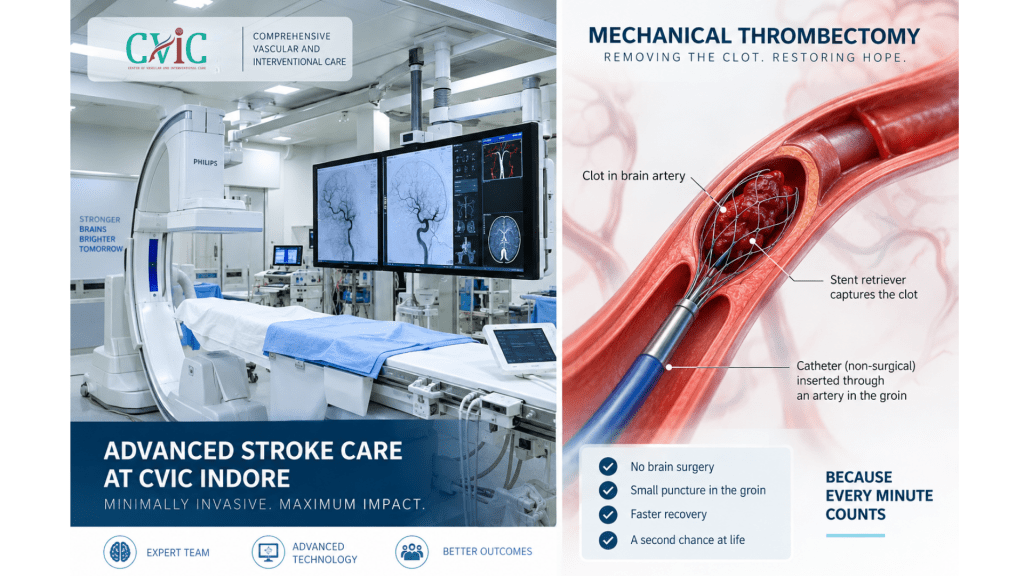
For larger clots, or when a patient arrives outside the thrombolysis window, mechanical thrombectomy is often the answer. This is a minimally invasive, catheter-based procedure performed in an angiography suite — not an operating theatre, and with no incision on the head.
Here is how it works: a thin catheter is guided through an artery, usually entering from the wrist or groin, all the way up to the blocked blood vessel in the brain. A small device called a stent retriever is then used to physically capture and remove the clot, restoring blood flow almost immediately.
CVIC Indore reports a mechanical thrombectomy success rate of over 85% in appropriately selected patients. While thrombolysis must generally be given within 4.5 hours, thrombectomy can benefit selected patients for up to 24 hours after symptom onset, based on advanced imaging that shows how much brain tissue is still salvageable.
Notably, the AHA/ASA’s 2026 guideline has broadened thrombectomy eligibility further, now supporting its use in carefully selected patients with large-core infarcts and basilar artery occlusions — groups that earlier guidelines were more cautious about. This is a very recent shift in stroke care, and one that families in Indore searching for the latest treatment options should be aware of.
Read more about this procedure on CVIC’s Neuro Interventions page, and about the team’s specific expertise on the Best Neuro Interventional Radiologist in Indore page.
3. Carotid Artery Stenting & Angioplasty
Strokes are sometimes caused, or threatened, by narrowing of the carotid arteries in the neck, known as carotid stenosis. Traditionally, this was corrected through an open operation called carotid endarterectomy. Today, carotid artery stenting — placing a small mesh tube through a catheter to widen the narrowed artery — offers a minimally invasive alternative for many patients, typically with a much shorter recovery time than open surgery.
4. Endovascular Coiling & Flow Diversion — For Hemorrhagic and Aneurysm-Related Strokes
When a stroke is caused by a ruptured brain aneurysm, the old standard treatment was open surgical clipping. Today, many aneurysms can instead be treated with endovascular coiling, in which soft platinum coils are packed into the aneurysm through a catheter, sealing it off from normal blood circulation — again, without opening the skull. Complex or wide-necked aneurysms may be treated with flow-diverting stents, which redirect blood flow away from the weakened vessel wall and allow it to heal naturally over time.
5. AI-Assisted Imaging & Rapid Diagnosis
Every non-surgical decision depends on the speed and accuracy of diagnosis. CVIC Indore uses in-house CT and MRI, biplane digital subtraction angiography (DSA), 3D rotational angiography, and AI-assisted stroke-detection software to identify the type, size, and exact location of a stroke within minutes. This allows the team to decide on the safest, least invasive treatment path without losing precious time.
6. Medical Management
Not every stroke, or every stroke-risk situation, needs a procedure at all. Antiplatelet drugs such as aspirin or clopidogrel, anticoagulants for patients with irregular heart rhythms like atrial fibrillation, statins to control cholesterol, and blood pressure management are all purely medicine-based tools used both to treat minor strokes or TIAs and to prevent a second, often more damaging, event.
Also Read: Stroke Specialist Near Me | Advanced Stroke Treatment at CVIC Indore
The Golden Window: Why Every Minute Matters
Whether or not a stroke can be treated without surgery often comes down to one single factor: time. Doctors use the mnemonic BE FAST to help ordinary people recognize a stroke immediately, without needing any medical training:
| Sign | What to Look For |
|---|---|
| B – Balance | Sudden loss of balance or coordination |
| E – Eyes | Sudden blurred, double, or lost vision |
| F – Face | One side of the face drooping when asked to smile |
| A – Arms | One arm drifting downward when both are raised |
| S – Speech | Slurred, strange, or difficult speech |
| T – Time | Call emergency services immediately |
If you notice any of these signs, in yourself or in someone else, call for emergency help right away and note the exact time symptoms began. That single detail — the time — often determines whether thrombolysis, thrombectomy, or both non-surgical options remain available to the treating team.
What Happens When You Reach CVIC Indore After Stroke Symptoms Begin
Understanding the process can ease a lot of fear for patients and families. Here is what typically happens, step by step:
- Emergency arrival and triage – The patient is received as a priority “stroke alert” case, and the team is often informed in advance so preparation begins before arrival.
- Rapid imaging – A CT scan, and often CT or MR angiography, is performed within minutes to determine whether the stroke is ischemic or hemorrhagic, and to map the exact blocked or bleeding vessel.
- Specialist decision-making – Based on the imaging, symptom-onset time, and the patient’s overall health, the neuro-interventional team decides between thrombolysis, mechanical thrombectomy, medical management, or — in select cases — a surgical consultation.
- The procedure – If a non-surgical treatment is chosen, it is carried out in the angiography suite, typically taking anywhere from 30 minutes to a couple of hours depending on complexity.
- ICU monitoring – Patients are closely monitored for at least 24–48 hours to watch for complications and confirm the treatment has worked as intended.
- Rehabilitation planning – Even before discharge, the team begins planning physiotherapy, occupational therapy, and speech therapy where needed, so recovery starts as early as possible.
When Might Surgery Still Be Necessary?
Honesty matters here, and the team at CVIC Indore believes patients deserve the complete picture, not just the reassuring part. Surgery may still genuinely be required when:
- A hemorrhagic stroke causes a large blood clot that is dangerously compressing the brain
- There is severe brain swelling raising the risk of herniation, sometimes requiring a decompressive craniectomy
- An aneurysm’s shape, size, or location makes it unsuitable for coiling or flow diversion
- A large territory of the brain is affected and pressure must be relieved surgically to save the patient’s life
Even in these situations, the approach at CVIC Indore is to explore every safe, minimally invasive option first, and to involve neurosurgical care only when it is genuinely the safest path for that patient — never as a default response.
Life After Stroke: Recovering Without Surgery
Treatment does not end once blood flow is restored. Recovery is where many patients and families spend the following weeks and months, and this entire phase is non-surgical:
- Physiotherapy to rebuild strength, balance, and movement
- Occupational therapy to relearn daily activities such as dressing, bathing, and eating
- Speech and swallowing therapy for patients with speech difficulty
- Cognitive rehabilitation to support memory, attention, and thinking
- Psychological support for patients and families adjusting to life after a stroke
CVIC Indore’s rehabilitation-focused approach is discussed in more depth in Physiotherapy vs Neuro Treatment: What Is Better & When? and in Best Treatment for Paralysis After Stroke — both worth reading alongside this guide.
Why Choose CVIC Indore for Non-Surgical Stroke Treatment?
CVIC Indore — Center Of Vascular And Interventional Care — is recognized as Central India’s first dedicated vascular intervention center, built specifically around minimally invasive, catheter-based treatment across neuro, vascular, and several other specialties.
The center is led by three co-directors with deep, specialized expertise in interventional and neuro-interventional radiology:
- Dr. Alok K. Udiya — MD (Radiology), with advanced sub-specialty training including a Fellowship in Neuro Intervention Radiology (FINR) from Switzerland
- Dr. Shailesh Gupta — MD (Radiology), PDCC in Interventional Radiology
- Dr. Nishant Bhargava — MD (Radiology), with a Fellowship in Neuro Intervention Radiology from Switzerland
Together, the team brings extensive, focused experience in stroke thrombectomy, aneurysm coiling, carotid stenting, and neurovascular embolization. You can read more about their backgrounds on the Top Neuro Doctors in Indore at CVIC page.
CVIC Indore is equipped with a hybrid neuro-operating suite, biplane DSA, robotic-assisted navigation, in-house CT and MRI, and round-the-clock emergency stroke response — all essential for delivering fast, minimally invasive treatment exactly when it matters most. Learn more on the Stroke Specialist Near Me in Indore page, and about warning signs and prevention in Brain Stroke: Warning Signs, Prevention, and Best Treatment.
Myths vs Facts: Non-Surgical Stroke Treatment
Myth: Every stroke patient eventually needs brain surgery. Fact: Most ischemic strokes — the majority of all strokes — are treated with medication or catheter-based procedures, not surgery.
Myth: Minimally invasive procedures are less effective than open surgery. Fact: For eligible ischemic stroke patients, thrombectomy and thrombolysis are considered gold-standard, first-line treatments, often with a faster recovery than surgery.
Myth: If there is no visible wound, the treatment “did not do much.” Fact: A catheter-based clot removal or coiling procedure can be just as life-saving as open surgery. Results are measured in restored brain function, not visible incisions.
Myth: Non-surgical treatment means “wait and watch.” Fact: Non-surgical stroke treatment is often more time-urgent than surgery, since both thrombolysis and thrombectomy depend on strict treatment windows.
Myth: Once paralysis sets in after a stroke, it is permanent. Fact: With timely non-surgical treatment and consistent rehabilitation, many patients regain significant, sometimes complete, function.
What Does Non-Surgical Stroke Treatment Cost in Indore?
Costs vary depending on the exact treatment required — thrombolysis alone, mechanical thrombectomy, stenting, or a combination — along with the length of hospital stay, ICU care, and rehabilitation needs. For a detailed, transparent breakdown of what influences these costs, see CVIC’s dedicated guide: Brain Stroke Treatment Cost in India: A Complete Guide.
Who Is at Risk, and How Can a Stroke Be Prevented?
Stroke risk rises with age, but as Indian registry data shows, it is far from an “old age only” condition — a significant share of patients are under 45. The good news is that most risk factors are modifiable:
- Keep blood pressure under control — the single biggest risk factor for stroke, and for hemorrhagic stroke in particular
- Manage diabetes and cholesterol through diet, exercise, and medication
- Quit smoking and limit alcohol intake
- Stay physically active and maintain a healthy weight
- Get irregular heart rhythms, such as atrial fibrillation, properly diagnosed and treated
- Go for regular health check-ups, especially after age 40, or earlier with a family history of stroke or heart disease
Frequently Asked Questions
1. Can a stroke be treated without surgery in Indore?
Yes. Most ischemic strokes are treated with clot-dissolving medication (thrombolysis) or catheter-based clot removal (mechanical thrombectomy) — both non-surgical, minimally invasive procedures available at CVIC Indore.
2. What is the time window for non-surgical stroke treatment?
Thrombolysis is most effective within 4.5 hours of symptom onset. Mechanical thrombectomy can help selected patients for up to 24 hours after onset, depending on brain imaging findings.
3. Is mechanical thrombectomy safer than brain surgery?
Thrombectomy is minimally invasive, performed through a small catheter rather than an incision on the skull, and is generally associated with a shorter recovery period than open brain surgery — though outcomes always depend on the individual case.
4. Can a brain aneurysm be treated without surgery?
Many aneurysms can be treated with endovascular coiling or flow-diverting stents instead of open surgical clipping, depending on the aneurysm’s size, shape, and location.
5. Is non-surgical stroke treatment suitable for elderly patients?
Often, yes. Because there is no large incision or lengthy anaesthesia in most cases, minimally invasive treatments are frequently well tolerated even in older or medically fragile patients, though each case is assessed individually.
6. What should I do if I notice stroke symptoms?
Call emergency services immediately, note the exact time symptoms started, and get to a hospital equipped for advanced stroke care, such as CVIC Indore, without any delay. Do not wait to see if symptoms improve on their own.
7. Does CVIC Indore provide 24/7 stroke care?
Yes, CVIC Indore offers round-the-clock emergency stroke evaluation and treatment, supported by in-house imaging and a dedicated neuro-interventional team.
Final Thoughts: Surgery Is No Longer the Only Answer
For years, a stroke diagnosis carried with it an assumption of inevitable surgery. That assumption is outdated. With timely diagnosis and access to modern interventional techniques, the majority of stroke patients in Indore today can be treated without a single incision on the skull — through thrombolysis, thrombectomy, stenting, and coiling.
What has not changed is the importance of speed. If you or a loved one shows any signs of stroke, do not wait — call for emergency help and reach a center equipped for advanced, minimally invasive stroke care.
Visit CVIC Indore
CVIC — Center Of Vascular And Interventional Care 403, Panama Tower, Gita Bhawan Road, near Crown Palace, South Tukoganj, Indore, Madhya Pradesh 452008
Phone: 0731 4675670 / +91-8103727728 Email: cviccenter23@gmail.com Website: cvicvascular.com
For emergencies, always call 112 first. For consultations, second opinions, and planned care around stroke treatment in Indore, reach out to CVIC Indore directly.
Disclaimer: This blog is for educational purposes only and does not replace professional medical advice, diagnosis, or treatment. Stroke is a medical emergency — always consult a qualified neurologist, neuro-interventional radiologist, or emergency medical service immediately if you notice any warning signs.