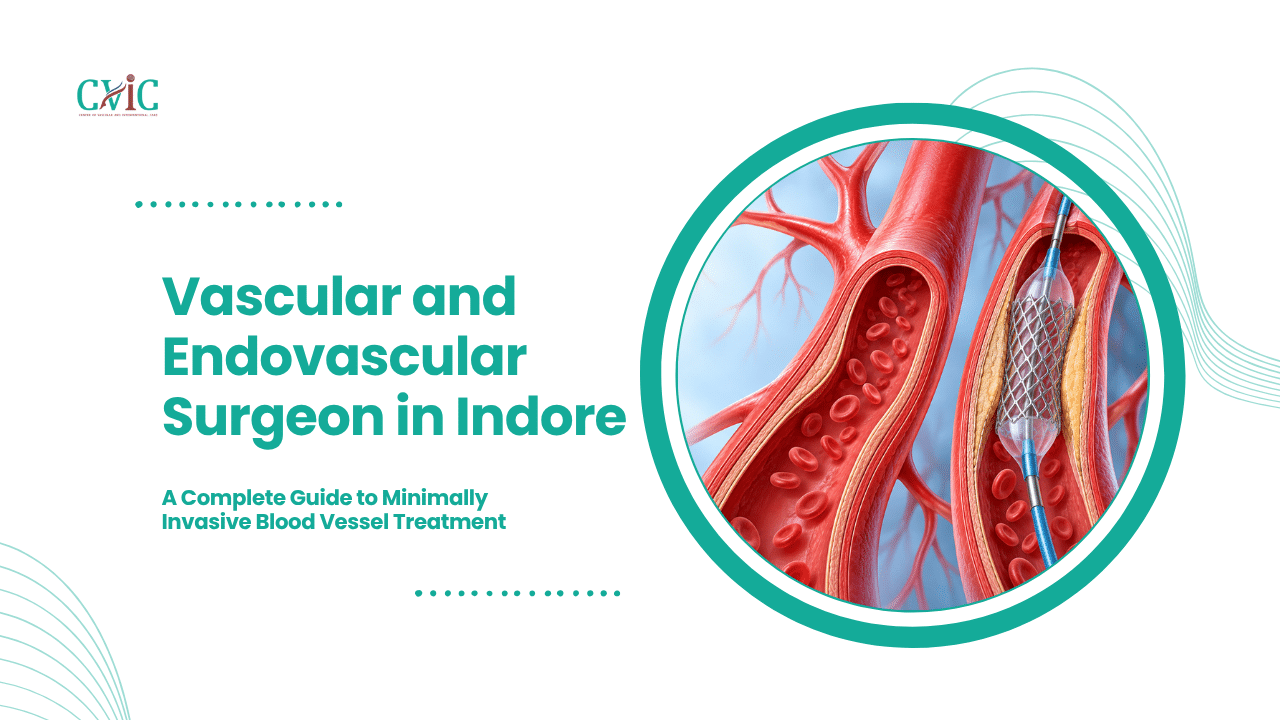
Not long ago, treating a blocked artery, a brain aneurysm, or a large blood clot often meant major open surgery, a long hospital stay, and weeks of recovery. Today, many of these same problems can be treated through a tiny puncture no bigger than a pen tip. This is called endovascular treatment, and it has changed how blood vessel diseases are managed.
If you are searching for a vascular and endovascular surgeon in Indore, you likely want to know what these procedures involve, whether they are safe, and whether you are a suitable candidate. This guide answers those questions in simple language.
At CVIC Indore, our specialists use advanced imaging to guide minimally invasive procedures inside the blood vessels, helping patients from Indore and across Madhya Pradesh recover faster with less pain.
Key Takeaways
Endovascular means treating a blood vessel from the inside, using thin tubes and wires guided by live imaging.
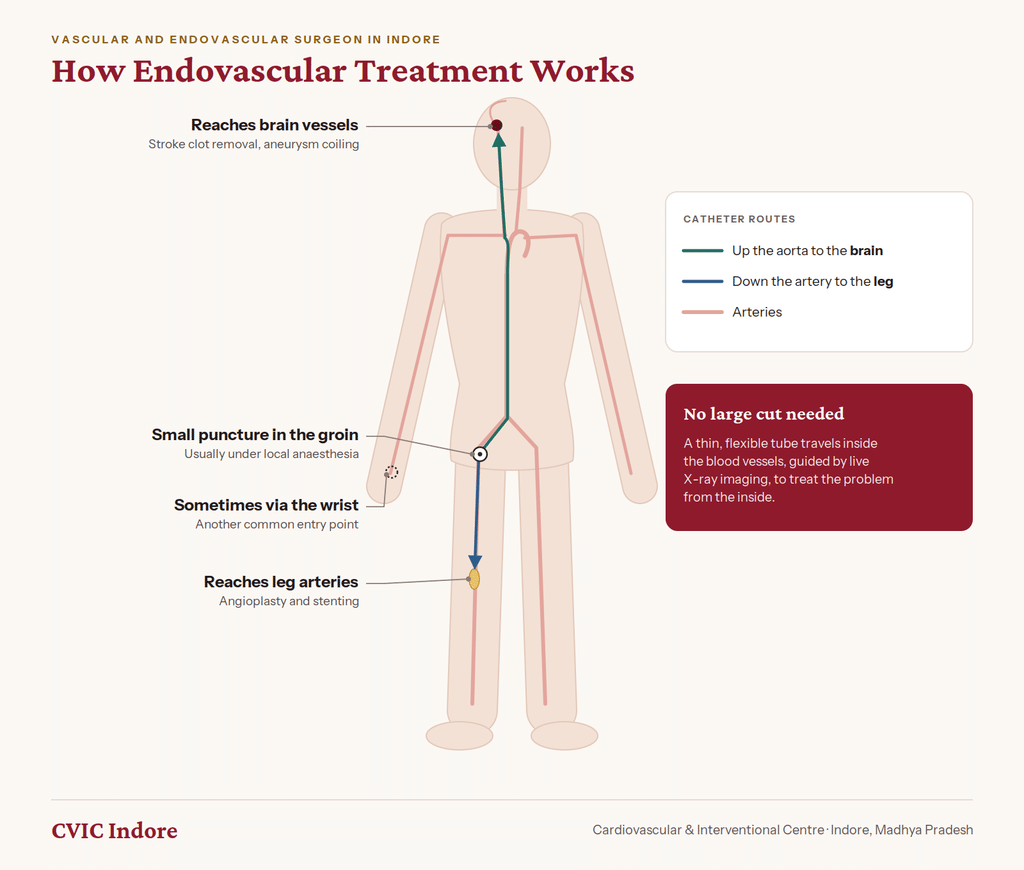
It is usually done through a small puncture in the groin or wrist, often under local anaesthesia.
It can treat stroke, aneurysms, blocked arteries, clots, varicose veins, and more.
Benefits include less pain, smaller scars, shorter hospital stays, and faster recovery.
Open surgery is still the better choice for some patients; a good specialist will explain why.
What Is Endovascular Treatment?
The word “endovascular” means “inside the blood vessel”. In an endovascular procedure, the doctor does not open the body to reach the diseased vessel. Instead, a thin, flexible tube called a catheter is passed through a small puncture into an artery or vein, usually in the groin or wrist. Using live X-ray imaging, the catheter is steered through the blood vessels to the exact problem area, where it is used to open a blockage, remove a clot, seal an aneurysm, or close an abnormal vessel.
Also Read: Understanding Endovascular Surgery: The Future of Vascular Treatment
Vascular vs Endovascular: What Is the Difference?
- Vascular care covers all diseases of the arteries and veins, treated by any method: lifestyle changes, medicines, open surgery, or endovascular procedures.
- Endovascular care is the part of vascular care done from inside the blood vessel, without a large cut.
Who Performs Endovascular Procedures?
Endovascular procedures are performed by several types of specialists with dedicated training:
- Vascular surgeons trained in both open and endovascular techniques
- Interventional radiologists, who specialise in image-guided procedures throughout the body
- Neuro-interventional specialists, who focus on the blood vessels of the brain and spine
What matters most is not the title, but the specialist’s training and experience with the procedure you need.
How Does an Endovascular Procedure Work?
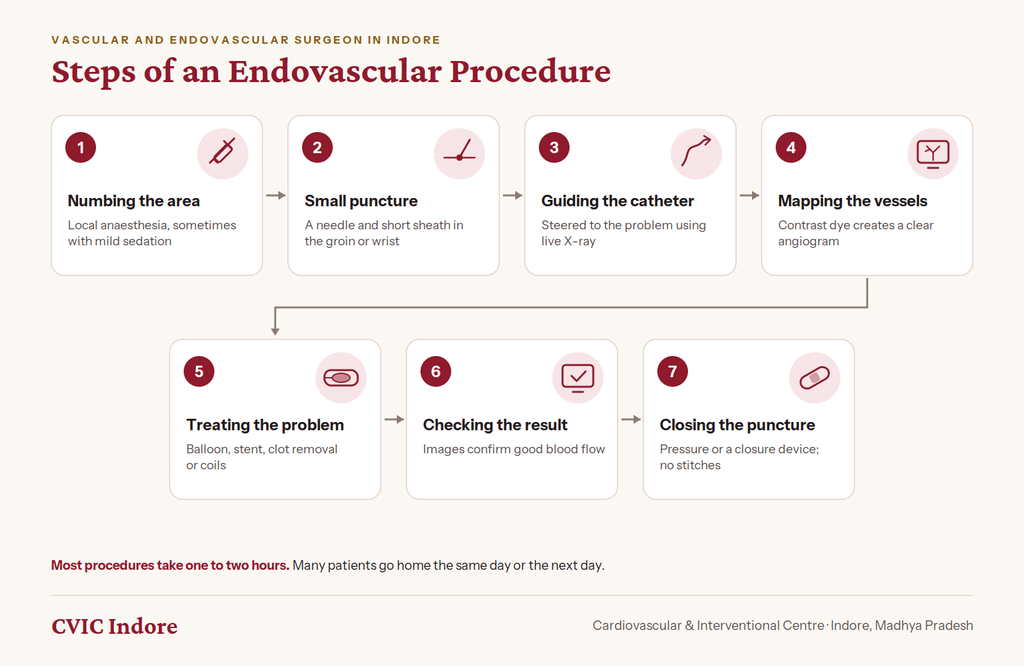
Most endovascular procedures follow the same basic steps:
- Numbing the area: The skin over the groin or wrist is cleaned and numbed with local anaesthesia. Some patients also get mild sedation to relax.
- Small puncture: A needle is placed into the artery or vein, and a short tube called a sheath is inserted to act as a doorway.
- Guiding the catheter: A thin guidewire and catheter are passed through the sheath and steered to the problem area using live X-ray imaging.
- Mapping the vessels: A contrast dye is injected to create a clear picture of the blood vessels, called an angiogram.
- Treating the problem: Depending on the condition, the doctor may inflate a balloon, place a stent, remove a clot, insert coils, or seal a vessel.
- Checking the result: More images confirm that blood is flowing well or the problem is sealed.
- Closing the puncture: The tubes are removed and the puncture is closed with pressure or a small closure device. No stitches are usually needed.
Many procedures take one to two hours, though complex ones can take longer.
Also Read: Endovascular Surgery Cost in India: Affordable, Advanced, and Accessible
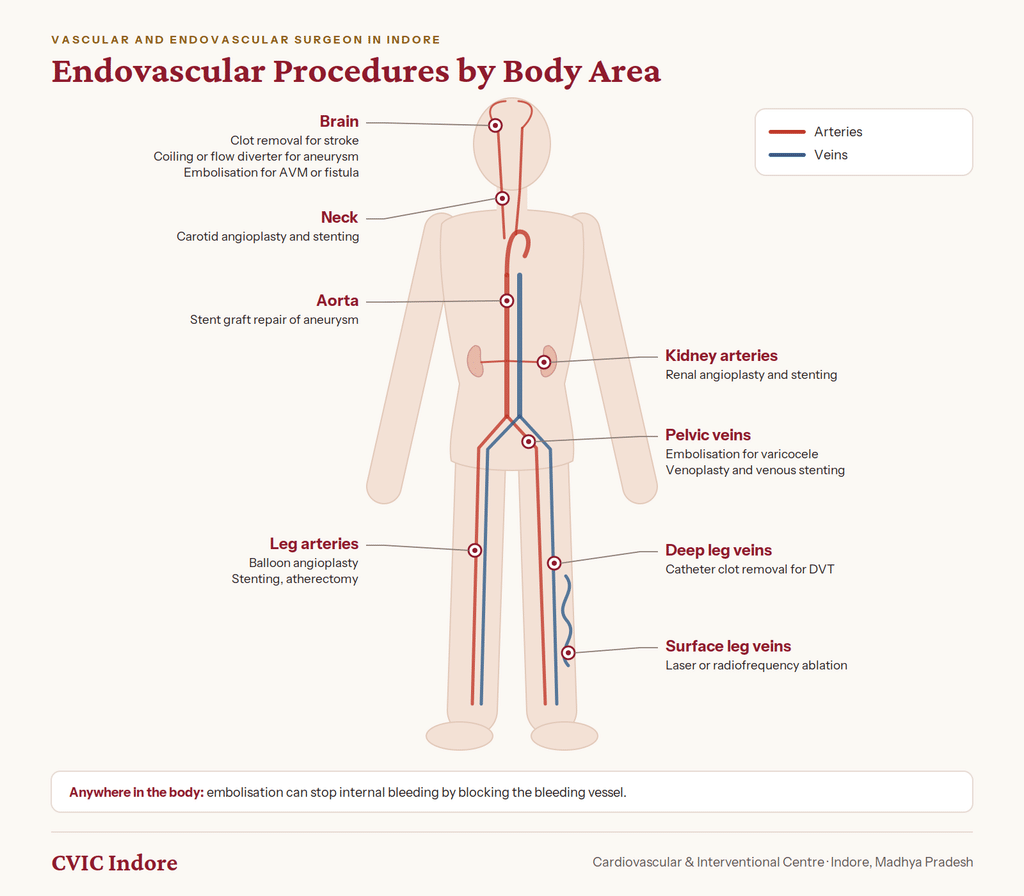
Common Endovascular Procedures
| Body area | Condition | Endovascular treatment |
|---|---|---|
| Brain | Acute ischaemic stroke | Mechanical thrombectomy (clot removal) |
| Brain | Brain aneurysm | Coiling, stent-assisted coiling, or flow diverter |
| Brain | Abnormal vessel connections (AVM, fistula) | Embolisation |
| Neck | Carotid artery narrowing | Carotid angioplasty and stenting |
| Abdomen and chest | Aortic aneurysm | Endovascular aneurysm repair with a stent graft |
| Legs | Peripheral artery disease | Balloon angioplasty, stenting, atherectomy |
| Legs | Deep vein thrombosis | Catheter-directed thrombolysis or thrombectomy |
| Legs and pelvis | Narrowed or blocked veins | Venoplasty and venous stenting |
| Legs | Varicose veins | Endovenous laser or radiofrequency ablation |
| Pelvis | Varicocele or pelvic congestion | Vein embolisation |
| Anywhere | Internal bleeding | Embolisation to block the bleeding vessel |
| Kidney | Narrowed kidney artery | Renal angioplasty and stenting |
Not every centre offers every procedure.
Benefits of Endovascular Treatment
- No large cut: Treatment is done through a puncture a few millimetres wide.
- Usually local anaesthesia: Many patients stay awake and comfortable.
- Less pain and blood loss than open surgery.
- Shorter hospital stay: Often same day to a day or two.
- Faster recovery: Many people return to light activity within days.
- Option for high-risk patients: Older patients or those with heart or lung problems may not be fit for open surgery but can often have an endovascular procedure.
- Time-critical treatment: In stroke, endovascular clot removal can restore blood flow to the brain quickly.
Possible Risks
Endovascular procedures are generally safe, but like any procedure they carry some risks. Your doctor will explain those that apply to you:
- Bruising, bleeding, or swelling at the puncture site
- Reaction to the contrast dye
- Effect of contrast dye on kidney function, especially in people with existing kidney disease
- Injury to the blood vessel
- Re-narrowing of a treated artery over time, sometimes needing a repeat procedure
- Rarely, a clot or debris moving to another part of the body
Tell your doctor about any allergies, kidney problems, diabetes, or blood thinners before the procedure.
Also Read: Best Neuro Interventional Radiologist in Indore | Advanced Neurovascular Care at CVIC Indore
Are You a Candidate for Endovascular Treatment?
Whether endovascular treatment is right for you depends on:
- The condition and its location: Some blockages or aneurysms are well suited to a catheter; others are not.
- The shape and length of the blockage: Short, focal narrowings often respond very well.
- Your overall health: Endovascular treatment can be a safer option for people who are not fit for major surgery.
- Kidney function and allergies: These affect the use of contrast dye.
- Your preferences and lifestyle needs.
When Open Surgery May Be Better
- Very long or complex blockages in the leg arteries
- Some aneurysms with a shape that a stent graft cannot seal safely
- Repeated failure of earlier endovascular treatment
- Infection of a blood vessel or graft
- Certain carotid artery narrowings, depending on the person’s age and risks
A trustworthy specialist will discuss both approaches and, when surgery is the better option, will say so and refer you appropriately.
Preparing for an Endovascular Procedure
- Share all your reports, scans, and a list of medicines with your doctor.
- Ask whether to continue or pause blood thinners or diabetes medicines; never stop them on your own.
- Tell your team about allergies, especially to iodine or contrast dye, and any kidney problems.
- You may need blood tests and a scan beforehand.
- You will usually be asked not to eat for a few hours before the procedure.
- Arrange for someone to take you home.
On the Day of the Procedure
- A small IV line is placed in your arm for fluids and medicines.
- The puncture site is cleaned and numbed.
- You may feel slight pressure, or warmth when the contrast dye is injected, but usually no sharp pain.
- Your team monitors your heart rate, blood pressure, and oxygen throughout.
Recovery and Aftercare
- You rest for a few hours, keeping the leg or arm with the puncture still.
- Many patients go home the same day or the next day; brain procedures and stroke treatment may need a longer stay.
- Mild bruising at the puncture site is normal.
- Avoid heavy lifting and strenuous exercise for the period your doctor advises.
- Take prescribed medicines, such as blood thinners, exactly as instructed.
- Attend follow-up scans and visits.
Seek help urgently if you notice growing swelling or bleeding at the puncture site, a cold or numb limb, chest pain, breathlessness, or any new weakness, speech problems, or severe headache.
Choosing a Vascular and Endovascular Surgeon in Indore
When choosing a vascular and endovascular surgeon in Indore, focus on these essentials:
- Dedicated endovascular training in the area you need treated, whether brain, neck, legs, or veins.
- A modern catheterisation lab (cath lab) with high-quality imaging, essential for safe endovascular work.
- Experience with your specific procedure, such as stroke thrombectomy, aneurysm coiling, or leg angioplasty.
- Round-the-clock availability for emergencies like stroke, where every minute matters.
- Balanced advice that includes open surgery when it is the better choice.
- Clear explanations of benefits, risks, recovery, and cost.
Quick Questions to Ask
- Is my condition suitable for an endovascular procedure?
- Which specific procedure do you recommend, and why?
- How often do you perform it?
- What are the risks for someone with my health conditions?
- How long will I stay in hospital?
- What follow-up will I need?
Endovascular Care at CVIC Indore
CVIC Indore is a cardiovascular and interventional centre built around precise imaging and minimally invasive, image-guided treatment inside the blood vessels. Our team has a particular focus on the blood vessels of the brain and on stroke care.
Our Specialist Team
- Dr. Alok K Udiya — Neuroradiology and Vascular Imaging: Dr. Udiya’s expertise in neuroradiology and vascular imaging guides the whole treatment journey, from confirming the diagnosis on CT, MRI, and angiography to planning the safest route for each endovascular procedure.
- Dr. Shailesh Gupta — Interventional Neurology and Stroke Management: Dr. Gupta specialises in interventional neurology and stroke management, including rapid assessment of stroke patients who may benefit from endovascular clot removal, and long-term stroke prevention.
- Dr. Nishant Bhargava — Cerebrovascular Intervention: Dr. Bhargava performs endovascular procedures on the blood vessels of the brain, such as treatment of stroke, aneurysms, and abnormal vessel connections, through a small puncture instead of open surgery.
Why Patients Choose CVIC Indore
- Endovascular focus, especially for brain and stroke-related conditions
- Advanced imaging for accurate diagnosis and planning
- Team-based decisions on complex cases
- Honest advice, including referral when open surgery suits a patient better
- Clear explanations and dedicated follow-up
Location: [CVIC INDORE ADDRESS]
Appointments: [PHONE NUMBER]
Emergency contact: [EMERGENCY NUMBER]
Frequently Asked Questions
What is a vascular and endovascular surgeon?
A vascular and endovascular surgeon treats diseases of the arteries and veins, using open surgery and minimally invasive procedures done from inside the blood vessel. Interventional radiologists and neuro-interventional specialists also perform endovascular procedures.
What does endovascular mean?
Endovascular means “inside the blood vessel”. The doctor treats the problem using thin tubes and wires passed through a small puncture, guided by live imaging.
Is endovascular treatment safe?
It is generally safe and usually has fewer complications than open surgery. Risks include bleeding at the puncture site, contrast dye reactions, and vessel injury, which your doctor will explain.
Is an endovascular procedure painful?
Most are done under local anaesthesia. You may feel pressure or warmth but usually no sharp pain.
How long does recovery take?
Many patients go home the same day or the next day and return to light activity within days. Brain and stroke procedures may need a longer stay.
Can a stroke be treated with an endovascular procedure?
Yes. In stroke caused by a large clot, mechanical thrombectomy can remove the clot through a catheter.
Can brain aneurysms be treated without open surgery?
Many brain aneurysms can be treated with coiling or flow-diverter stents placed through a catheter, without opening the skull.
Will I need a repeat procedure?
Some treated arteries can narrow again over time.
Is endovascular treatment covered by insurance?
Many policies cover endovascular procedures. Check with your insurer and ask the hospital for a written estimate.
Does CVIC Indore perform endovascular procedures?
Yes. CVIC Indore focuses on advanced imaging and endovascular treatment, especially for brain blood vessel conditions and stroke.
Conclusion
Endovascular treatment has made blood vessel care safer and more comfortable for many patients. A small puncture, precise imaging, and the right expertise can now treat problems that once needed major surgery, with faster recovery and less pain.
If you are looking for a vascular and endovascular surgeon in Indore, choose a team with dedicated endovascular training, advanced imaging, and the honesty to recommend open surgery when it is the better choice.
Book a consultation at CVIC Indore with Dr. Alok K Udiya, Dr. Shailesh Gupta, and Dr. Nishant Bhargava to understand your options for minimally invasive blood vessel treatment.
Medical disclaimer: This article is for general information only and is not a substitute for professional medical advice, diagnosis, or treatment. Treatment choices depend on each patient’s condition. In an emergency such as a stroke, call emergency services immediately.