

You waited days for your biopsy report. You opened it hoping for a clear answer. Instead, it says “inconclusive.” If you feel confused, worried, or even frustrated right now, that is completely normal.
Here is the good news: an inconclusive biopsy report is not a bad result. It simply means the sample did not give doctors enough information to make a final diagnosis. It is a pause, not a verdict.
At CVIC Indore, we meet many patients and families in this exact situation. In this guide, we explain in simple words what an inconclusive biopsy means, why it happens, what the next steps are, and how you can get a clear answer with the right care.
Key Takeaways
- An inconclusive biopsy report means the result is unclear, not that something is wrong.
- Common causes include too little tissue, a sample taken from the wrong spot, or cells that are hard to classify.
- Next steps may include extra lab tests, a second opinion, more scans, or a repeat biopsy.
- An image-guided biopsy (using CT or ultrasound) often gives a clearer answer the second time.
- Most patients get a final diagnosis after one more step. Ask your doctor what that step is for you.
What Is a Biopsy?
A biopsy is a test where a doctor removes a small piece of tissue or a few cells from your body. A pathologist (a doctor who studies tissue under a microscope) then examines it to find out what is going on.
Doctors usually advise a biopsy when a scan shows a lump, growth, or unusual area. The biopsy helps confirm whether it is an infection, inflammation, a harmless (benign) growth, or something that needs urgent treatment.
Common Types of Biopsy
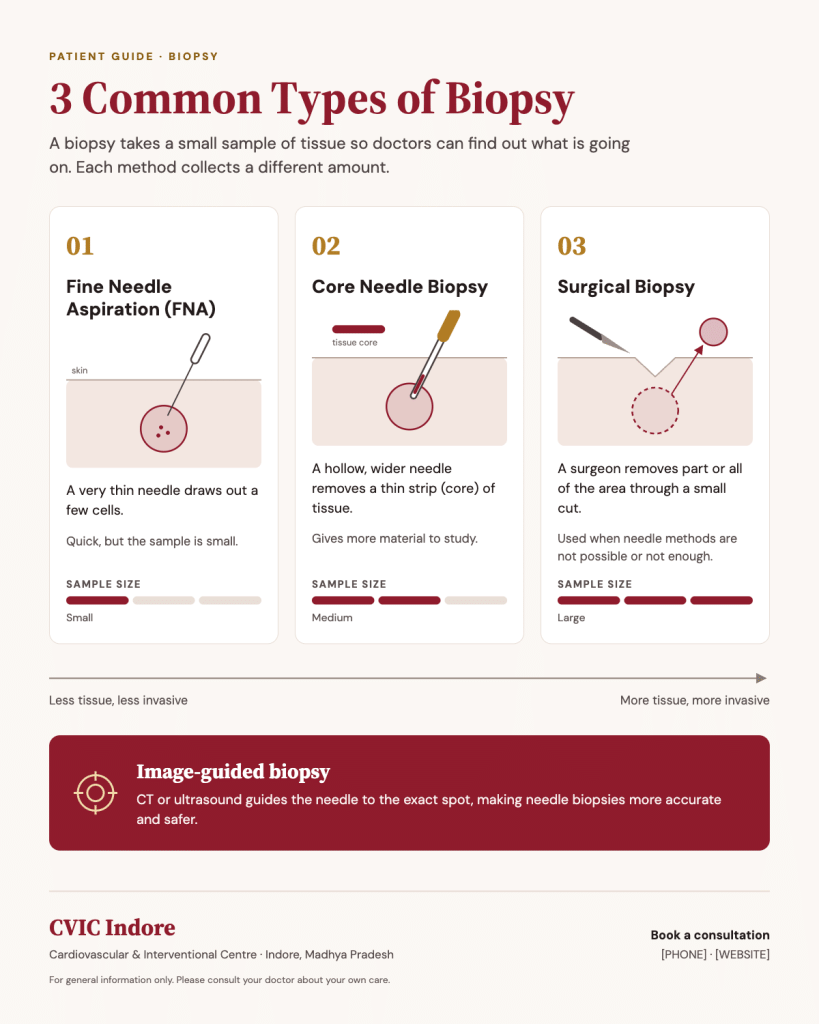
- Fine needle aspiration (FNA): A very thin needle draws out a few cells. It is quick, but the sample is small.
- Core needle biopsy: A slightly larger hollow needle removes a thin strip (core) of tissue. This gives more material to study.
- Image-guided biopsy: The needle is guided using live imaging so it reaches the exact target. The two most common are:
- CT-guided biopsy: Uses a CT scan (detailed X-ray images in slices) to guide the needle to deeper areas like the lungs, bones, or abdomen.
- Ultrasound-guided biopsy: Uses sound waves to show the area in real time. It is often used for the thyroid, liver, breast, and lymph nodes.
- Surgical biopsy: A surgeon removes part or all of the abnormal area through a small cut. It is used when needle methods are not possible or not enough.
Each type has its strengths. The right choice depends on where the abnormal area is, its size, and how safely it can be reached.
Also Read: What Patients Need to Know Before a Breast Biopsy with the Encor Enspire System
What Does an Inconclusive Biopsy Report Mean?
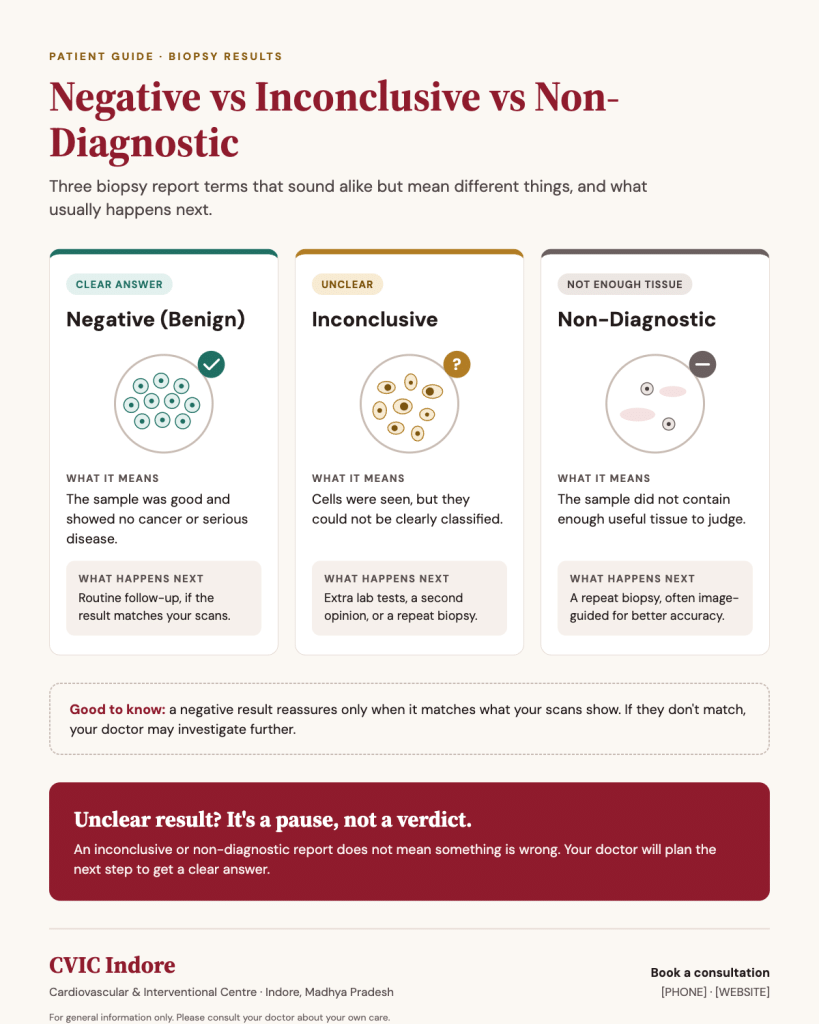
An inconclusive biopsy report means the pathologist could not reach a firm answer from the sample. The report may use words like “inconclusive,” “non-diagnostic,” “insufficient sample,” “indeterminate,” or “atypical cells.”
In simple terms, the test did not fail you. It just did not collect enough clear information. Think of it like a blurry photo: the object is there, but you need a sharper picture to be sure what it is.
This is why your doctor will not stop at an inconclusive biopsy result. They will plan the next step to get a clear diagnosis.
Inconclusive vs. Negative vs. Non-Diagnostic Biopsy
These terms sound similar, but they mean different things:
| Term | What it means | What usually happens next |
|---|---|---|
| Negative (benign) | The sample was good and showed no cancer or serious disease | Routine follow-up, if the result matches the scans |
| Inconclusive / Indeterminate | Cells were seen, but they could not be clearly classified | Extra lab tests, second opinion, or repeat biopsy |
| Non-diagnostic | The sample did not contain enough useful tissue to judge | Repeat biopsy, often image-guided |
| Positive | A clear diagnosis was made (for example, infection or cancer) | Treatment planning |
One important point: a “negative” result only reassures if it matches what the scans show. If the scan strongly suggests a problem but the biopsy looks normal, doctors may still treat it as unclear and investigate further.
Common Reasons a Biopsy Is Inconclusive
An inconclusive biopsy is rarely anyone’s fault. The body is complex, and some areas are simply harder to sample. Here are the most common reasons:
- Too little tissue: The needle collected only a few cells, not enough for the pathologist to judge properly.
- Sample from the wrong spot: A lump may have healthy and unhealthy parts. If the needle hits the healthy or dead (necrotic) part, the real problem can be missed.
- Crushed or damaged sample: Tissue can get squeezed or broken while being taken or handled, which makes the cells hard to read.
- Unclear cell changes: Some cells look “atypical” (slightly unusual). They are not clearly normal and not clearly harmful, so more tests are needed.
- Difficult location: Growths deep inside the body, near blood vessels, or close to vital organs are harder to reach safely.
- Small size of the lesion: A lesion (any abnormal area of tissue) that is very small is a tiny target and easy to miss.
- Inflammation or infection around the area: Swelling and infection can hide or mimic other changes under the microscope.
- Mostly blood or fluid in the sample: Sometimes the needle draws more blood than tissue, leaving little to examine.
Knowing the reason helps your doctor choose the best next step. Always ask, “Why was my biopsy result inconclusive?”
Also Read: Vacuum-Assisted Breast Biopsy vs Core Needle Biopsy: 5 Reasons to Choose Encor Enspire
Does an Inconclusive Biopsy Mean Cancer?
No. An inconclusive biopsy does not mean you have cancer. It also does not rule it out. It simply means the answer is not known yet.
Many inconclusive results later turn out to be harmless conditions, such as a benign growth, a cyst, scar tissue, or inflammation. In some cases, further testing does find a condition that needs treatment. The point of the next step is to find out which one it is, so you get the right care.
Here is what helps doctors judge the level of concern:
- What your scans (CT, MRI, ultrasound) show about the size, shape, and edges of the area
- Your symptoms and medical history
- Any blood test results
- Whether the area has changed over time
If your doctor feels the overall picture is low-risk, they may suggest monitoring. If the picture raises concern, they will move faster with a repeat biopsy or more tests. Either way, staying in close touch with your doctor is the safest path.
What Happens Next After an Inconclusive Biopsy Report?
Your doctor will choose the next step based on your scans, symptoms, and the reason the result was unclear. Not every patient needs every step below. Often, one or two are enough.
1. Doctor Review and Team Discussion
First, your doctor reviews the biopsy report alongside your scans and history. In many cases, a multidisciplinary team (a group of specialists from radiology, pathology, and the treating department) discusses the case together. This helps decide whether the result matches the scans or needs more work.
2. Extra Lab Tests on the Same Sample
Sometimes the existing tissue can still give answers with special tests, so you may not need another needle at all:
- Special stains: Dyes that highlight certain features in cells or detect infections.
- Immunohistochemistry (IHC): A test that uses markers to identify the type of cells present.
- Molecular or genetic tests: Tests that look for specific changes in the cells’ genetic material.
3. Second Opinion on the Pathology Slides
You can ask for your slides and tissue blocks to be reviewed by another experienced pathologist. A fresh expert view can sometimes turn an unclear result into a clear one. This is common, accepted practice, and your doctor will not be offended.
4. Repeat Biopsy
If the sample was too small or from the wrong spot, a repeat biopsy is often the best option. The second attempt is usually planned more carefully, often with image guidance, a larger needle, or more samples taken in one sitting.
5. Additional Imaging
More scans can help target the right spot or show how the area behaves:
- CT scan: Detailed cross-section images of the body.
- MRI: Uses magnets and radio waves to show soft tissues in fine detail.
- PET scan: Shows which areas are more active, helping pick the best spot for a repeat biopsy.
- Ultrasound: Real-time images, useful for areas near the surface.
6. Watchful Waiting and Follow-Up Scans
If the overall risk looks low, your doctor may suggest repeating a scan after a set period, area stays the same, that is often reassuring. If it grows or changes, the next step is taken without delay. Never skip these follow-up visits.
Also Read: MRI vs Ultrasound vs Stereotactic Breast Biopsy | Encor Enspire | CVIC Indore
How Image-Guided Biopsy Improves Accuracy
One of the most common reasons for an inconclusive result is that the needle did not sample the right part of the lesion. Image-guided biopsy solves much of this problem.
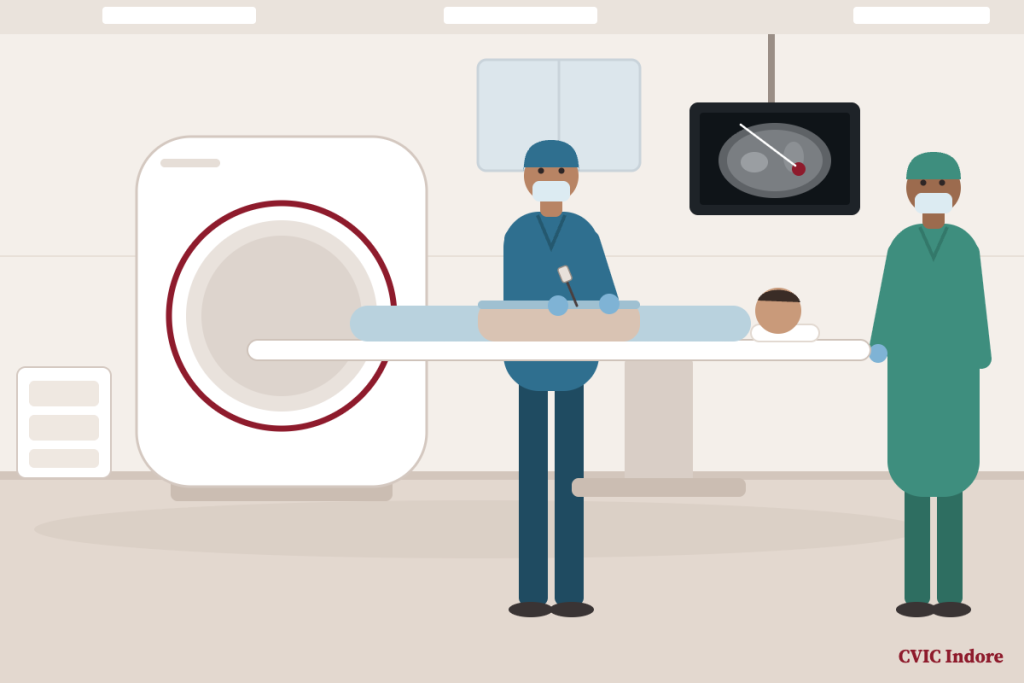
In an image-guided biopsy, an interventional radiologist (a doctor trained to perform procedures using imaging) watches the needle on a CT or ultrasound screen as it moves. This allows them to:
- Hit the exact target, even if it is small or deep inside the body
- Choose the most active part of the lesion, avoiding dead or fluid-filled areas
- Avoid blood vessels and nearby organs, which makes the procedure safer
- Take several samples from different parts in one sitting through a single entry point
- Confirm the needle position before each sample is taken
Most image-guided needle biopsies are done under local anaesthesia (numbing only the area), through a tiny skin puncture, with no large cut. Many patients go home the same day after a short observation period.
At CVIC Indore, imaging expertise is central to how we approach diagnosis. Dr. Alok K Udiya, who specialises in neuroradiology and vascular imaging, brings deep experience in reading complex scans and planning the safest, most precise path to a target.
How Long Until You Get a Clear Answer?
The time depends on which next step your doctor chooses. As a general guide:
- Extra lab tests on the same sample: usually a few days to about a week
- Second opinion on slides: often one to two weeks, depending on transport and review
- Repeat biopsy: can usually be scheduled soon; results typically follow within a week or so
- Follow-up scans (watchful waiting): weeks to a few months, as advised by your doctor
If you feel the wait is too long, speak up. Your doctor can tell you whether your case needs to be prioritised.
Coping With the Uncertainty
Waiting for answers can be harder than the procedure itself. Anxiety, poor sleep, and constant worry are all common. A few things can help:
- Get the facts from your doctor, not from random internet searches or forwarded messages.
- Take a family member to appointments to listen and take notes.
- Keep a folder of all reports, scans, and CDs so nothing gets lost.
- Stay active and eat well as much as you can.
- Talk about it with someone you trust. If worry becomes overwhelming, ask your doctor about counselling support.
Questions to Ask Your Doctor
Take this list to your next appointment:
- Why exactly was my biopsy report inconclusive?
- What do my scans suggest, based on everything you know so far?
- Can more tests be done on the sample already taken?
- Should I get a second opinion on my pathology slides?
- Do I need a repeat biopsy? If yes, how will it be different this time?
- Will the repeat biopsy be CT-guided or ultrasound-guided?
- What are the risks of the repeat procedure, and how do I prepare?
- Do I need any more scans, such as MRI or PET?
- How soon should the next step happen?
- What symptoms should make me contact you right away?
Why Choose CVIC Indore for Biopsy and Diagnosis
When a biopsy result is unclear, the quality of the next step matters most. CVIC Indore brings together imaging expertise, minimally invasive procedures, and specialist doctors under one roof, so patients from Indore and across Madhya Pradesh can get answers without running from place to place.
Meet Our Specialists
- Dr. Alok K Udiya — Neuroradiology and Vascular Imaging: Dr. Udiya specialises in reading and interpreting complex brain, spine, and vascular scans. His imaging expertise helps pinpoint the exact area to target and supports careful planning of image-guided procedures.
- Dr. Shailesh Gupta — Interventional Neurology and Stroke Management: Dr. Gupta treats complex brain and nerve conditions. For patients whose unclear findings involve the brain or nervous system, his clinical judgement helps decide the right next step and the urgency of care.
- Dr. Nishant Bhargava — Cerebrovascular Intervention: Dr. Bhargava specialises in minimally invasive procedures on the blood vessels of the brain. His experience is valuable when an abnormal area lies close to important blood vessels and needs a careful, safe approach.
What Patients Can Expect
- Advanced imaging to plan every procedure precisely
- Image-guided, minimally invasive procedures with small punctures instead of large cuts
- Team-based review, where specialists discuss unclear cases together
- Clear communication, with doctors explaining reports in simple language
- Patient-centric care that respects your time, worries, and questions
If you are looking for a trusted centre for biopsy in Indore, or need guidance after an unclear report, our team is here to help you move from uncertainty to clarity.
Frequently Asked Questions
Is an inconclusive biopsy bad?
No. An inconclusive biopsy is not a bad result. It means the sample did not give enough information for a final diagnosis. Your doctor will suggest the next step to get a clear answer.
Can a biopsy be repeated?
Yes. A repeat biopsy is common and safe in most cases. The second biopsy is often image-guided and planned more carefully to collect better samples.
How accurate is a needle biopsy?
Needle biopsies are generally very accurate, especially when guided by CT or ultrasound. Accuracy depends on the lesion’s size, location, and how much tissue is collected.
Is a repeat biopsy painful?
Most needle biopsies are done under local anaesthesia, so you may feel pressure but little pain. Mild soreness at the needle site for a day or two is normal.
What is the difference between non-diagnostic and inconclusive?
A non-diagnostic biopsy did not contain enough useful tissue. An inconclusive biopsy contained cells, but they could not be clearly classified. Both need further steps.
Does an inconclusive biopsy mean cancer?
No. It neither confirms nor rules out cancer. Many inconclusive results later turn out to be harmless conditions after further testing.
Should I get a second opinion on my biopsy?
A second opinion on pathology slides is reasonable when a result is unclear. It is common practice and can help confirm or clarify the diagnosis.
How long does it take to get repeat biopsy results?
Results usually come within a few days to about a week. Special tests may take slightly longer.
What is a CT-guided biopsy?
A CT-guided biopsy uses CT scan images to guide a needle precisely to a target inside the body. It is often used for deep areas like the lungs, bones, or abdomen.
Where can I get an image-guided biopsy in Indore?
CVIC Indore offers advanced imaging and image-guided procedures with an experienced specialist team. You can book a consultation to discuss your report and next steps.
Conclusion
An inconclusive biopsy report can feel like a setback, but it is only one step on the way to a clear diagnosis. With careful review, extra testing, better imaging, or a precise repeat biopsy, most patients get the answers they need.
The most important thing is not to ignore an unclear result. Follow up with your doctor, ask questions, and choose a team that can guide you with expertise and care.
Received an inconclusive biopsy report? Book a consultation at CVIC Indore with our specialist team, including Dr. Alok K Udiya, Dr. Shailesh Gupta, and Dr. Nishant Bhargava. Bring your reports and scans, and let us help you plan the right next step.
Medical disclaimer: This article is for general information only and is not a substitute for professional medical advice, diagnosis, or treatment. Every patient’s situation is different. Please consult a qualified doctor about your own biopsy results and care.