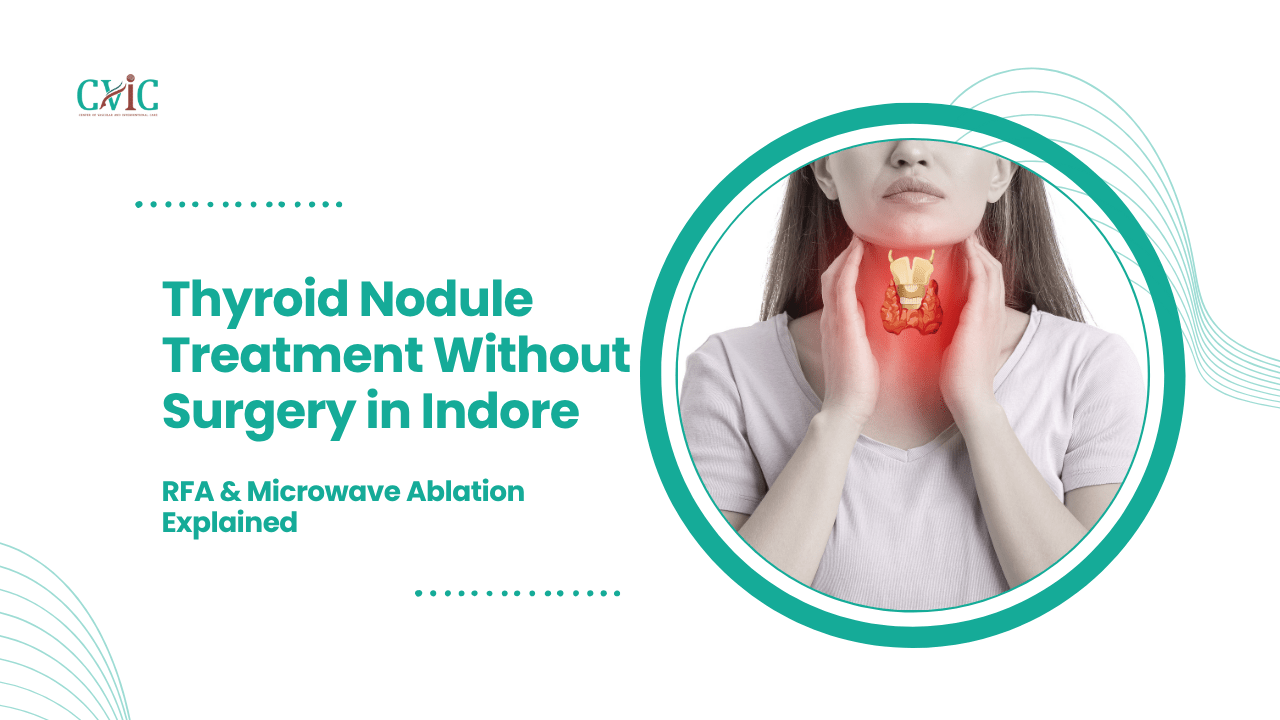
For decades, the standard answer to a troublesome thyroid nodule was the same: surgery. Open the neck, remove part or all of the thyroid gland, spend a few days in hospital, and live with a visible scar — sometimes along with lifelong thyroid hormone replacement tablets. For many patients, that is still the right answer. But for a large number of people with benign nodules, it no longer has to be.
Thyroid Nodule Treatment has changed significantly over the past decade with the arrival of image-guided thermal ablation — procedures that shrink a nodule from the inside out using heat, delivered through a needle-thin probe, with no incision at all. Two techniques lead this shift: Radiofrequency Ablation (RFA) and Microwave Ablation (MWA). Both are now available at CVIC Indore, and both are explained in full, technical detail in this guide.
Quick answer: Yes, many benign thyroid nodules can be treated without surgery using RFA or microwave ablation — both are minimally invasive, image-guided procedures that heat and shrink the nodule from inside, typically done under local anaesthesia in 30 to 60 minutes, with no visible scar and same-day discharge. Studies show 50–90% nodule volume reduction over 6–12 months for suitable candidates. Neither is right for every nodule — suspicious or confirmed malignant nodules are usually still managed differently — which is why proper evaluation at a center like CVIC Indore matters before choosing a path.
Also Read: Thyroid Health: Treating Hypothyroidism, Goiters, and Thyroid Nodules
What Is a Thyroid Nodule?
A thyroid nodule is a lump that forms within the thyroid gland, the butterfly-shaped gland at the base of the neck that regulates metabolism. Thyroid nodules are extremely common — it’s estimated that over 60% of adults will develop at least one thyroid nodule by the age of 60, and the vast majority are benign (non-cancerous). Most are found incidentally during an ultrasound or scan done for another reason, or when a nodule becomes large enough to be felt or seen.
Not every nodule needs treatment. Small, symptom-free, benign nodules are often simply monitored. Treatment — surgical or non-surgical — becomes relevant when a nodule causes visible neck swelling, pressure symptoms like difficulty swallowing or a sensation of tightness, cosmetic concern, or when it is “autonomously functioning” and producing excess thyroid hormone.
Why Consider Treatment Without Surgery?
Traditional thyroid surgery (thyroidectomy or lobectomy) is effective, but it comes with trade-offs that not every patient wants to accept for a benign nodule:
- A visible neck scar, which can be a genuine cosmetic and confidence concern
- General anaesthesia and its associated risks
- A hospital stay, typically one to a few days
- Risk of needing lifelong thyroid hormone replacement tablets, especially if a large portion of the gland is removed
- A recovery period of one to two weeks before returning to normal activity
- A small but real risk of injury to the parathyroid glands or the nerve controlling the voice box
For a nodule that has already been confirmed benign on biopsy, these trade-offs can feel disproportionate — which is exactly the gap that RFA and microwave ablation were developed to fill.
Also Read: Why Do I Have Thyroid Nodules? Causes, Symptoms, and Treatment
What Is Thermal Ablation? Introducing RFA and Microwave Ablation
Thermal ablation is a family of minimally invasive techniques that use heat, delivered precisely under continuous ultrasound guidance, to destroy targeted tissue while leaving the surrounding gland and structures untouched. Both RFA and microwave ablation belong to this family, along with less commonly used techniques like laser ablation. Despite using different forms of energy, all of them work on the same underlying principle: controlled thermal damage causes the nodule’s cells to die and the tissue to gradually shrink and reabsorb over the following months, without ever removing the gland itself.
How Radiofrequency Ablation (RFA) Works
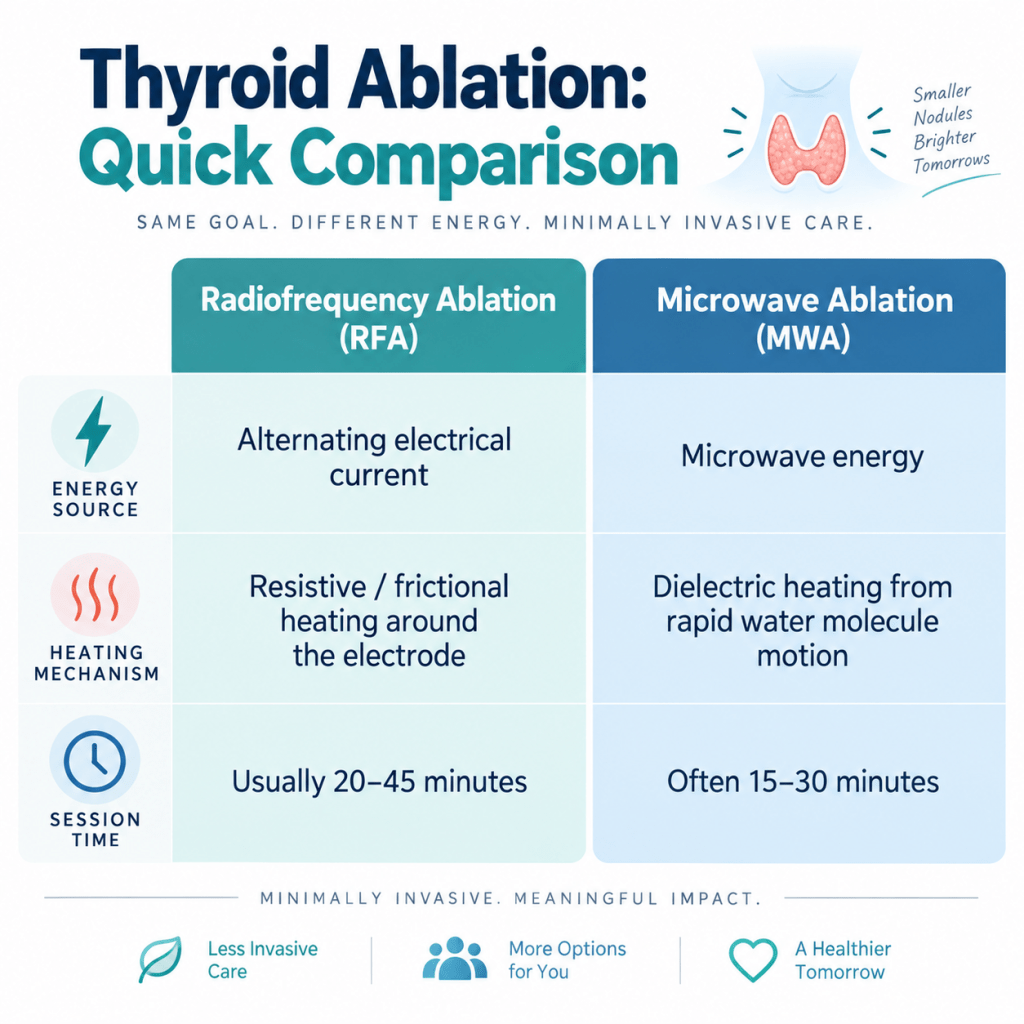
RFA uses a high-frequency alternating electrical current, delivered through a thin, internally cooled needle electrode inserted into the nodule under ultrasound guidance. This current causes the ions in the surrounding tissue to vibrate rapidly, generating frictional heat — a process called resistive (or Joule) heating — that reaches temperatures high enough to destroy the targeted tissue while sparing what lies just outside the treatment zone.
RFA for thyroid nodules is almost always performed using the “moving-shot” technique: rather than delivering energy from one fixed point, the operator mentally divides the nodule into small conceptual units and ablates them one at a time, continuously repositioning the needle tip. This allows the treatment to closely follow the nodule’s exact shape while maintaining a careful safety margin from critical nearby structures — the trachea, the carotid artery, and the recurrent laryngeal nerve that controls the voice box.
Also Read: Thyroid Nodules: 6 Causes and Symptoms and How We Can Help
How Microwave Ablation (MWA) Works
Microwave ablation uses a different form of energy entirely: electromagnetic microwaves, emitted from a thin antenna placed into the nodule. These microwaves cause water molecules within the tissue to oscillate at extremely high speed, generating heat through a process called dielectric heating — distinct from RFA’s electrical-current-based mechanism.
Because microwave energy is less affected by tissue charring and electrical impedance than radiofrequency current can be, each ablation zone can sometimes be created a little faster. Like RFA, MWA for thyroid nodules is delivered under real-time ultrasound guidance, generally using a similar moving-shot or track-based approach to safely cover the full nodule.
RFA vs Microwave Ablation: What’s the Real Difference?
Patients researching Thyroid Nodule Treatment options often ask which technique is “better.” The honest answer, based on current evidence, is that both are highly effective and safe for appropriately selected benign nodules, and neither has been conclusively shown to be superior to the other for routine use. Here is how they compare:
| Feature | Radiofrequency Ablation (RFA) | Microwave Ablation (MWA) |
|---|---|---|
| Energy source | High-frequency electrical current | Electromagnetic microwave energy |
| Heating mechanism | Resistive (Joule) heating | Dielectric heating |
| Technique | Moving-shot, unit-by-unit ablation | Moving-shot / track-based ablation |
| Guidance | Real-time ultrasound | Real-time ultrasound |
| Typical session time | 30–60 minutes | 30–60 minutes |
| Evidence base | The most extensively studied technique worldwide, with long-term (5–10 year) follow-up data | Growing evidence base, particularly strong for larger nodules |
| Anaesthesia | Local anaesthesia, often with mild sedation | Local anaesthesia, often with mild sedation |
In practice, the choice between RFA and microwave ablation depends less on which is “better” in the abstract and more on the nodule’s size, location, composition, and the treating specialist’s assessment and experience — which is exactly why an in-person evaluation at CVIC Indore is the right starting point rather than choosing a technique based on internet research alone.
Who Is a Good Candidate for Non-Surgical Thyroid Nodule Treatment?
RFA and microwave ablation are not appropriate for every thyroid nodule. Based on current clinical evidence and guidelines, good candidates typically include patients with:
- A confirmed benign nodule on fine-needle aspiration (FNA) biopsy — this step is non-negotiable and always comes first
- A solid or predominantly solid nodule, generally 2 cm or larger, causing pressure symptoms or cosmetic concern
- An autonomously functioning (hyperfunctioning) nodule causing mild hyperthyroidism, in select cases
- A preference to avoid surgery, general anaesthesia, or a visible scar
- No suspicious features on ultrasound or cytology that would warrant surgical removal instead
Patients with a multinodular goiter — multiple nodules rather than a single one — can sometimes still be candidates for ablation, treating the dominant, symptom-causing nodule(s) individually rather than removing the entire gland, though this needs careful case-by-case assessment. Similarly, a “toxic” or hyperfunctioning nodule causing mild thyrotoxicosis is sometimes managed with ablation as an alternative to radioactive iodine therapy or surgery, though results for hormonal control can be more variable than for straightforward symptomatic benign nodules.
Ablation is generally not the first choice for nodules that are suspicious for or confirmed as malignant on biopsy — these are usually still best managed with surgery or, in select specialist centers and research settings, closely monitored ablation protocols for very specific low-risk cancers. Pregnant patients and those with uncorrected bleeding disorders are also generally not candidates. This is precisely why biopsy and imaging come before any ablation decision, never after.
Step-by-Step: What Happens During the Procedure
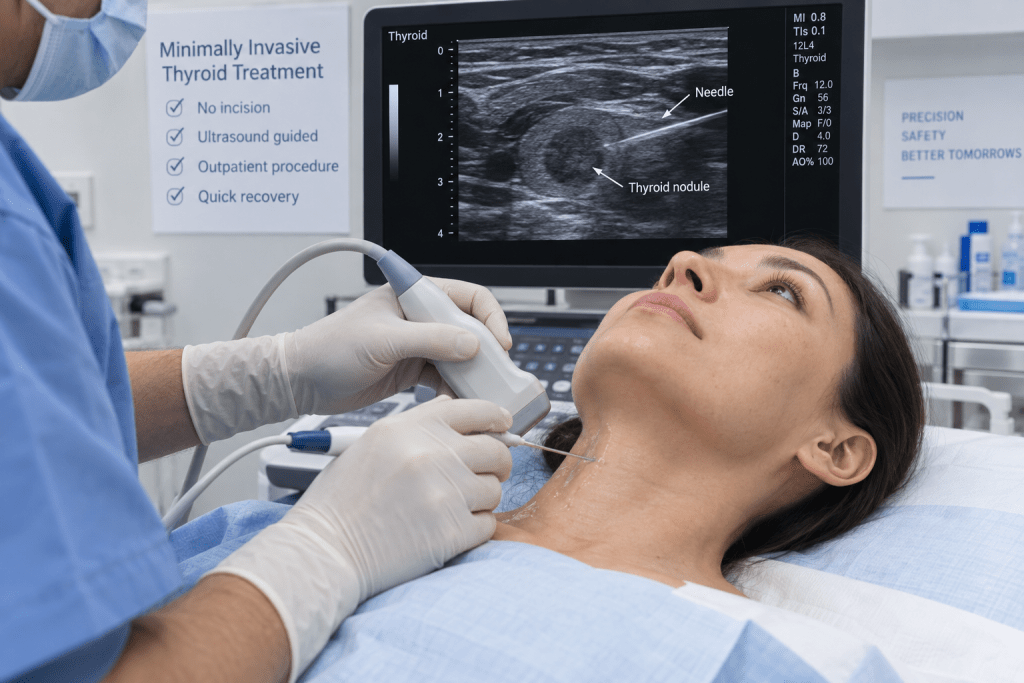
- Pre-procedure evaluation — ultrasound imaging and, if not already done, an FNA biopsy to confirm the nodule is benign.
- Positioning and local anaesthesia — the patient lies down with the neck slightly extended; local anaesthetic is applied to numb the skin and surrounding tissue.
- Needle/antenna placement — under continuous ultrasound guidance, the RFA electrode or MWA antenna is inserted precisely into the nodule.
- Ablation — energy is delivered in a controlled, moving-shot pattern until the targeted tissue has been treated, while the operator continuously monitors the ultrasound image.
- Monitoring — the patient is observed for a short period after the procedure to check for any immediate reaction.
- Same-day discharge — most patients go home the same day and can resume light activity within 24 hours.
The entire procedure typically takes 30 to 60 minutes, depending on nodule size and complexity.
Results & Recovery: What to Expect
Unlike surgery, where the nodule is physically gone the moment the operation ends, ablation results unfold gradually as the treated tissue is broken down and reabsorbed by the body:
- Symptom relief — pressure symptoms often begin improving within 2 to 4 weeks
- Cosmetic improvement — visible reduction in neck swelling is typically noticeable within 2 to 3 months
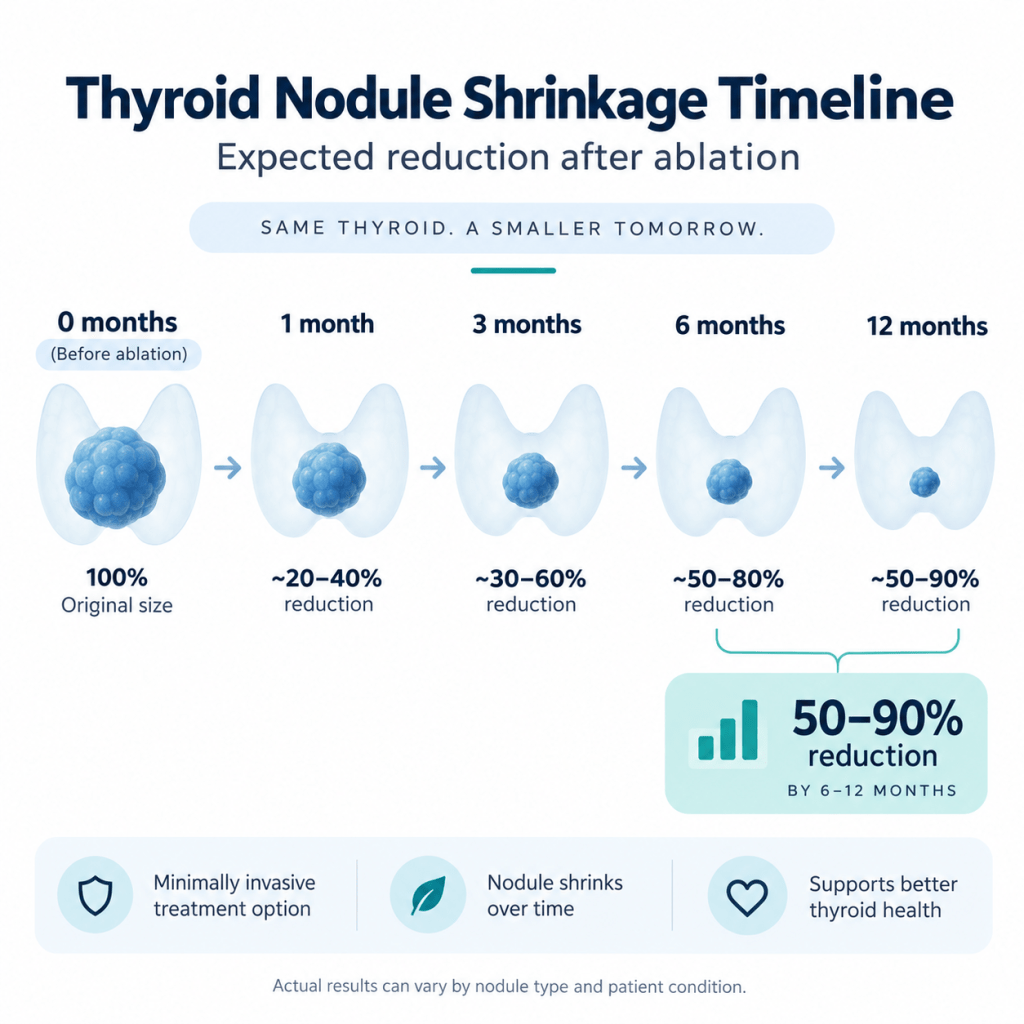
- Volume reduction — clinical studies report 50% to 90% nodule volume reduction over 6 to 12 months, with some long-term studies showing continued shrinkage of up to 90%+ over several years
- Recurrence — a small percentage of nodules regrow and may need a repeat session; long-term studies report recurrence rates in the range of roughly 4–6%
Most patients return to desk work the same or next day, and to full normal activity, including exercise, within a few days.
Follow-Up and Long-Term Monitoring After Ablation
Ablation is not a “one visit and forget it” treatment — like any thyroid nodule, whether treated surgically or not, it benefits from structured follow-up:
- A follow-up ultrasound is typically done at around 1, 3, 6, and 12 months to track how much the treated nodule has shrunk and confirm it is responding as expected.
- Thyroid function tests may be repeated periodically, particularly for nodules that were producing excess hormone before treatment.
- If a nodule does not shrink adequately, or symptoms persist, a repeat ablation session can often be performed — this is a genuine advantage over surgery, where re-operating is far more involved.
- Even after successful treatment, periodic thyroid check-ups remain a sensible long-term habit, the same way they would be recommended for anyone with a history of thyroid nodules.
Cost Considerations
Cost is a genuine, practical factor for most patients comparing ablation with surgery. While exact pricing depends on nodule size, number of sessions needed, and individual case complexity, ablation generally avoids several of the larger cost drivers of surgery — general anaesthesia, a multi-day hospital admission, and, in many cases, lifelong thyroid hormone medication. For a detailed, transparent breakdown specific to CVIC Indore, see the cost section within the Scarless Thyroid Procedure in Indore guide.
Safety & Possible Complications
RFA and microwave ablation for thyroid nodules have a strong safety record, with major complication rates typically cited at around 1% to 3% in published series — notably lower than the complication profile of open thyroid surgery. That said, “very safe” does not mean “risk-free,” and an honest guide covers both sides:
- Mild, temporary discomfort or swelling at the treatment site — the most common side effect, usually resolving within days
- Transient voice change or hoarseness — uncommon, and in the large majority of cases temporary, related to the nerve that runs close to the thyroid gland
- Skin burn — rare, minimized by cooling techniques and careful needle positioning
- Bleeding or small hematoma — uncommon and usually managed conservatively
- Undertreatment or regrowth — occasionally a nodule doesn’t shrink as expected and needs a repeat session or reconsideration of surgery
Thyroid hormone function is typically well preserved after ablation, since — unlike surgery — the healthy surrounding thyroid tissue is left largely intact.
RFA/Microwave Ablation vs Surgery: Side-by-Side
| Factor | RFA / Microwave Ablation | Traditional Surgery |
|---|---|---|
| Incision | None — needle puncture only | Visible neck incision/scar |
| Anaesthesia | Local, with mild sedation | General anaesthesia |
| Hospital stay | Same-day discharge | Typically 1–3 days |
| Recovery to light activity | Within 24 hours | 1–2 weeks |
| Thyroid function | Usually preserved | Hormone replacement often needed if a large portion is removed |
| Best suited for | Confirmed benign nodules | Suspicious/malignant nodules, very large or complex cases |
For a deeper look at this comparison specifically, see CVIC’s dedicated guides: Thyroid Nodule Ablation in Indore — A Safe, Scar-Free Alternative to Thyroid Surgery and Scarless Thyroid Procedure in Indore.
Why Choose CVIC Indore for Thyroid Nodule Treatment?
CVIC Indore — Center Of Vascular And Interventional Care — brings the same image-guided, minimally invasive philosophy used in its neuro and vascular interventions to thyroid care. The center’s interventional radiology team — Dr. Alok K. Udiya, Dr. Shailesh Gupta, and Dr. Nishant Bhargava — performs thyroid nodule ablation using high-resolution ultrasound guidance, with a strong focus on precision and patient safety.
CVIC Indore is equipped for the complete pathway a patient needs: diagnostic ultrasound, image-guided FNA biopsy, and both RFA and microwave ablation performed as outpatient, same-day procedures — all without the patient ever needing to be admitted for surgery.
Myths vs Facts: Thyroid Nodule Treatment Without Surgery
Myth: Ablation is only cosmetic and doesn’t really treat the nodule. Fact: Ablation destroys the targeted nodule tissue directly, leading to genuine, measurable volume reduction of 50–90% and real relief of pressure symptoms — not just a cosmetic fix.
Myth: RFA and microwave ablation can treat cancerous thyroid nodules just as well as surgery. Fact: Standard practice reserves ablation mainly for confirmed benign nodules. Suspicious or malignant nodules generally still require surgery, except in select, closely monitored specialist protocols.
Myth: The nodule disappears immediately after the procedure. Fact: Shrinkage happens gradually over weeks to months as the treated tissue is reabsorbed by the body — it is not an instant result.
Myth: Non-surgical treatment always damages thyroid hormone production. Fact: Because healthy surrounding thyroid tissue is preserved, thyroid function is usually maintained after ablation — unlike surgery, which can require lifelong hormone tablets if a large portion of the gland is removed.
Myth: Anyone with a thyroid nodule can get RFA or MWA. Fact: Candidacy depends on the nodule being confirmed benign on biopsy, along with its size, composition, and location — proper evaluation always comes first.
Frequently Asked Questions
1. What is the difference between RFA and microwave ablation for thyroid nodules? RFA uses electrical current to generate heat through resistive heating, while microwave ablation uses electromagnetic energy through dielectric heating. Both are ultrasound-guided, minimally invasive, and broadly similarly effective for suitable benign nodules.
2. Is thyroid nodule treatment without surgery painful? Most patients report only mild discomfort. The procedure is done under local anaesthesia, often with mild sedation, and most people return to light activity within 24 hours.
3. How much can a thyroid nodule shrink with RFA or microwave ablation? Clinical studies report volume reductions of roughly 50% to 90% over 6 to 12 months, with continued shrinkage sometimes seen over a longer follow-up period.
4. Can a cancerous thyroid nodule be treated with RFA or microwave ablation? Generally no — ablation is primarily used for confirmed benign nodules. Suspicious or malignant nodules are usually still treated with surgery, with only limited, specialist-guided exceptions.
5. Will I need thyroid hormone tablets after ablation? Usually not, since ablation targets only the nodule itself and preserves the surrounding healthy thyroid tissue, unlike surgery involving significant gland removal.
6. How long does the procedure take, and is it done under general anaesthesia? The procedure typically takes 30 to 60 minutes and is done under local anaesthesia with mild sedation, not general anaesthesia, with same-day discharge.
7. Does CVIC Indore offer both RFA and microwave ablation for thyroid nodules? Yes. CVIC Indore’s interventional radiology team offers both techniques, along with the ultrasound imaging and biopsy services needed to determine which nodules are suitable for non-surgical treatment.
Final Thoughts: A Real Alternative, Not a Universal One
RFA and microwave ablation have genuinely changed what Thyroid Nodule Treatment looks like for many patients — no incision, no general anaesthesia, no hospital stay, and a fast return to normal life, with strong evidence behind both techniques for confirmed benign nodules. But “non-surgical” is not the same as “right for everyone.” The nodule still needs to be properly imaged, biopsied where indicated, and evaluated by a specialist before any treatment path is chosen.
If you have a thyroid nodule causing symptoms, cosmetic concern, or uncertainty about the best path forward, that evaluation — not guesswork — is the right next step.
Visit CVIC Indore
CVIC — Center Of Vascular And Interventional Care 403, Panama Tower, Gita Bhawan Road, near Crown Palace, South Tukoganj, Indore, Madhya Pradesh 452008
Phone: 0731 4675670 / +91-8103727728 Email: cviccenter23@gmail.com Website: cvicvascular.com
For evaluation of a thyroid nodule, or to find out whether RFA or microwave ablation is right for your case, reach out to CVIC Indore directly.
Disclaimer: This blog is for educational purposes only and does not replace professional medical advice, diagnosis, or treatment. Whether RFA, microwave ablation, or surgery is appropriate for a specific thyroid nodule can only be determined after in-person evaluation, ultrasound imaging, and biopsy by a qualified specialist.