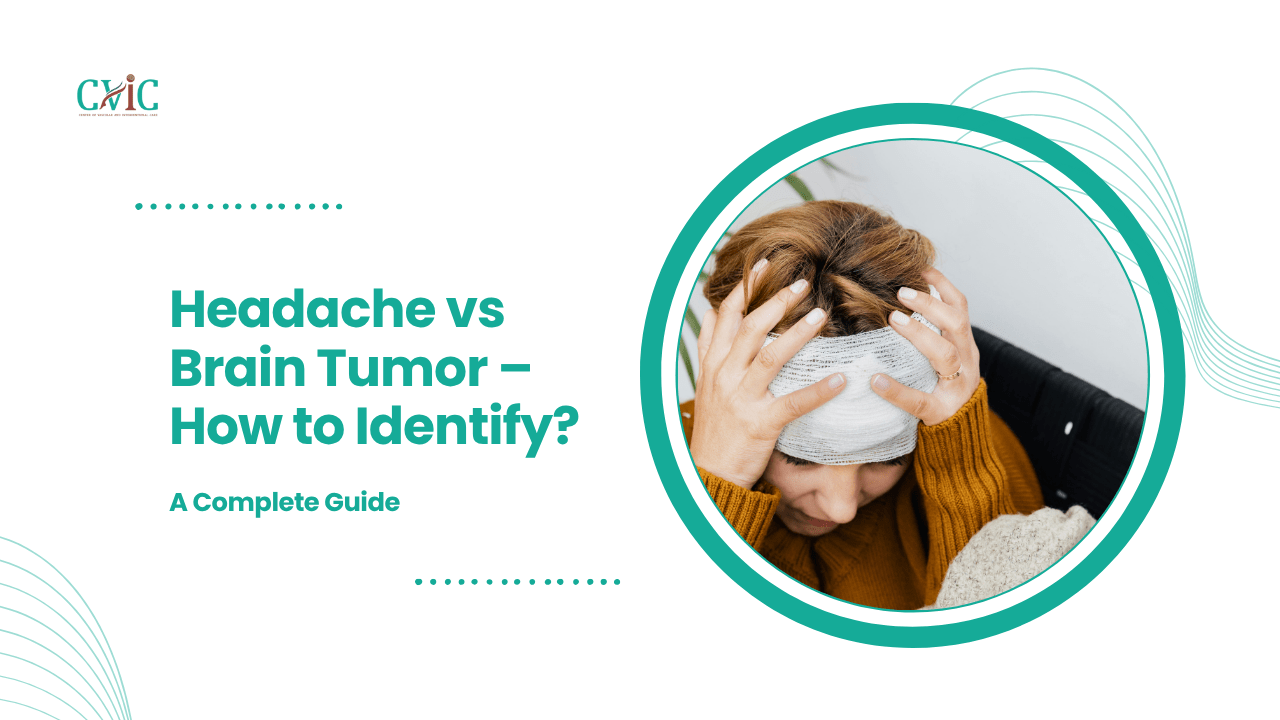
Headaches are one of the most common health complaints in the world. Almost every person has experienced a headache at some point in their life — after a long day at work, due to dehydration, stress, lack of sleep, or even too much screen time. In most cases, a headache is harmless and goes away on its own.
But every once in a while, a headache can be a sign of something more serious — like a brain tumor.
This thought alone is enough to make anyone anxious. You wake up with a pounding head and immediately start wondering: Is this just a normal headache, or is something seriously wrong inside my brain?
The good news is — the vast majority of headaches are NOT caused by brain tumors. But the key is knowing when to be concerned and when to get checked.
In this blog, the expert team at CVIC Indore — including Dr. Alok K Udiya, Dr. Shailesh Gupta, and Dr. Nishant Bhargava — walks you through everything you need to know about headache vs brain tumor — how they feel different, what red flags to watch for, and when to seek medical help.
First, Let’s Understand What a Brain Tumor Is
A brain tumor is an abnormal growth of cells inside the brain or the tissues surrounding it. Tumors can be:
- Benign (non-cancerous): They grow slowly and don’t spread to other parts of the body. But even a benign tumor can be dangerous if it presses on important brain areas.
- Malignant (cancerous): These grow faster, are more aggressive, and can invade nearby brain tissue.
Brain tumors can originate in the brain itself (called primary brain tumors) or spread to the brain from cancer elsewhere in the body (called secondary or metastatic brain tumors).
Now, here’s the important thing: not all brain tumors cause headaches, and not all headaches mean a brain tumor. So how do you tell the difference?
Also Read: Early Symptoms of Brain Tumor: Signs You Should Never Ignore | CVIC Indore
How Common Headaches Feel
Before we talk about brain tumor headaches, let’s understand what typical, everyday headaches feel like. This will help you notice what’s different.
Tension Headaches
These are the most common type. They feel like a tight band or pressure around the head, usually on both sides. Stress, poor posture, eye strain, and dehydration are common triggers. They come and go, and respond well to rest and basic painkillers.
Migraines
Migraines are more intense — they usually affect one side of the head, are throbbing in nature, and can be accompanied by nausea, vomiting, and sensitivity to light and sound. Many migraine sufferers have a pattern — they know what triggers their attacks and what relieves them.
Cluster Headaches
These are severe, burning headaches around one eye, occurring in “clusters” — multiple times a day for weeks, then disappearing for months. They’re rare but very painful.
Sinus Headaches
These come with facial pressure, nasal congestion, and are usually related to a sinus infection or allergies. They worsen when you bend forward.
All of these types of headaches are NOT caused by brain tumors. They have identifiable patterns, known triggers, and usually respond to standard treatment.
Also Read: Memory Loss – Normal or Serious? A Complete Guide by CVIC Indore
Headaches Caused by Brain Tumors — What Makes Them Different?
This is the heart of the headache vs brain tumor question. Brain tumor headaches have certain distinctive features that set them apart from common headaches. Here’s what the specialists at CVIC Indore, including Dr. Alok K Udiya, tell patients to watch out for:
1. Headaches That Are Worst in the Morning
One of the most classic features of a brain tumor headache is that it is worse when you wake up and tends to ease after an hour or so of being upright. This happens because when you lie flat during sleep, pressure inside the skull (intracranial pressure) increases slightly — and if a tumor is present, this extra pressure makes the headache worse.
A morning headache that regularly wakes you up or is present as soon as you open your eyes — and is not explained by sinusitis, sleep apnea, or alcohol — deserves attention.
2. Headaches That Get Progressively Worse Over Weeks or Months
Common headaches come and go. A brain tumor headache tends to gradually worsen over time — becoming more frequent, more intense, and lasting longer. This progression is an important red flag.
If you or a family member has had headaches that have been slowly getting worse over the past few weeks or months, and they don’t respond to regular painkillers like before, it’s time to consult a specialist.
3. Headaches With Vomiting — Especially in the Morning
Vomiting associated with brain tumors often occurs without nausea first — meaning the person vomits suddenly, almost without warning, especially in the morning. This is called projectile vomiting and is caused by raised intracranial pressure acting directly on the brain’s vomiting center.
This is different from migraine-related vomiting, which usually follows significant nausea and a typical migraine headache.
4. Headaches That Change With Position
If your headache gets significantly worse when you lie down, bend over, cough, sneeze, or strain (like during a bowel movement), it could be related to changes in intracranial pressure — a sign worth investigating. Tumors, especially those blocking the flow of cerebrospinal fluid, cause pressure to build with these activities.
5. Headaches Accompanied by Neurological Symptoms
This is perhaps the most important differentiating factor in the headache vs brain tumor debate. A brain tumor headache rarely occurs in isolation. It is often accompanied by other neurological signs such as:
- Weakness or numbness on one side of the body (arm, leg, or face)
- Difficulty speaking or understanding words (aphasia)
- Memory problems or sudden personality changes
- Seizures (fits) in a person with no prior history of epilepsy
- Problems with balance or coordination — stumbling, difficulty walking
- Vision changes — double vision, blurred vision, or loss of vision in part of the visual field
- Hearing changes — ringing in the ears or gradual hearing loss
If a headache comes with ANY of these symptoms — no matter how mild — please seek medical evaluation immediately.
Dr. Shailesh Gupta at CVIC Indore explains: “Most patients who come to us with brain tumors recall that their headache alone didn’t alarm them — it was when they noticed their handwriting changing, or their family pointed out that they were forgetting things, that they finally came in. Don’t wait for multiple symptoms. One is enough to get checked.”
6. New Headache Pattern in People Over 50
If someone who has never been a headache sufferer suddenly starts getting frequent, new headaches after the age of 50, it should be taken seriously. While still more likely to be a benign condition, new-onset headaches in older adults warrant imaging to rule out tumors or other structural causes.
7. Headaches in Cancer Patients
If a person has a history of cancer anywhere in the body (breast, lung, colon, etc.) and develops new or worsening headaches, it’s critical to rule out brain metastasis — the spread of cancer to the brain. This requires immediate evaluation at a center like CVIC Indore that has advanced neuroimaging facilities.
The Key Differences: Headache vs Brain Tumor — At a Glance
Let’s summarize the important differences clearly:
| Feature | Common Headache | Brain Tumor Headache |
|---|---|---|
| Time of day | Any time | Often worse in the morning |
| Pattern | Comes and goes | Gradually worsening over weeks/months |
| Response to painkillers | Usually improves | Often doesn’t respond well |
| Vomiting | With nausea (migraine) | Sudden, without nausea |
| Associated symptoms | Rare | Seizures, vision changes, weakness |
| Triggers | Stress, screen time, food | Position changes, coughing, straining |
| Duration | Hours | Days to weeks, getting worse |
| History | Recurring similar headaches | New type, different from before |
Other Conditions That Can Cause Serious Headaches
It’s important to note that a “serious headache” doesn’t always mean a brain tumor. There are other serious but treatable conditions that can cause alarming headaches, including:
- Brain aneurysm — a bulging blood vessel that can rupture (see our detailed blog on symptoms before brain aneurysm rupture)
- Meningitis — infection of the brain’s protective lining, causing severe headache, fever, and neck stiffness
- Hypertensive crisis — dangerously high blood pressure causing severe head pain
- Subdural hematoma — blood pooling between the brain and skull, often after a fall or head injury
The team at CVIC Indore, led by Dr. Nishant Bhargava, is experienced in distinguishing between all of these conditions quickly and accurately through advanced diagnostic protocols.
When Should You See a Doctor Immediately?
Here is a simple checklist. If any of the following applies to you, do not delay — seek medical help right away:
- Headache described as “the worst of your life” — sudden onset
- Headache that wakes you up from sleep regularly
- Headache accompanied by fever, stiff neck, and rash
- Headache after a head injury
- Headache with weakness, numbness, or vision changes
- Headache with confusion, memory loss, or personality change
- Headache with seizures
- Progressive headache that keeps getting worse over weeks
- New headaches in someone over 50 with no prior headache history
- Headaches in a person with known cancer history
How Brain Tumors Are Diagnosed in Indore
If your doctor suspects a brain tumor based on your symptoms, the next step is imaging. At CVIC Indore, the diagnostic process includes:
MRI Brain (Magnetic Resonance Imaging)
MRI is the gold standard for detecting brain tumors. It provides detailed images of brain tissue and can identify even small tumors, their exact location, size, and how they are affecting surrounding brain areas. Dr. Alok K Udiya at CVIC Indore is highly experienced in interpreting complex neuroimaging and has diagnosed numerous brain tumors that were initially mistaken for migraine or tension headaches.
MRI with Contrast (Gadolinium)
A special dye is injected to highlight abnormal tissue. Tumors often “light up” on contrast MRI because their blood vessels are leaky — a characteristic feature that helps distinguish tumors from other conditions.
CT Scan
While less detailed than MRI for soft tissue, CT scans are faster and are often the first test done in emergency situations to rule out bleeding or large masses.
MR Spectroscopy & Perfusion Imaging
These are advanced MRI techniques that help determine the type and grade of a tumor without surgery. CVIC Indore is equipped with these cutting-edge diagnostic tools.
Biopsy
If imaging confirms a suspicious mass, a small tissue sample may be taken (biopsy) to determine whether the tumor is benign or malignant and what type of cells it contains. This guides treatment planning.
Don’t Be Afraid to Get Checked
One of the biggest barriers people face is fear of what they might find out. Many patients in Indore — and across India — delay visiting a neurologist because they’re scared of a serious diagnosis. But the reality is:
- Early detection of a brain tumor dramatically improves outcomes.
- Many brain tumors, when caught early, can be treated successfully with surgery, radiation, or targeted therapy.
- The longer you wait, the more the tumor grows — and the more difficult treatment becomes.
Dr. Shailesh Gupta often tells patients: “Fear of diagnosis has cost more lives than the disease itself. Coming in for a scan when you first notice something different about your headaches — that’s courage, not weakness.”
Lifestyle Tips to Support Brain Health
While you can’t always prevent a brain tumor, you can take steps to support overall brain and vascular health:
- Control blood pressure — hypertension is linked to multiple brain conditions
- Avoid smoking and excessive alcohol — both increase cancer risk
- Eat a brain-healthy diet — rich in antioxidants, omega-3 fatty acids, and low in processed food
- Exercise regularly — improves blood flow to the brain
- Manage stress — chronic stress raises cortisol levels, which can affect brain health
- Get regular health check-ups — especially if you have a family history of cancer or neurological conditions
- Limit radiation exposure — especially for children; avoid unnecessary CT scans
Why Choose CVIC Indore for Brain Health?
CVIC (Comprehensive Vascular and Interventional Centre), Indore is one of central India’s most advanced centers for neurological and vascular conditions. Here’s what makes it the trusted choice for patients across Madhya Pradesh:
- Advanced MRI and CT imaging with expert interpretation by Dr. Alok K Udiya
- Experienced neurovascular team including Dr. Shailesh Gupta and Dr. Nishant Bhargava
- Comprehensive approach — from diagnosis to treatment planning to follow-up care
- Patient-first philosophy — every patient is explained their condition in simple, clear language
- Rapid diagnostic turnaround — because when it comes to the brain, time matters
Whether you’re coming in for a persistent morning headache, a first-ever seizure, or a concerning scan result from another facility, CVIC Indore provides the expertise and technology to give you clear answers and the best possible care.
Final Words: Trust Your Instincts, Act on Warning Signs
Most headaches are nothing to worry about. But your brain is too important to take chances with. If something about your headache feels different, new, or worse than usual — trust that instinct and get it checked.
The difference between a common headache and a brain tumor headache often comes down to subtle clues — a gradual progression, an early-morning pattern, a seizure that came out of nowhere, or a family member noticing that something seems “off.” These clues matter.
At CVIC Indore, the expert team of Dr. Alok K Udiya, Dr. Shailesh Gupta, and Dr. Nishant Bhargava is committed to helping you find those answers — quickly, accurately, and compassionately.
If you’re in Indore or anywhere in central India and have concerns about your headaches or any neurological symptoms, book a consultation at CVIC Indore today. Your brain health is worth it.
CVIC Indore — Comprehensive Vascular & Interventional Centre Advanced Neuroimaging | Expert Diagnosis | Compassionate Care
For appointments and inquiries, contact CVIC Indore today.
Disclaimer: This blog is for educational purposes only and does not replace professional medical advice, diagnosis, or treatment. Always consult a qualified neurologist or medical professional for any health concerns.