Bulging, twisted veins on the legs. Heavy, aching feet at the end of the day. Swelling around the ankles. If this sounds familiar, you may have varicose veins, and you may already be wondering about treatment.
Many people in Indore and across Madhya Pradesh fear that varicose vein treatment means a big operation, a long hospital stay, and weeks of rest. Today, that is often not true. Varicose veins laser treatment is a modern, minimally invasive method that closes the diseased vein from inside through a tiny puncture, usually without large cuts or stitches.
In this guide, we explain in simple English what laser treatment is, how it works, who is suitable, what the procedure feels like, recovery, safety, cost, and how it compares with other options. We also share how CVIC Indore, with Dr. Alok K Udiya, Dr. Shailesh Gupta, and Dr. Nishant Bhargava, supports patients searching for varicose veins laser treatment in Indore.
A Quick Look at Varicose Veins
Veins carry blood back to the heart. In your legs, blood has to travel upward, against gravity. Small one-way valves inside the veins keep blood moving in the right direction.
In varicose veins, these valves become weak. Blood leaks backward and pools in the vein. The vein stretches, twists, and bulges under the skin.
Common symptoms include:
- Visible, rope-like or twisted veins
- Heavy, tired, or aching legs
- Swelling in the feet and ankles
- Burning, throbbing, or night-time cramps
- Itching around the veins
- Dark or hard skin near the ankle
- Slow-healing sores on the leg
Common causes and risk factors:
- Family history
- Long hours of standing or sitting
- Pregnancy
- Age
- Being overweight
- Past leg injury or clot
- Lack of regular exercise
Varicose veins are not just a cosmetic problem. If untreated, they can lead to skin damage, bleeding, clots, and leg ulcers. For a full overview of all options, you can read our guide on varicose veins treatment in Indore.
Also Read: Varicose Veins During Pregnancy: Causes, Symptoms, Relief and Treatment

What Is Varicose Veins Laser Treatment?
Varicose veins laser treatment is a procedure that uses laser energy to close a faulty vein from the inside. Doctors call it endovenous laser ablation (EVLA), and you may also see it called EVLT.
“Endovenous” means inside the vein. “Ablation” means closing or destroying. So the name simply means closing a vein from within using laser.
The treated vein does not need to be cut out. After it closes, the body slowly absorbs it over time. Blood then flows through healthier veins nearby.
You can think of it like this. A leaking pipe is no longer useful, so instead of tearing the wall open, the doctor seals the pipe from inside, and water flows through other healthy pipes.
How Does Laser Treatment Work?
The key idea is simple. The laser creates heat. The heat damages the inner wall of the diseased vein. The vein shrinks, seals shut, and stops carrying blood. Over the following weeks and months, the closed vein turns into a thin cord that the body absorbs.
Here is the process step by step.
1. Ultrasound mapping. The doctor uses ultrasound to see the diseased vein and plan the safest route.
2. Numbing. The skin is cleaned and numbed with local anaesthesia.
3. Small puncture. A tiny puncture is made, and a thin tube (catheter) is placed in the vein under ultrasound guidance.
4. Laser fibre. A very thin laser fibre is passed through the tube up to the starting point of the diseased vein.
5. Numbing fluid around the vein. Diluted numbing fluid is placed around the vein. This protects nearby tissue from heat, helps with comfort, and squeezes the vein around the fibre.
6. Laser energy. The laser is turned on, and the fibre is slowly pulled back. As it moves, it heats and seals the vein segment by segment.
7. Dressing and compression. The fibre is removed, a small dressing is applied, and a compression stocking or bandage is placed.
8. Walking. Patients are usually encouraged to walk soon after, as advised.
The whole procedure often takes under an hour for one leg, though time varies from patient to patient.
Also Read: Varicose Veins vs DVT (Deep Vein Thrombosis): How to Tell the Difference
Why Do Patients Choose Laser Treatment?
Laser treatment is popular for good reasons.
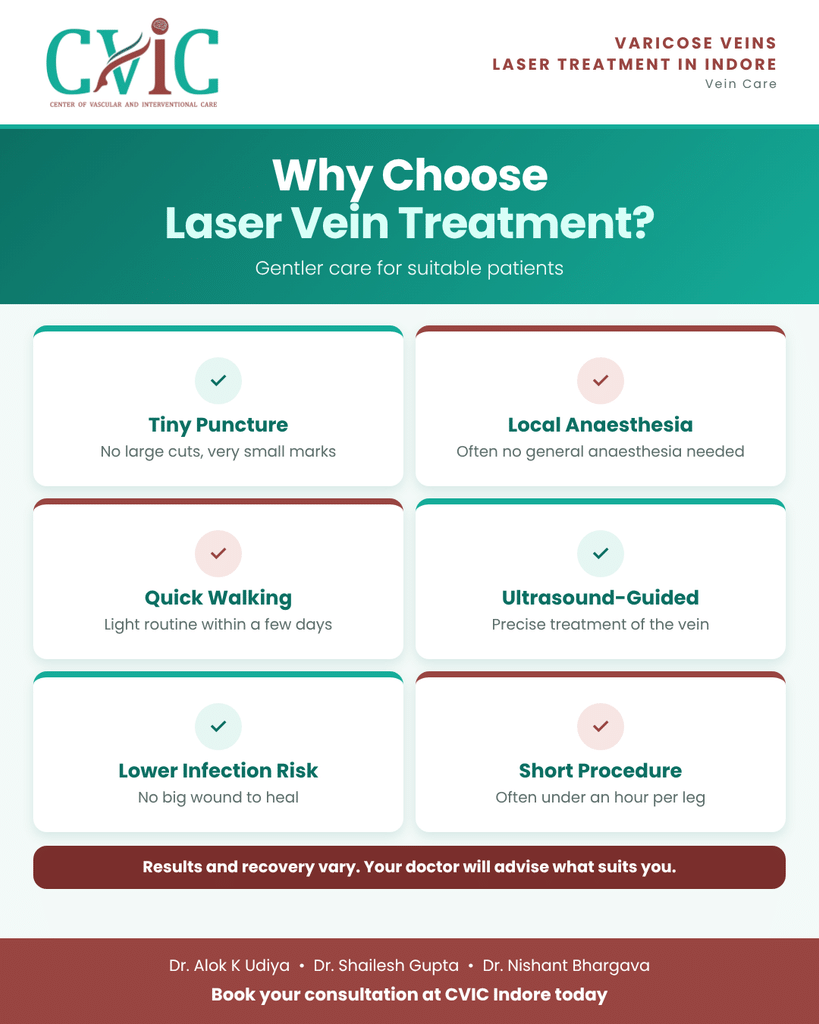
- No large cuts. Only a tiny puncture is needed, so scars are very small.
- Often done under local anaesthesia. Many patients do not need general anaesthesia.
- Usually less pain after the procedure than traditional surgery.
- Short treatment time.
- Quick return to walking and routine life. Many people resume light activity within a few days.
- Lower chance of wound infection, since there is no big incision.
- Ultrasound guidance helps the doctor treat precisely.
- Good results in suitable patients, with long-lasting closure of the treated vein.
Who Is Suitable for Laser Treatment?
Laser treatment suits many patients, but not everyone. The decision is made after a proper Doppler ultrasound scan.
You may be a good candidate if:
- You have symptoms such as pain, heaviness, swelling, or cramps
- Your scan shows a leaking main vein (often the great saphenous vein or small saphenous vein)
- The vein is suitable in size and shape for the laser fibre to pass
- You have skin changes or sores caused by vein disease
- You want a gentler alternative to traditional surgery
Laser may not be right, or may need extra caution, if:
- Your deep veins are blocked or have a recent clot
- The vein is extremely twisted or very close to the skin, making fibre passage difficult
- You are pregnant (procedures are usually planned after delivery)
- You have severe artery disease in the legs
- You have a serious health problem that makes sedation or procedures risky
- You have an active infection in the leg
Your doctor will check these points and tell you honestly if laser is right for you, or if another method suits you better.
Also Read: Laser Treatment for Varicose Veins: Is It the Best Option?
Tests Before Laser Treatment
1. Consultation and examination. The doctor asks about your symptoms, work, family history, medicines, and past illnesses, then examines your legs while you stand.
2. Venous Doppler ultrasound. This is the most important test. It shows which veins are leaking, how severe the backward flow is, and whether the deeper veins are healthy. It uses sound waves, is painless, and has no radiation.
3. Blood tests. Basic blood tests may be advised, depending on your health.
At CVIC Indore, Dr. Alok K Udiya brings expertise in advanced imaging, which helps in careful vein mapping. Good mapping is the foundation of a safe laser procedure.
How to Prepare for Your Procedure
- Bring all reports and scans, and a list of your medicines.
- Tell your doctor about blood thinners, diabetes medicines, allergies, and previous clots.
- Follow fasting or medicine instructions exactly as given. Do not stop medicines on your own.
- Wear loose, comfortable clothes that can be rolled above the knee.
- Keep your legs clean and avoid applying creams or oils on the day.
- Arrange a family member to come with you.
- Keep a pair of comfortable shoes for walking afterwards.
What Does It Feel Like?
Most patients describe the experience as manageable.
- A small pinch when the numbing medicine is given
- A feeling of pressure or tightness as the numbing fluid is placed around the vein
- Little or no pain during laser energy, because the area is numb
- A warm feeling in some cases
After the procedure, you may feel tightness, a pulling sensation along the vein, or mild soreness for a few days. Bruising is common and fades with time.
Recovery After Laser Treatment
Recovery is usually simple, but proper care helps get the best result.
Right after the procedure:
- Walk as advised. Gentle walking supports blood flow.
- Wear your compression stocking or bandage exactly as told.
- Take medicines as prescribed.
First few days:
- Mild soreness, tightness, and bruising are common.
- Avoid heavy lifting and hard exercise as advised.
- Avoid long hours of standing.
- Avoid very hot baths, saunas, or steam as instructed.
Following weeks:
- Return to normal activity gradually.
- Keep follow-up appointments. A follow-up ultrasound confirms the vein has closed.
- Keep walking regularly.
Call your doctor if you notice:
- Fever
- Increasing pain, redness, or swelling in the leg
- Bleeding that does not stop with gentle pressure
- A hard, red, painful lump along a vein
Go to emergency immediately for sudden breathlessness, chest pain, or a suddenly swollen and painful leg.
Is Laser Treatment Safe?
Laser vein treatment has a good safety record when performed by a trained team with ultrasound guidance. But like any medical procedure, it carries some risk.
Possible effects include:
- Bruising and soreness
- Tightness or a pulling feeling along the vein
- Skin discolouration or pigmentation along the treated vein
- Temporary numb patches
- Inflammation of the vein
- Skin burn (uncommon, and lowered by careful numbing-fluid technique)
- Infection (uncommon)
- Blood clot in a vein (uncommon)
- The vein not closing fully, or needing a repeat session
Safety depends on careful planning, good ultrasound guidance, proper technique, and good follow-up. Your doctor will explain the risks that apply to you before you sign the consent form.
Laser Treatment vs Other Varicose Vein Treatments
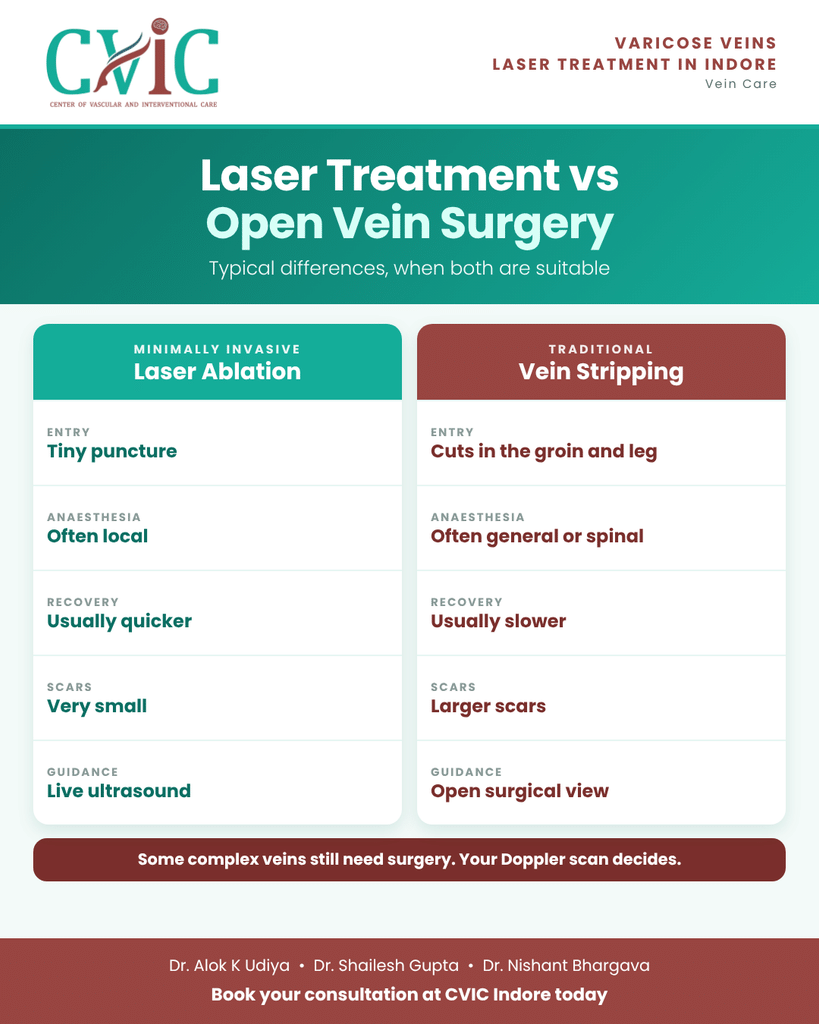
Patients often ask how laser compares with other options. Here is a simple comparison.
Laser vs radiofrequency ablation (RFA): Both close the vein with heat, through a small puncture, under ultrasound guidance. Laser uses light energy and RFA uses radiofrequency energy. Results are comparable in many patients. The choice depends on the vein and the doctor’s judgment.
Laser vs traditional surgery (vein stripping): Surgery removes the vein through cuts and often needs general anaesthesia and a longer recovery. Laser avoids large cuts and is generally gentler. Some complex cases may still need surgery.
Laser vs sclerotherapy: Sclerotherapy uses an injection to close small veins and spider veins. Laser ablation is generally used for larger main veins. Sometimes both are combined.
Laser vs medical glue: Glue seals the vein with an adhesive and uses no heat. It can suit selected patients. Laser has a long track record for main leaking veins.
Laser vs compression stockings alone: Stockings ease symptoms but do not close leaking veins.
There is no single best treatment for everyone. Your Doppler scan decides.
Will the Veins Come Back?
Laser closes the diseased vein, and a closed vein does not reopen in most cases. However, your body can develop new weak veins over time, especially if the original risk factors continue, such as family history, long standing, weight gain, or pregnancy.
To lower this chance:
- Walk regularly
- Maintain a healthy weight
- Avoid long periods of standing or sitting still
- Raise your legs when resting
- Wear compression stockings if advised
- Keep follow-up visits
Varicose Veins Laser Treatment Cost in Indore
Cost is one of the first questions patients ask. The cost of varicose veins laser treatment in Indore depends on:
- Whether one leg or both legs are treated
- How many veins need treatment
- The kind of laser fibre and equipment used
- Diagnostic tests such as Doppler ultrasound
- Whether day-care or a hospital stay is needed
- Medicines, compression stockings, and follow-up scans
- Insurance coverage, where applicable
Because every leg is different, a fair estimate is possible only after examination and ultrasound. Ask the centre to explain clearly what is included, so there are no surprises. Some insurance plans may cover treatment when it is medically needed. Check with your insurer.
Laser Treatment for Varicose Veins in Women, Men and Older Adults
Women: Varicose veins are common in women, often related to pregnancy and hormones. Procedures are usually planned after pregnancy is completed and breastfeeding plans are discussed with the doctor.
Men: Men also get varicose veins, especially those with long standing jobs. Treatment is the same, and early care prevents skin damage.
Older adults: Because laser treatment is often done under local anaesthesia, it can be a good option for older patients and those with other health problems, if the doctor finds it suitable.
When Should You See a Doctor?
See a doctor if you have:
- Leg pain, heaviness, or swelling that keeps coming back
- Veins that are growing or becoming painful
- Dark, itchy, or hard skin near the ankles
- A leg sore that is slow to heal
- Bleeding from a varicose vein
- A red, hard, painful lump along a vein
Early treatment is simpler and may help prevent complications.
Why Choose CVIC Indore for Varicose Veins Laser Treatment?
CVIC Indore (Center of Vascular and Interventional Care) focuses on blood vessel diseases and image-guided treatment. Varicose veins are a vein disease, and this is exactly the kind of care CVIC is built around.
- Vein-focused care: Vascular and interventional care is the main work.
- Ultrasound mapping before treatment: A careful scan helps find the true source of the problem.
- Image-guided precision: Ultrasound guidance helps the team treat accurately.
- Minimally invasive approach: Where suitable, treatment is planned through a tiny puncture for quicker recovery.
- Honest advice: You are told if laser is right for you or if another option suits you better.
- Clear communication: Diagnosis, options, risks, and expected results are explained in simple language.
- Follow-up support: Care continues after the procedure to check results and help prevent new problems.
The Team at CVIC Indore
Dr. Alok K Udiya brings expertise in advanced imaging and image-guided procedures. Detailed ultrasound mapping is the first step toward a safe laser procedure.
Dr. Shailesh Gupta brings clinical leadership and interventional experience. His approach is to look at the patient’s overall health before choosing a treatment.
Dr. Nishant Bhargava brings interventional skills for catheter-based and needle-guided vein procedures.
Together, Dr. Alok K Udiya, Dr. Shailesh Gupta, and Dr. Nishant Bhargava review each case carefully, so patients get a plan that fits their veins and their health.
Patients from Across Madhya Pradesh
Many patients travel to Indore from other towns and cities in Madhya Pradesh for specialised vein care. If you are coming from outside Indore:
- Call ahead to confirm timing, tests, and documents.
- Bring all old reports, especially earlier ultrasound reports.
- Bring a family member with you.
- Ask about follow-up, so you can plan your return visit for the check scan.
- Keep your doctor’s contact details handy after you go home.
You can also read our guides on choosing a vascular surgeon in Madhya Pradesh and what to expect from a vascular clinic in Indore.
Questions to Ask Before Laser Treatment
- Will I have a Doppler ultrasound before treatment?
- Is laser the right option for my veins? What are the alternatives?
- Who will perform the procedure, and how often does the team perform it?
- Will it be done under local anaesthesia? Can I go home the same day?
- What are the risks in my case?
- What will it cost, and what does it include?
- What follow-up scans will I need?
- Can I get a second opinion?
A good centre will answer clearly and patiently.
Common Myths About Laser Treatment for Varicose Veins
Myth 1: Laser treatment is only cosmetic. Fact: It treats the leaking vein that causes pain, swelling, and skin problems.
Myth 2: Laser treatment is very painful. Fact: The area is numbed, so most patients feel little pain. Mild soreness afterwards is common.
Myth 3: I will need weeks of bed rest. Fact: Walking is usually encouraged soon after the procedure.
Myth 4: Laser will burn my skin. Fact: Numbing fluid around the vein and ultrasound guidance protect surrounding tissue. Skin burns are uncommon but possible, so skilled technique matters.
Myth 5: Once treated, I can never get varicose veins again. Fact: New weak veins can form over time. Healthy habits and follow-up help.
Myth 6: Laser works for every varicose vein. Fact: Laser suits many patients, but not all. A Doppler scan decides.
Frequently Asked Questions
Q1. What is varicose veins laser treatment? It is a minimally invasive procedure where a thin laser fibre is placed inside the diseased vein through a tiny puncture. Laser heat closes the vein, and the body slowly absorbs it.
Q2. Is laser treatment for varicose veins painful? The area is numbed with local anaesthesia, so most patients feel little pain. Mild soreness or tightness for a few days is common.
Q3. How long does the procedure take? Many procedures take under an hour for one leg, but time varies by case.
Q4. Do I need to stay in the hospital? Many laser procedures are done as day-care. Your doctor will advise based on your case.
Q5. How long is recovery? Many patients return to light routine activity within a few days. Follow your doctor’s instructions for exercise and standing.
Q6. Is laser treatment safe? It has a good safety record when done by a trained team with ultrasound guidance, but every procedure has some risk. Your doctor will explain the risks for your case.
Q7. Can varicose veins come back after laser treatment? The treated vein usually stays closed, but new weak veins can develop over time. Healthy habits and follow-up help.
Q8. Who should not have laser treatment? People with a recent deep vein clot, severe leg artery disease, an active infection, or those who are pregnant may need a different plan. Your doctor will check suitability.
Conclusion
Varicose veins do not have to mean pain, heavy legs, and fear of surgery. Modern varicose veins laser treatment in Indore closes the leaking vein from inside through a tiny puncture, often with local anaesthesia and a quick return to routine life.
At CVIC Indore, Dr. Alok K Udiya, Dr. Shailesh Gupta, and Dr. Nishant Bhargava work together to give patients careful ultrasound-based planning, clear answers, and safe, effective care.
For a wider look at all options, read our complete guide on varicose veins treatment in Indore. You can also learn about choosing an endovascular surgeon in Indore and an interventional radiologist in Indore.
Do not ignore aching legs and bulging veins. Book a consultation with the team at CVIC Indore today and find out if laser treatment is right for you.
Disclaimer: This blog is for general educational purposes only and is not a substitute for professional medical advice, diagnosis, or treatment. If you have symptoms, please consult a qualified doctor. In an emergency, go to the nearest hospital immediately.