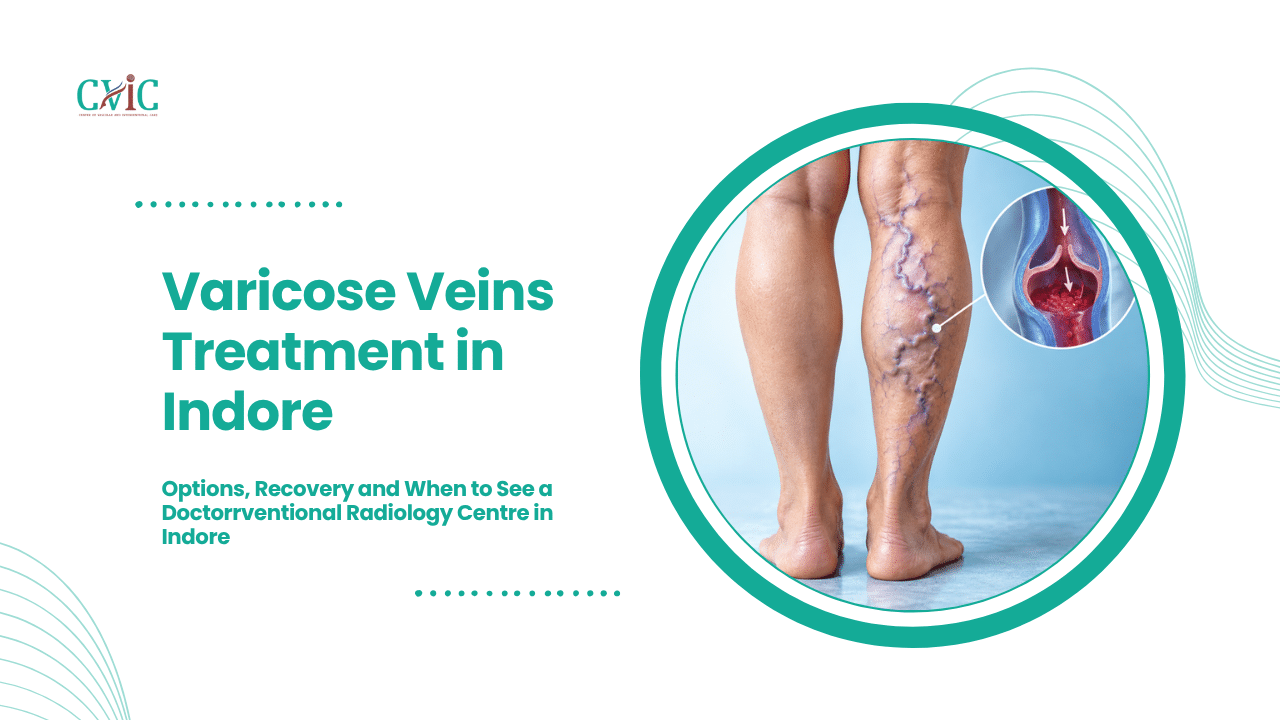
Do you have twisted, bulging, blue or purple veins on your legs? Do your legs feel heavy, tired, or achy by the end of the day? You may have varicose veins.
Many people in Indore and across Madhya Pradesh live with these veins for years. They think it is only a “cosmetic” problem or that it is normal with age. But varicose veins can slowly get worse. Without care, they can lead to swelling, skin changes, and even painful leg sores.
The good news is that modern varicose veins treatment is gentle. Most treatments today use a tiny puncture instead of a large cut, and many patients walk the same day.
In this guide, we explain in simple English what varicose veins are, why they form, the treatment options, recovery, costs, and how to choose the right place. We also share how CVIC Indore, with Dr. Alok K Udiya, Dr. Shailesh Gupta, and Dr. Nishant Bhargava, helps patients looking for varicose veins treatment in Indore.
What Are Varicose Veins?
Veins carry blood from your body back to your heart. In your legs, blood must travel upward, against gravity. To help, veins have tiny one-way valves that open to let blood move up and close to stop it from falling back.
In varicose veins, these valves become weak or damaged. Blood leaks backward and pools in the vein. The vein stretches, twists, and bulges under the skin. This is why varicose veins look rope-like and swollen.
Varicose veins are most common in the legs, because standing and walking put the most pressure there.
Spider veins are a smaller version. They are thin red, blue, or purple lines close to the skin surface. They are usually harmless but can sometimes appear together with varicose veins.
Symptoms of Varicose Veins
Symptoms can be mild at first. Watch for:
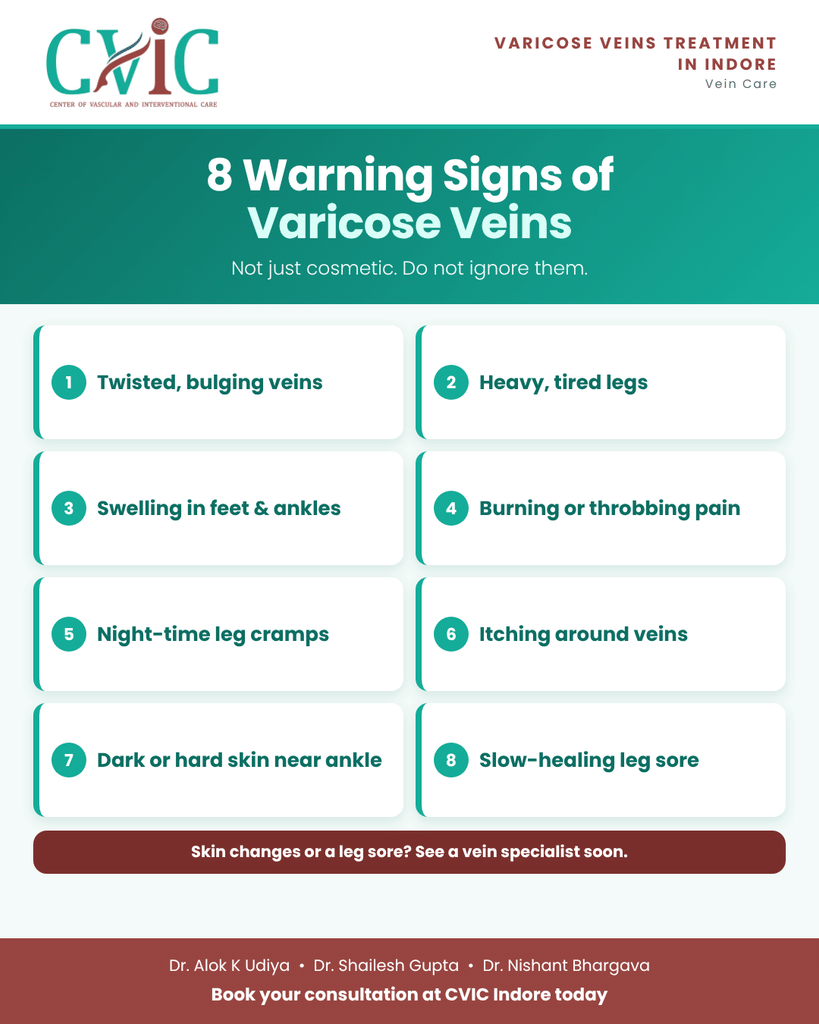
- Twisted, bulging veins you can see or feel
- Heavy, tired, or aching legs, especially by evening
- Swelling in the feet and ankles
- Burning, throbbing, or cramps in the legs
- Itching around the veins
- Night-time leg cramps
- Restless feeling in the legs
- Dark, brown, or hard skin near the ankles
- Skin that looks shiny or tight
- Sores or ulcers near the ankle that heal slowly
Some people have symptoms without much visible veins. Some have large veins but few symptoms. Either way, a proper check is the best way to know.
Also Read: Vascular and Endovascular Surgeon in Indore
Why Do Varicose Veins Happen?
Several things can increase your risk.
1. Family history. If your parents had varicose veins, you are more likely to get them.
2. Standing or sitting for long hours. Shopkeepers, teachers, nurses, police personnel, drivers, factory workers, and office workers often have this problem. Blood pools when you do not move.
3. Pregnancy. Extra blood volume and hormones put more pressure on leg veins.
4. Age. Valves wear out slowly over time.
5. Being overweight. Extra weight adds pressure on leg veins.
6. Gender. Women are affected more often, partly due to hormones.
7. Past leg injury or clot. Damage to veins can weaken valves.
8. Lack of exercise. Walking helps leg muscles push blood upward. Less movement means weaker blood flow.
You cannot change every risk factor, but you can manage many of them.
Is It Only a Cosmetic Problem?
No. This is a common myth.
Early varicose veins may only look unpleasant. But if left untreated, they can cause:
- Constant leg pain and swelling
- Skin darkening and hardening (called venous eczema or lipodermatosclerosis)
- Bleeding if a vein near the skin is hurt, which can be heavy
- Superficial vein inflammation (painful, red, hard lump along a vein)
- Blood clots in veins
- Venous ulcers, which are slow-healing wounds near the ankle
Treating varicose veins early can lower the chance of these problems and improve comfort. If you already have skin changes or sores, do not wait. See a specialist soon.
Also Read: Best Vascular Surgeon in Indore: How to Choose the Right Specialist for Your Blood Vessel Care
How Are Varicose Veins Diagnosed?
A good diagnosis is the foundation of good treatment. Treating only what you see on the surface may miss the real source of the problem, which is often a deeper leaking vein.
Step 1: Consultation and examination. The doctor asks about your symptoms, job, family history, and past illnesses. Then the doctor examines your legs while you are standing.
Step 2: Venous Doppler ultrasound. This is the key test. It uses sound waves to show blood flow in your leg veins. Shows which veins are leaking, how severe the backward flow is, and whether the deeper veins are healthy or have an old clot. It is painless, safe, and does not use radiation.
Step 3: Treatment planning. With the scan results, the team chooses the best treatment for your veins.
At CVIC Indore, Dr. Alok K Udiya brings expertise in advanced imaging, which helps in mapping leg veins carefully before any treatment is planned.
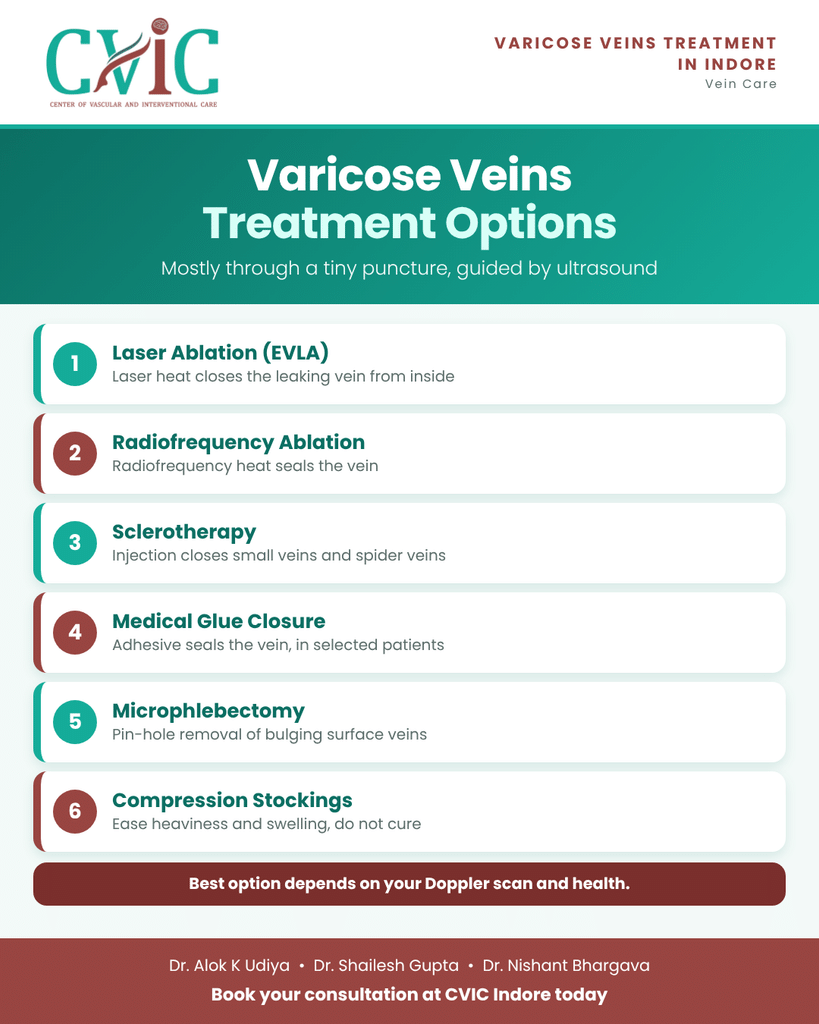
Varicose Veins Treatment Options
Treatment depends on your symptoms, vein size, scan findings, and overall health. Here are the main options, explained simply.
1. Lifestyle Changes and Compression Stockings
For mild cases, or while you wait for treatment, doctors often suggest:
- Walking daily
- Raising your legs above heart level for 15 to 20 minutes, a few times a day
- Avoiding long periods of standing or sitting still
- Maintaining a healthy weight
- Wearing medical-grade compression stockings
Compression stockings squeeze the legs gently and help blood move upward. They can ease heaviness and swelling. But they do not cure the leaking veins. They manage symptoms.
2. Endovenous Laser Ablation (EVLA)
This is a widely used modern treatment for varicose veins.
How it works: After numbing the skin, the doctor passes a very thin laser fibre into the diseased vein through a tiny puncture, guided by ultrasound. As the fibre is slowly pulled back, laser energy heats and closes the vein from inside. The closed vein is slowly absorbed by the body, and blood is rerouted to healthier veins.
Why patients like it:
- No large cut or stitches
- Often done under local anaesthesia
- Short procedure
- Quick return to walking
- Very small marks on skin
3. Radiofrequency Ablation (RFA)
This is similar to laser treatment, but it uses radiofrequency heat instead of laser energy to close the vein. It is also done through a small puncture under ultrasound guidance. Many patients find recovery comfortable, with mild bruising or tightness for a few days.
4. Sclerotherapy
In sclerotherapy, a special medicine is injected into the vein. It irritates the vein wall so that it closes and fades.
- Liquid sclerotherapy is used for spider veins and small varicose veins.
- Foam sclerotherapy mixes the medicine with air-like foam and can treat larger veins, under ultrasound guidance.
It needs no cuts. Sometimes more than one session is needed.
5. Medical Glue (Cyanoacrylate) Closure
In selected patients, a special medical adhesive is used to seal the diseased vein. It does not need heat, so numbing needs are lower in some cases. Whether it suits you depends on your veins and your doctor’s judgment.
6. Microphlebectomy
For bulging surface veins, tiny pin-hole cuts are made and the vein pieces are removed. It is often combined with laser or radiofrequency treatment for the main leaking vein.
7. Surgery (Vein Stripping and Ligation)
This is the older, traditional method. It is now needed less often, since gentler methods work well in most patients. In some complex cases, surgery may still be the best choice. Your doctor will explain what suits you.
Which Treatment Is Best for Me?
There is no single “best” treatment for everyone. The right choice depends on:
- Which vein is leaking and how large it is
- The shape and path of the vein
- Your symptoms and how severe the disease is
- Whether you have had clots before
- Your age, health, and other medical conditions
- Your daily routine and recovery needs
A careful ultrasound and a clear conversation with your doctor make the decision easier.
Also Read: Vascular Doctor in Indore: When to See One and How to Choose the Right Specialist
Varicose Veins Treatment Without Surgery
Many patients ask, “Can varicose veins be treated without surgery?” In many cases, yes.
Treatments like laser ablation, radiofrequency ablation, sclerotherapy, and glue closure are minimally invasive. They use needles and thin tubes instead of large incisions. That means:
- Smaller marks on the skin
- Less pain after the procedure
- Often no hospital stay or a very short one
- Faster return to routine life
- Lower risk of wound infection
Not every patient can be treated this way, so your doctor will check your scan and then advise.
What Happens During the Procedure?
Knowing the steps can reduce anxiety. Here is a typical flow for an ultrasound-guided procedure such as laser or radiofrequency treatment.
- Preparation. You are asked to wear loose clothes. The doctor marks the veins on your leg using ultrasound.
- Numbing. The skin is cleaned and numbed with local anaesthesia.
- Entry. A tiny puncture is made, and a thin tube or fibre is placed into the vein under ultrasound guidance.
- Treatment. The vein is closed using heat or medicine.
- Dressing and bandage. A small dressing is applied, followed by a compression bandage or stocking.
- Walking. You are usually encouraged to walk soon after.
Many procedures take less than an hour, though time varies by case. Your doctor will tell you what to expect for your own treatment.
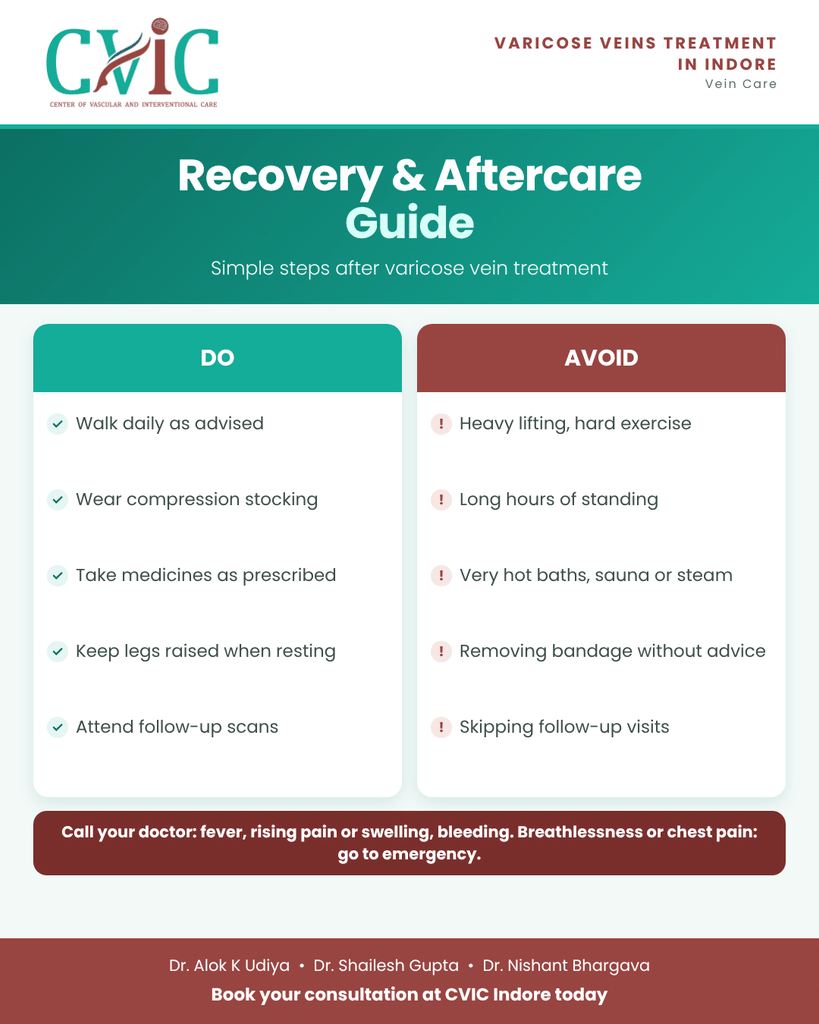
Recovery and Aftercare
Recovery is usually simple.
Right after treatment:
- Walk as advised. Gentle walking helps blood flow.
- Wear your compression stocking or bandage exactly as told.
- Take medicines as prescribed.
First few days:
- Mild tightness, bruising, or a pulling feeling along the treated vein is common.
- Avoid heavy lifting, hard exercise, and long hours of standing, as advised.
- Avoid very hot baths, saunas, or steam as instructed.
Following weeks:
- Return gradually to normal activity.
- Keep follow-up visits and scans. These confirm that the treated vein has closed.
- Continue walking daily.
When to call your doctor quickly:
- Increasing pain, redness, or swelling in the leg
- Fever
- Bleeding that does not stop with gentle pressure
- Sudden shortness of breath or chest pain (go to emergency immediately)
Are There Risks?
Varicose vein treatments have a good safety record, but no procedure is completely risk-free. Possible effects, depending on the method, include:
- Bruising, soreness, or tightness
- Skin discolouration along the treated vein
- Numb patches (usually temporary)
- Inflammation of a treated vein
- Infection (uncommon)
- Blood clot in a vein (uncommon)
- The need for further treatment of other veins or a repeat session
Your doctor will explain risks that apply to you before you sign consent.
Can Varicose Veins Come Back?
Treatment closes or removes the diseased veins. But your body can form new weak veins over time, especially if the reasons that caused them (family history, long standing, weight, pregnancy) continue. This is why follow-up and healthy habits are important.
You can lower the chance of new veins by:
- Walking regularly
- Keeping a healthy weight
- Avoiding long periods of standing or sitting
- Raising your legs when resting
- Wearing compression stockings if advised
Varicose Veins Treatment Cost in Indore
Many people search for the cost before they search for the doctor. The cost of varicose veins treatment in Indore depends on:
- The treatment method (laser, radiofrequency, glue, foam, or surgery)
- How many veins or legs are treated
- Diagnostic tests such as Doppler ultrasound
- Whether day-care or hospital stay is needed
- Follow-up visits and compression stockings
- Insurance coverage, where applicable
Since every leg is different, a fair estimate is possible only after examination and ultrasound. Ask your centre for a clear explanation of what is included, so there are no surprises.
Varicose Veins in Pregnancy
Many women get varicose veins during pregnancy because of extra blood volume and hormone changes. Often, they improve a few months after delivery. During pregnancy, doctors usually suggest simple measures such as leg elevation, walking, and compression stockings. Procedures are usually planned after delivery, unless there is a specific need. Always speak to your doctor first.
When Should You See a Doctor?
See a doctor if you notice:
- Leg pain, heaviness, or swelling that keeps coming back
- Veins that are growing bigger or more painful
- Dark, itchy, or hard skin near the ankles
- A sore on the leg that is slow to heal
- A hard, red, painful lump along a vein
- Bleeding from a varicose vein
Emergency alert: A sudden swollen, red, painful leg, especially with breathlessness or chest pain, can mean a dangerous clot. Go to the nearest emergency department immediately.
Why Choose CVIC Indore for Varicose Veins Treatment?
CVIC Indore (Center of Vascular and Interventional Care) focuses on diseases of blood vessels and image-guided treatment. Varicose veins are a vein problem, and that is exactly the kind of care CVIC is built around.
Here is what patients can expect.
- Specialist vein focus: Care is centered on blood vessels, not treated as a side service.
- Proper ultrasound mapping: A careful scan helps find the true source of the problem.
- Minimally invasive options: Where suitable, treatment is planned through small punctures for quicker recovery.
- Personalised plans: Treatment is chosen to match your veins, health, and routine.
- Honest advice: You will be told if you need a procedure or only monitoring and simple measures.
- Clear communication: Diagnosis, options, risks, and expected results are explained in simple language.
- Follow-up support: Care continues after the procedure to check results and prevent new problems.
The Team at CVIC Indore
Dr. Alok K Udiya brings expertise in advanced imaging and image-guided procedures. Careful ultrasound mapping is the first step in successful vein treatment.
Dr. Shailesh Gupta brings clinical leadership and interventional experience. His approach is to look at the patient’s overall health before choosing a treatment.
Dr. Nishant Bhargava brings interventional skills for catheter-based and needle-guided vein procedures.
Together, Dr. Alok K Udiya, Dr. Shailesh Gupta, and Dr. Nishant Bhargava review each case carefully, so patients get a plan that fits them.
Patients from Across Madhya Pradesh
Many patients travel to Indore from other cities and towns in Madhya Pradesh for specialised vein care. If you are coming from outside Indore:
- Call ahead to confirm timing and tests.
- Bring all old reports and scans, and a list of your medicines.
- Wear loose clothing that is easy to roll up above the knee.
- Bring a family member if possible.
- Ask about follow-up, so you can plan your next visit or a local check.
To learn more about the wider care available, you can read our guide to a vascular clinic in Indore and how to choose a vascular surgeon in Madhya Pradesh.
How to Choose the Right Place for Varicose Veins Treatment in Indore
Ask these questions:
- Will I get a Doppler ultrasound before treatment?
- Which treatment options do you offer, and why do you recommend this one for me?
- How many such procedures does your team perform?
- Is it done under local anaesthesia? Will I go home the same day?
- What are the risks and what are my other options?
- What will it cost, and what does it include?
- What follow-up will I need?
- Can I get a second opinion?
A good centre will answer clearly and patiently.
Common Myths About Varicose Veins
Myth 1: Varicose veins are only a cosmetic issue. Fact: They can cause pain, swelling, skin damage, and ulcers if untreated.
Myth 2: Only women get varicose veins. Fact: Women are affected more often, but men get them too.
Myth 3: Massaging the veins will cure them. Fact: Massage does not fix leaking valves and can be harmful in some cases. Ask your doctor first.
Myth 4: Surgery is the only treatment. Fact: Many patients can be treated with minimally invasive methods like laser, radiofrequency, or sclerotherapy.
Myth 5: Treatment means weeks of bed rest. Fact: Walking is usually encouraged soon after treatment.
Myth 6: Compression stockings cure varicose veins. Fact: They ease symptoms but do not close the leaking vein.
Myth 7: Crossing your legs causes varicose veins. Fact: It may be uncomfortable but is not the main cause. Family history, age, and long standing are bigger factors.
Frequently Asked Questions
Q1. What is the best treatment for varicose veins? There is no single best option for everyone. Laser, radiofrequency, sclerotherapy, and glue closure are common modern choices. The right one depends on your ultrasound findings and health.
Q2. Is varicose veins treatment painful? Most procedures use local anaesthesia, so you feel little pain. Mild soreness or tightness for a few days is common.
Q3. Do I need to stay in the hospital? Many ultrasound-guided procedures can be done as day-care. Your doctor will advise based on your case.
Q4. How long does recovery take? Many people return to light routine activity within a few days, while some need a little longer. Follow your doctor’s advice.
Q5. Can varicose veins be cured without surgery? Many cases can be treated without traditional surgery, using minimally invasive methods. Your doctor will check suitability.
Q6. Can varicose veins come back after treatment? New weak veins can form over time. Healthy habits and follow-up help lower this chance.
Q7. Are varicose veins dangerous? Early ones may only cause discomfort, but untreated disease can lead to skin changes, ulcers, bleeding, or clots.
Q8. What is the cost of varicose veins treatment in Indore? Cost depends on the method, number of veins, tests, and any hospital stay. A fair estimate is possible after examination and scan.
Q9. Is varicose veins treatment safe? Modern procedures have a good safety record when done by a trained team, but every procedure has some risk. Your doctor will explain the risks for your case.
Q10. How do I book an appointment at CVIC Indore? You can contact CVIC Indore through its website or by phone to book a consultation with the team.
Conclusion
Varicose veins are more than a cosmetic concern. They can affect comfort, sleep, work, and long-term leg health. The good news is that today’s varicose veins treatment in Indore is gentler and faster than ever, with options like laser, radiofrequency, and sclerotherapy, which are often done through tiny punctures.
At CVIC Indore, Dr. Alok K Udiya, Dr. Shailesh Gupta, and Dr. Nishant Bhargava work together to give patients clear answers, careful ultrasound-based planning, and safe, effective care.
You can also read our guides on choosing an endovascular surgeon in Indore, an interventional radiologist in Indore, and what to look for in an interventional radiology centre in Indore.
Do not ignore heavy, aching legs or bulging veins. Book a consultation with the team at CVIC Indore today and take the first step toward lighter, healthier legs.
Disclaimer: This blog is for general educational purposes only and is not a substitute for professional medical advice, diagnosis, or treatment. If you have symptoms, please consult a qualified doctor. In an emergency, go to the nearest hospital immediately.